


Ask a tank contractor what removal costs and they will quote you something reasonable, two grand, maybe less. Ask them what it costs if the soil sample fails and watch the answer change shape. Suddenly it depends. Suddenly nobody wants to give you a number over the phone.
Both answers are honest. They just belong to two different projects, and which one you are buying gets decided by a lab you will never visit, testing dirt from the bottom of a hole in your yard. I want to walk through both branches properly, because the industry quotes you the first one and lets you discover the second.
Pulling The Tank Costs Less Than People Fear
The digging and hauling part is ordinary work. Angi’s current data puts the national average at $1,356, with most people landing somewhere between $593 and $2,157.
An above-ground tank in a basement or beside the house runs $500 to $1,500. A crew cuts it apart and carries it out, done by lunch. Underground is more, $1,000 to $3,500 for a clean pull depending on where you live, and the Northeast sits at the top of that because the rules are tighter and the yards are smaller. Size scales it the way you would expect. One licensed environmental outfit prices a 550 gallon buried tank at $1,800 to $2,500, a 1,000 gallon at $3,500 to $4,500, and 1,500 gallons at four to five thousand.
Then the small stuff nobody mentions until the invoice. Permits, fifty to five hundred dollars depending on your town. Pumping out whatever oil is still in there, a few dollars a gallon or a flat fee. Two to eight hundred for pulling the old supply lines. Landscaping afterward if the excavator went through ground you cared about, which it did.
And the soil test, $250 to $550. Smallest line on the quote. Decides everything.
The genuine budget-wrecker at this stage is placement. A tank under a porch, a driveway, or a later addition stops being a removal and becomes demolition with a removal attached.
What The Lab Decides
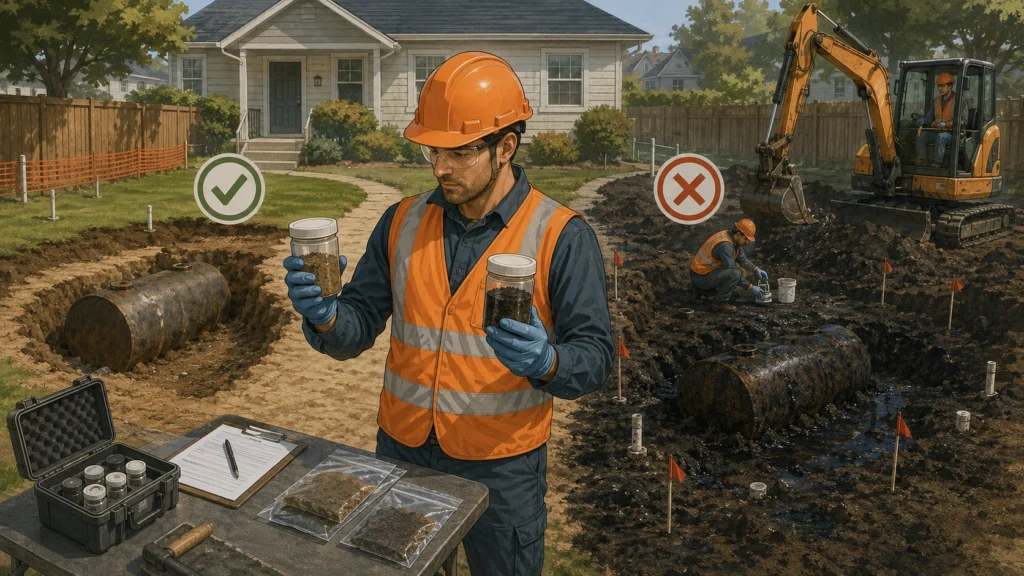
Samples from the excavation go out for testing against your state’s petroleum thresholds. There is no judgment call in it and no negotiating with it.
If the numbers come back clean, you are nearly finished. The contractor backfills, files a closure report, and within one to three months the state issues a No Further Action letter. Whole project, $1,500 to $5,000. Keep that letter somewhere you can find it in twenty years. I mean that literally, and I will explain why in a minute.
If a sample comes back hot, stop thinking of this as a removal. It is now a reportable environmental cleanup, and reporting it is a legal obligation, not a courtesy. First someone has to figure out how far the oil went, which means more sampling outward and down until the edges of the plume are mapped. Some states then want a formal Remedial Action Plan approved before a shovel moves again. Then the dirty soil comes out, at $50 to $200 a cubic yard for hauling and disposal, and fresh samples have to prove what is left behind is clean. Then, finally, the same closure letter the clean branch got in week six.
Money on this branch: commonly $2,500 to $17,000 for residential jobs, and a Florida cleanup program puts its statewide range at ten to forty thousand for a leaking home and living tank. Most cases are the small version, oil close to the tank and nowhere near groundwater. When groundwater is involved the timeline goes from weeks to years, because monitoring wells need repeated sampling rounds before any state will close the file.
Figure an extra one to three months on the ordinary bad branch. If you are pulling a tank mid-sale, that number should frighten you more than the dollar figure does.
How often does the test fail? One Florida remediation company says forty to sixty percent of the underground removals they see. They sell cleanups, so treat the precision with suspicion. The direction, though, is hard to argue with. Buried steel lasts twenty to twenty five years, most residential tanks went in decades before that clock ran out, and wet ground wins eventually. My own rule for anyone with a tank older than twenty five years: get the clean quote, then quietly set aside double or triple it. Spending the reserve on a vacation later is the good outcome.
The Letter Matters More Than The Hole

Here is the thing the cost articles skip, and it is the actual reason to do this properly.
That No Further Action letter is proof the problem is closed. Your buyer’s attorney will ask for it. The buyer after that will ask their seller for it. It follows the property forever, and its absence follows the property forever too.
The way the absence surfaces is always the same story with different names. A tank comes out around 2003, no soil test, no closure filing, nobody blinks. House sells fine. Twenty-odd years later that owner lists it, and this time the buyer’s side asks for soil documentation that never existed. A test finally gets done on ground the tank left decades ago, and it finds petroleum that has been sitting there spreading the whole time. The person selling now, who never owned the tank and never spilled anything, owns the contamination, because it is on their land. Eight to fifteen thousand dollars and a two month closing delay, for someone else’s leak.
Flip it around and you see what you are really buying from a removal contractor. Not a hole. Three things: the physical work, lab results from a licensed environmental firm rather than a foreman’s opinion that the dirt looked fine, and the closure report filed with the state plus the letter that comes back. A quote that is vague about the last two is not a bargain at any price. It is a liability with a start date you do not get to pick.
Before You Sign Anything
Check whether your state helps pay. Cleanup funds for leaking tanks exist in a fair number of states and they vary wildly, Illinois covers up to a million and a half per occurrence while other states offer homeowners nothing. Ten minutes on your state environmental agency’s website is the best-paid ten minutes in this whole project if you end up on the wrong branch.
Check your insurance too, mostly to remove the illusion. Homeowner policies almost universally exclude tank leaks, and some carriers have started declining to write policies at all on houses with a buried tank of unknown condition. For people who are not selling and keep postponing this, that insurance letter is usually what finally gets the excavator booked.
The test costs about four hundred dollars whichever way it comes back. The tank is not improving down there. Waiting only ever makes one of the two branches more expensive, and it is never the clean one.

