


So I’m keeping the promise of the title, just rerouting it. The thing that works isn’t pressing a point on the foot. It’s what your hands and your body do to a baby’s nervous system when you hold, move, and stroke them a certain way. That’s the real “off switch,” and it has a name in the research: the calming reflex, and in one striking 2022 study, the transport response.
I’ll walk you through what actually holds up, roughly in order of how much I’d trust it.
The Strongest Evidence Isn’t A Massage At All. It’s A Five-Minute Walk.
This is the finding I keep telling people about. In 2022, a team led by Kumi Kuroda at Japan’s RIKEN Center for Brain Science published a study in Current Biology on something they call the transport response, the old mammal instinct where a mother picks up her young and the baby goes still and its heart rate drops. Cats do it, mice do it, and it turns out human babies do it too.
Here’s what they found, and why it’s specific enough to be worth trusting. Crying infants who were carried while the parent walked for five minutes calmed down, and about half of them fell asleep. Not held still. Carried, in motion. When a parent held a crying baby while sitting, it didn’t work nearly as well. The walking was the active ingredient.
The part that makes this genuinely useful is the second half of the protocol, because every parent knows the real disaster isn’t calming the baby, it’s the landing. You get them asleep, you lower them into the crib, and the eyes snap open. Kuroda’s team measured exactly that moment. Babies have a startle called the Moro reflex that fires when they feel themselves being lowered, and it wakes them. Their fix: after the five-minute walk, sit and hold the sleeping baby for another five to eight minutes before putting them down. That extra sit lets them drop into deeper sleep so the lay-down doesn’t jolt them awake.
Two honest caveats I won’t skip. Kuroda herself, a mother of four, was blunt that the effect is stochastic, her word, meaning it’s a probability boost, not a guarantee, and that 20 to 30 percent of babies cry a lot for no medical reason at all. And the study only tested mothers, so whether it works identically for a dad or a grandparent is a reasonable assumption but not yet proven. Still, this is the closest thing to a “do this exact thing and it usually works” that I found anywhere in the literature.
Harvey Karp’s 5 S’s Are The Closest Thing To A Real Technique, And They’ve Been Tested
If one name owns this topic in America, it’s Harvey Karp. He’s the pediatrician who, back in 2002, packaged a handful of things grandmothers already did into a method he called the 5 S’s, built on an idea he calls the fourth trimester: newborns are basically evicted from the womb three months early and spend their first weeks desperate to get that environment back. Recreate it, and you trip the calming reflex he describes as an inborn off switch.
The Five, And I’m Giving You The Real Mechanism On Each, Not Just The Label:
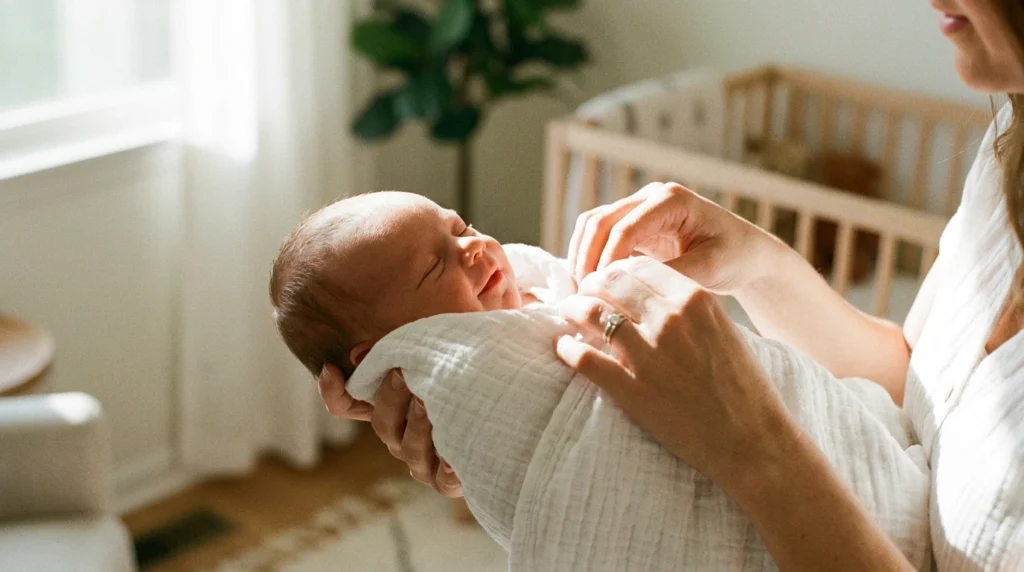
- Swaddle. Wrap snug so the arms are gently held at the sides. It mimics the tight womb and shuts down the flailing startle reflex that keeps jolting a baby awake. One rule that isn’t optional: swaddled babies go on their back to sleep, always, because the swaddle plus side or stomach sleeping raises the risk of sudden infant death.
- Side or stomach position. For calming only, in your arms, not for sleep. Held on their side or across your forearm, that calming mechanism kicks in. The second they’re asleep, they go on their back in the crib.
- Shush. Not a polite librarian shush. Loud, right up near the ear, matching the volume of the cry. The womb was as loud as a vacuum cleaner from the blood rushing through, so silence actually unnerves a newborn.
- Swing. Tiny, fast, jiggly motion while you fully support the head and neck, what Karp nicknamed the “Jell-O head jiggle,” never more than an inch or so of movement. This is the one place I want to be a broken record: supporting the head, gentle, never a shake in frustration.
- Suck. A pacifier, a clean finger, the breast. Sucking drops a baby into a deep calm, and Karp calls it the icing on the cake.
Karp’s own instruction is that you often need several of these at once and matched to the intensity of the crying, meeting a screaming baby at their level and then easing off as they settle. He compares it to dancing with the baby in the lead.
Does The Method Actually Survive Testing, Or Is It Just A Charismatic Pediatrician?
Fair question, and I asked it too. There’s real support. A randomized study in the 2019 Japan Journal of Nursing Science taught one group of new mothers the technique and left another group untaught, and six months on, the babies of the trained parents were crying significantly less. A separate 2019 report in PLOS ONE found the swaddle-plus-white-noise-plus-rocking combination lowered infant heart rate and fussiness quickly. So the mechanism isn’t hand-waving, at least parts of it move the needle in controlled conditions.
Where Actual Massage Lands: Real, Gentle, Good For You Both, But Oversold
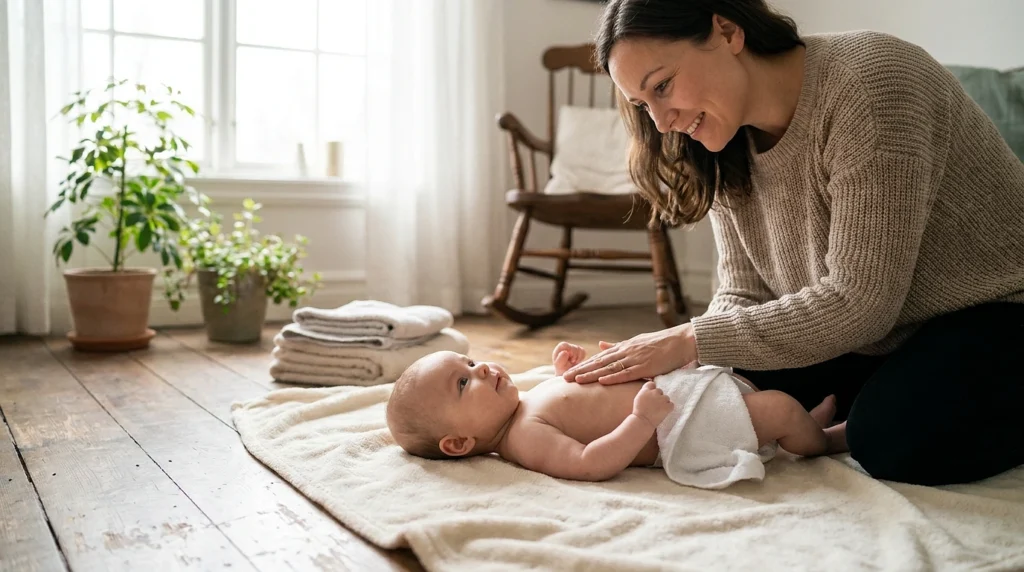
Now the part your title literally asks about, hands-on massage, and here I have to be straight or the whole piece is worthless. Infant massage is lovely and I’m not talking anyone out of it. But if you’re expecting me to tell you a peer-reviewed study proves stroking a baby’s tummy reliably stops crying, the evidence doesn’t get you there, and I’d rather you hear that from me than find out later.
The big one is a Cochrane review, which is the gold standard, pooling 34 trials of nearly 4,000 healthy babies under six months. The headline reads well at first: massaged babies showed less crying and fussing and slightly more sleep, roughly an extra 0.9 hours over 24 hours in the pooled numbers. Then comes the sentence everyone skips. Those benefits mostly disappeared once the reviewers stripped out the poorly-run studies, and more than half the studies were poorly run. Their actual conclusion was that the evidence doesn’t currently support routine infant massage for low-risk babies, largely because the research quality is weak, not because massage was proven useless.
A 2022 systematic review of whole-body massage landed in the same honest place. It found massage may nudge up a baby’s length in the early weeks, but called the effect on crying and sleep uncertain.
So what do I actually do with that? I read it as: massage genuinely helps some things that aren’t crying. The stress-hormone and mother-infant bonding evidence is more consistent than the stop-the-crying evidence, and one strand of that work suggests it can help mothers dealing with postnatal depression connect with their baby. That’s not nothing. That’s a real reason to do it. Just don’t do it expecting it to work like the walk does.
Here’s the same information laid flat, because I think it helps to see which of these is carrying real weight:
| Technique | What it actually is | What the research says |
|---|---|---|
| Carry-and-walk (5 min walk, then 5-8 min sit) | Motion soothing via the transport response | Strongest here. Controlled 2022 study, calms crying and promotes sleep, effect is a probability boost not a guarantee |
| The 5 S’s | Swaddle, side/stomach, shush, swing, suck, combined | Good. Randomized trials show less crying and faster settling |
| Gentle body/tummy massage | Slow stroking, often with oil, as a routine | Mixed. Real benefits for bonding and stress; crying/sleep effects fade once weak studies are removed |
| Pressure points / reflexology | Pressing specific “points” to stop crying | Weakest. No solid controlled evidence it works as an instant fix |
The Reason Any Of This Matters More Than It Looks Like It Should
It would be easy to treat all this as a nice-to-know parenting hack. It isn’t, and this is the part I care about most. A baby who won’t stop crying doesn’t just wear you out, it can push a sleep-deprived parent somewhere genuinely dangerous. Kuroda’s team said out loud that excessive infant crying is linked, in a small number of cases, to a parent losing control and harming the child. Karp makes the same point from the other direction, tying relentless crying to postpartum depression in parents. Having something in your hands that actually works at 3 a.m., a walk, a swaddle, a shush, is a pressure-release valve for the adult as much as a soothing tool for the baby.
Which is also why I’d hold the reflexology charts at arm’s length. Not because a foot rub hurts anything, it doesn’t, but because if you’re leaning on a technique with no real evidence while a baby screams and your own patience burns down, that’s the opposite of helpful.
One last thing, and it’s the boring responsible one that’s boring because it’s true: excessive crying is usually normal newborn business, but not always. Karp notes that under five percent of colicky babies have a real medical cause underneath, reflux, a urinary infection, a food intolerance. If your baby’s crying feels wrong to you, or comes with fever, poor feeding, or just won’t let up no matter what you try, that’s a call to your pediatrician, not a harder swaddle. Trust the instinct. You know your baby’s cry better than any chart does.

