


I almost lost a client over a villa in Portugal. The listing had photos of a desk, a line that said “fast wifi,” and I had a deliverable due Thursday. What the listing didn’t mention was that the router lived in a metal cupboard two floors down and produced a connection best described as ceremonial. It was Tuesday night when I discovered this, with a 40-megabyte file to send and a signal that couldn’t have delivered a haiku.
I made the deadline, barely, standing in a parking lot at 1 a.m. tethered to my phone, and the experience taught me the single most useful thing I know about working while traveling. Deadlines don’t die from travel. They die from untested assumptions. The wifi will work. The timezone math is right. The file is synced. Every near-miss I’ve had since, and every horror story I’ve collected from other people who work on the road, traces back to one assumption that nobody checked until the moment it failed. So this isn’t a packing list. It’s the system that replaced my assumptions, and it’s kept a decade of deadlines alive across hotel rooms, trains, and at least one more parking lot.
Run the Assumption Audit Before You Leave
The pre-trip move that matters most costs nothing and takes ten minutes: sit with your calendar for the trip and ask, for each commitment, “what am I assuming will be true for this to happen?” Write the answers down. They’ll be embarrassingly fragile. You’re assuming the accommodation’s wifi is real, that your Tuesday call accounts for the time difference, that the presentation lives on your laptop and not just in the cloud, that there’s a plug adapter in the bag and not in the drawer at home.
Then test what’s testable while you’re still somewhere with good internet and open shops. Tether your laptop to your phone for a full working hour at home, not a two-minute check, because tethering that works for email routinely chokes on a video call. Open the files you’ll need with the wifi turned off and see what actually loads. The audit sounds paranoid until you notice what it really is moving every failure forward in time to a moment when it’s cheap to fix.
Two of Everything That Can End Your Day

Redundancy sounds expensive and mostly isn’t. The rule is narrow: anything whose failure kills a workday needs a second way, and only three things qualify.
Connectivity, the Big One:
Never travel with one route to the internet. The stack that works: the accommodation’s wifi as the default, your phone’s tethering as the backup, and, for international trips, a local eSIM with a data package as the backup’s backup, since roaming data is either extortionate or throttled to uselessness exactly when you need it. The eSIM goes on the phone before you fly, not after you land tired in an airport with no connection to download it. And learn your area’s third space in the first hour, the café or coworking spot with real wifi, before you need it at 1 a.m.
Power, the Boring One:
A charged power bank that can feed the laptop, not just the phone, plus the right plug adapter, plus one spare cable for the port your machine actually uses. Nobody has ever regretted this paragraph. Plenty of people have regretted skipping it in an airport where their gate’s outlets were a rumor.
Files, the Sneaky One:
Cloud sync has quietly trained everyone into a dangerous habit believing a file is “on the laptop” when it’s actually a placeholder pointing at a server you may not be able to reach. Before travel, mark every file the trip needs as available offline, then verify with the wifi off. The deliverable, the reference documents, the contract you might need to quote. If you can’t open it in airplane mode, you don’t have it.
The Two Clocks and the Lost Day
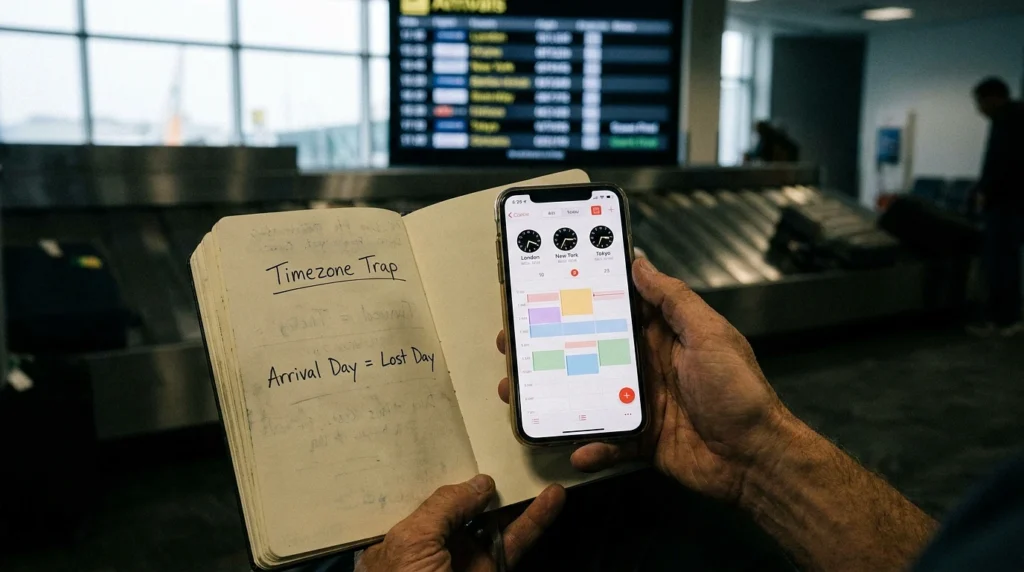
Now the two scheduling failures that have nothing to do with tech, and between them they cause more missed deadlines than every dead router combined.
The first is the timezone trap, and it’s brutal because it feels like arithmetic and behaves like a bear trap. “Due Thursday” means due Thursday in someone’s timezone, and when you’re seven hours ahead, their Thursday afternoon is your Thursday night, or is it Friday morning, and you’ve done this math confidently and wrongly at 11 p.m. before. The fix is to stop doing the math at all the moment a deadline or call is agreed, put it in the calendar in the other party’s timezone and let the software translate. One entry, made once, correctly, beats a week of mental conversion done tired.
The second is the arrival-day myth. Travel days feel like they contain afternoons, and on paper they do. In reality an arrival day contains a delayed flight, a passport line, a check-in that starts at three, a wifi password that doesn’t work, and a brain running at 60 percent. Never schedule a deliverable or an important call on a travel day, and treat the first morning after arrival as setup time, testing the wifi, finding the third space, confirming the calendar survived the timezone shift. The people who look effortlessly productive on the road aren’t working through arrival days. They’ve stopped pretending those days exist.
Work Offline-First, Sync When Lucky
The deepest habit change, and the one that makes everything else matter less, is inverting your relationship with connectivity. Most remote workers treat the internet as the default and its absence as an emergency. Flip it: assume you’re offline, and treat connectivity as a bonus that shows up sometimes.
Practically, that means drafting in local files rather than browser tabs, keeping a running list of “needs internet” tasks, emails to send, files to upload, things to look up, and batching them into the moments when the connection is good, rather than letting every task silently depend on the network being alive at the exact second you reach that step. It means downloading the brief before the train, not on it. Worked this way, a wifi outage stops being a crisis and becomes a scheduling detail: you keep producing, and the syncing happens when the world cooperates. The parking-lot night in Portugal would have been a non-event under this system, because the file would have been sent Tuesday afternoon from the good café, back when the deadline was still two days of buffer away.
Which is the last rule, and the one that makes all the others forgiving: on the road, done-early is the new on-time. At home, a deadline met at the deadline is fine, because home problems are fixable in minutes. Traveling, every problem arrives with shipping delays, so aim everything a day early and let the buffer absorb what the trip throws. Most trips, nothing goes wrong, and you’ve simply looked impressively prompt. The one trip something does, the buffer is the difference between a quiet fix and a parking lot at 1 a.m., and I can report from experience that the parking lot builds character exactly once.

