


Somewhere around 2016, a decent chunk of the English-speaking internet started talking like a golden retriever. Not about dogs. As dogs, or at least in a voice everyone silently agreed dogs would use if they could type, and the strange part is how fast it standardized. Doggo, pupper, bork, mlem, heckin. Nobody voted on any of it, there was no style guide, and yet by 2017 you could drop “he’s doin me a frighten” into a comment section anywhere in the world and be understood instantly.
It’s worth tracing where the pieces actually came from, because the history is better documented than you’d expect for something this silly, and almost every word has a real birthplace.
The Australians Started It, More Or Less By Accident
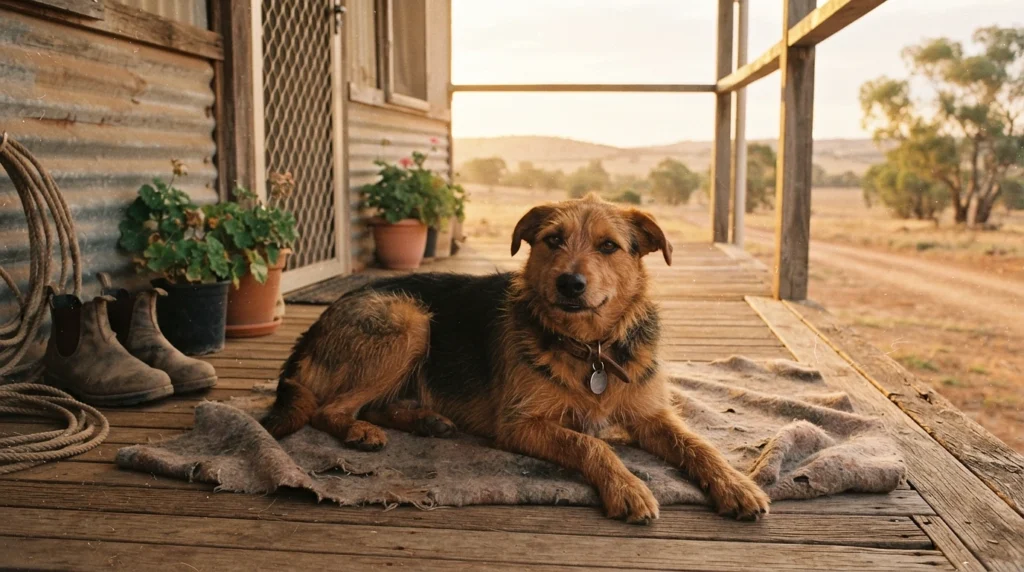
The word “doggo” has a traceable paper trail. Know Your Meme puts its first appearance on a now-dead Facebook page called Ding de la Doggo back in 2014, and around the same time it caught on inside Dogspotting, a Facebook group where members post photos of dogs they encounter in the wild. Not their own dogs, that’s against the rules, only spotted ones.
Dogspotting had a heavily Australian membership, and Australian slang already runs on exactly this habit, tacking an “-o” onto the end of everything. Arvo, servo, bottle-o. Doggo wasn’t an invention so much as Australians doing what Australians do to words, except this time the rest of the internet was watching. The group grew to over half a million members by April 2017 and was adding around ten thousand a week at its peak, which meant every new coinage inside it had a giant audience ready to carry it out.
Then A College Student At An Applebee’s Scaled It To Millions
The account that took the dialect mainstream started as a Twitter poll. Matt Nelson, a golf management major at Campbell University in North Carolina, was sitting in an Applebee’s in late 2015 when he asked his followers whether he should start an account that rates people’s dogs. They said yes, and WeRateDogs was born, the account that gives every dog a score like 12/10 because, as its most famous tweet put it, “they’re good dogs, Brent.”
That Brent line is its own perfect little artifact, by the way. A user named Brant Walker complained the ratings made no sense, Nelson misspelled his name on purpose in the reply, and one of the biggest memes of 2016 fell out of a typo committed deliberately.
WeRateDogs used “doggo” for the first time on April 1, 2016, and from there the account did for the dialect what radio once did for regional accents, it flattened millions of people onto one voice. And Nelson has a specific claim in all this that he’s actually modest about. When NPR asked him about “h*ck,” he said he was sure someone had done it before him, “but it was something original to me and I used it to such an extent that people associate it with [@dog_rates] now.”
The Noises Came From Somewhere Else Entirely
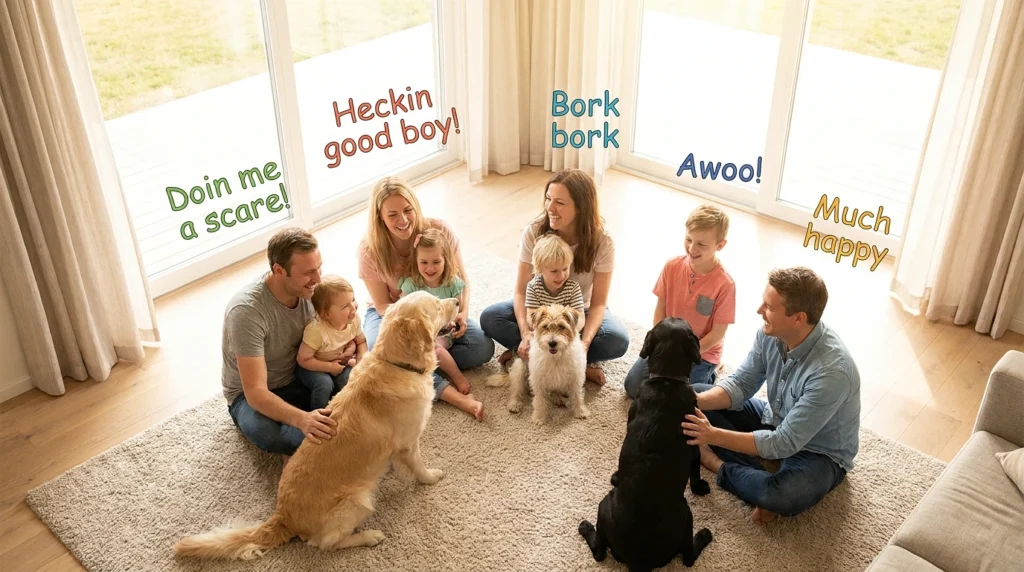
The onomatopoeia wing of the dialect, and it’s a big wing, has its own separate origins. Gretchen McCulloch, the internet linguist NPR brought in when it covered all this in April 2017, pointed out that DoggoLingo is unusually heavy on invented sounds. Bork for a bark. Mlem for a tongue licking chops. Blep for a tongue just left hanging out. Boof for the wind-up before a bork.
“Bork” got its biggest push from Gabe the Dog, a small fluffy Pomeranian-type whose borks were remixed into songs, “Careless Bork,” “Jurassic Bork,” entire discographies of a single dog’s bark pitched into melodies. The verbs came from meme templates too. “Doing me a frighten” traces to a late-2015 image of a startled Rottweiler parent telling its pup, “Stop it son, you are doing me a frighten,” and after that any dog could do anyone a frighten, or a concern, or a scare. The grammar is deliberately broken in a consistent way, which is the fascinating bit, wrong verb agreements, “hims” for him, adjectives where adverbs should be. An academic at Stony Brook, Elyse Graham, described the whole register as “upbeat, joyful, and clueless in a relentlessly friendly way,” which is about as precise as it gets.
Why The Only Swear Was A Fake One
Now the heckin question. In a dialect built by adults on the unfiltered internet, the strongest available curse was “heck,” and people would then censor it anyway, writing h*ck, bleeping a word that was already the bleep. That double-softening is the whole joke and, honestly, the whole worldview of the thing.
McCulloch traced the heck habit partly to the snek meme that came before it, snakes trying to act menacing and reading as loveable losers instead, where “heck” was the toughest talk a snek could manage. Carried into dog-speak, it fit even better, because the entire dialect is written in the voice of a creature that is incapable of malice. A dog can’t really swear. The worst thing in a doggo’s world is a frighten. So the vocabulary hard-caps at heck, and censoring it to h*ck plays at the idea that even that is almost too spicy for a good boy to say.
The people running these communities knew exactly what they’d built, too. A Dogspotting admin told NPR, in that same 2017 piece, that in a time of politics hijacking everyone’s social media, people needed dogs to smile and enjoy the good things in life. That’s a participant explaining it, not a think-piece, and it explains the swear cap better than any theory could. The dialect was a place the internet went to be nice, and the language enforced the niceness at the level of individual words.
One sour note on the record, since it belongs to the same history: the SPLC noted in 2023 that “fren,” the dialect’s word for friend, was later picked up by far-right accounts online as a deliberately innocent-sounding self-label. Nothing about the original coinage deserved that, but it’s part of what happened to the vocabulary once it left home.
Most of the words are still around, a little worn. People still call their dog a doggo without thinking about where it came from, the way nobody thinks about where “okay” came from. Which is roughly what happens to every successful piece of slang. It stops being a joke and just becomes how you talk.