


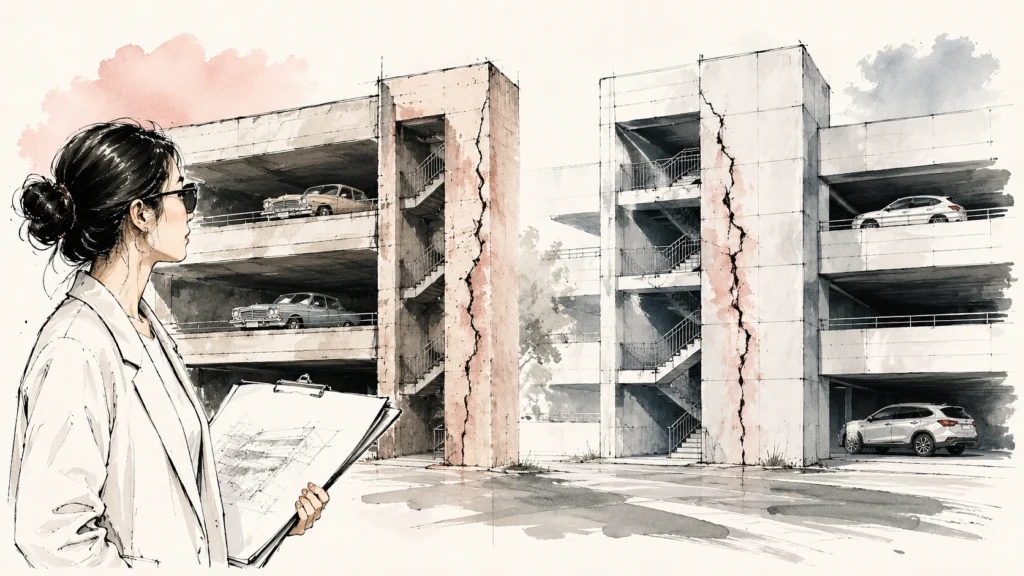
It is 1975 and a parking garage is going up outside a hospital in the Midwest. Cast-in-place concrete, four levels, a stair core at each end. Within three years there is a crack in the deck running alongside the north core, roughly parallel to the wall. The engineer notes it. Serviceability issue, not a safety issue. Sealed and forgotten.
Tear that garage down, and in 2026 build its replacement on the same lot with everything the industry has learned since. Deeper cover over the steel. A traffic membrane on every elevated deck. Encapsulated post-tensioning. Concrete specified to ACI durability zones that did not exist when the first garage was poured.
Within a few years there will be a crack in the deck running alongside the north core, roughly parallel to the wall.
Same crack. Same place. Fifty years apart. What follows is the story of why every improvement in between missed it.
The 1980s and 90s Attacked The Salt, Because The Salt Was Killing Garages
The first garage’s real enemy showed up on tires. Cars tracked in road brine all winter, the brine found the cracks, and the chemistry underneath is now textbook:
- Chloride works down to the reinforcing steel, and once it reaches roughly 1.0 to 1.5 pounds per cubic yard at the bar, corrosion starts.
- Rust takes up several times the volume of the steel it replaces, published figures running from about three times to as much as six, and that expansion cracks the concrete from inside.
- Water in those new cracks freezes and expands 9%, levering them wider every cycle, letting in more brine.
So the industry did what it should have done. Thicker cover. Sealers. Corrosion inhibitors. Deck flushing programs, spring and fall, straight out of what became ACI’s maintenance guide. Real progress against a real killer, and garage service lives got longer because of it.
The crack by the north core did not move an inch.
The 2000s Brought Membranes, Encapsulated Tendons And Durability Zones
The refinements kept coming, and they were genuinely good.
Traffic-bearing waterproof membranes became standard on elevated decks, which matters enormously because elevated decks are attacked from both faces at once, salt on top, chloride-laden drainage from the level above underneath. ACI 362 carved the country into five durability zones, three for freeze and deicing exposure, two for coastal airborne chlorides, with concrete requirements scaled to each. Post-tensioning, which by now sat inside 50 to 60% of new garages, got sealed and encapsulated tendon pulley systems, closing off the older details where water could reach strands under 30,000-plus pounds of tension and a single corrosion pit could sever one.
Every one of those changes made the aftermath of a crack slower and less dangerous.
Not one of them addressed what opens the crack.
The Crack Was Never About Corrosion, It is The Slab Losing a Fight With The Building

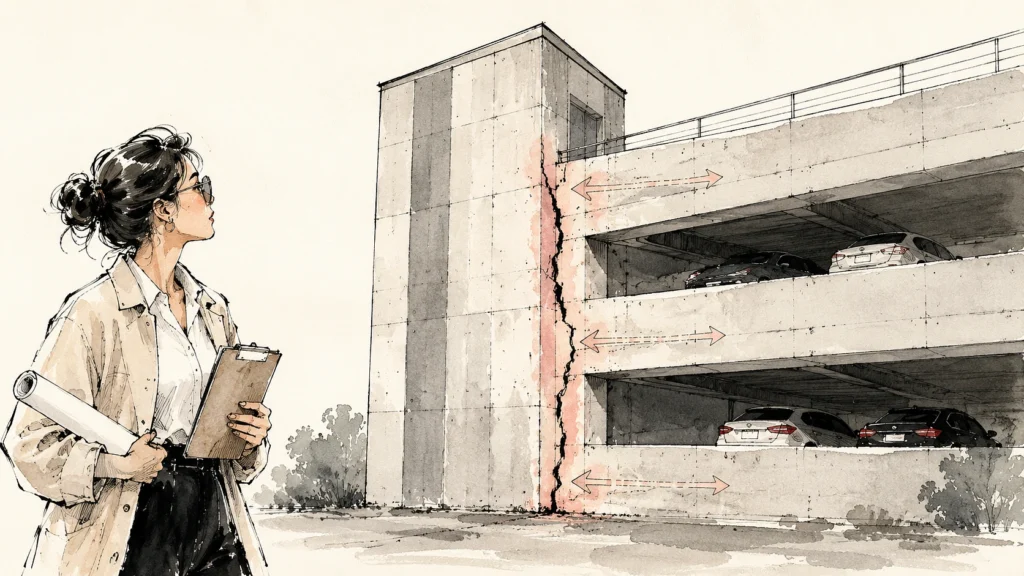
Here is the reveal the timeline has been walking toward, and it is physics rather than chemistry.
A concrete deck shrinks. It shrinks for four reasons at once, which the Post-Tensioning Institute bundles as volume change effects: drying shrinkage as the mix water leaves over months and years, creep under sustained load, temperature swings that hit every level of an open garage at full outdoor strength, and elastic shortening from the post-tensioning itself, since compressing a slab with tendons shortens it.
A shrinking slab attached to nothing would just get slightly smaller and crack nowhere. But the slab is tied to stair cores, elevator shafts and shear walls, and those things are rigid. The slab pulls. They refuse. Tensile stress builds at the junction, and concrete in tension is the weakest version of concrete there is.
The PTI’s paper on volume change effects says it without decoration: restraint to volume changes induces stresses that cause cracks, leaks and premature deterioration, and ACI 318 requires a “realistic assessment” of these effects in designing a patio people precisely because concrete creeps and shrinks in ways steel never does.
That is why the 1975 crack and the 2026 crack share an address. The corrosion improvements changed what happens after the crack. The geometry that creates it, stiff core, shrinking slab, was in both buildings.
The fixes that actually move the crack are old and unfashionable. Pour strips that let the slab do its early shrinking before it gets locked to the walls. Expansion joints placed where the movement is, not where the floor plan prefers. Release details at the stiff elements. The PTI paper exists because joint ui design, not concrete chemistry, is the lever. And expansion joints leak when nobody maintains them, which is how the cure enrolls in the disease.
The profession can now make concrete that shrugs off salt for decades. It still cannot make concrete that agrees to stay the same size. Honestly, there is something almost comforting about that.
What The Fifty-Year Rerun Means for Anyone Responsible For a Garage Today
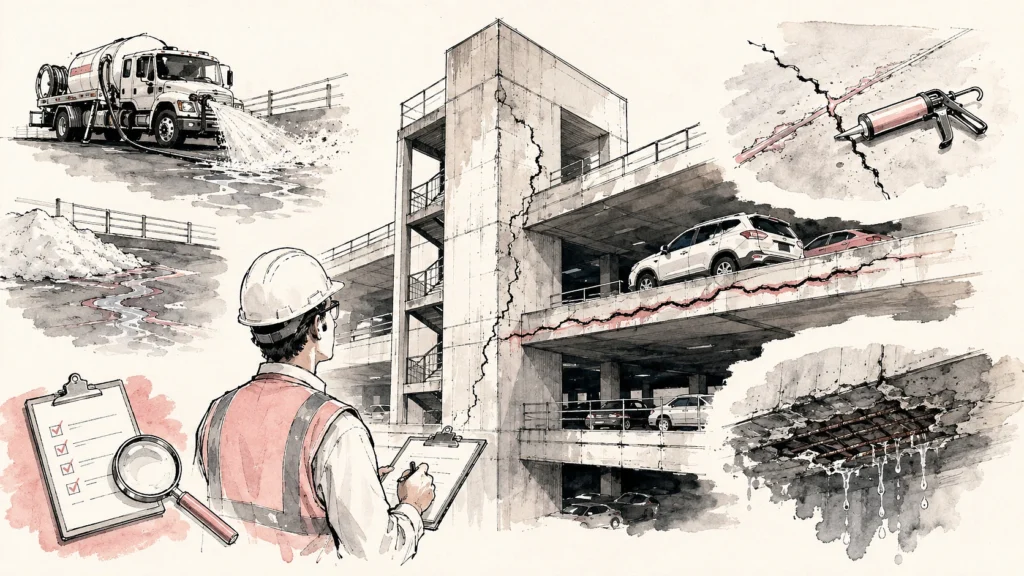
A crack beside the core is not evidence of bad construction. It is the most predictable crack in structural engineering, and inspectors can call its location sight unseen. The questions that matter are whether it is widening, moving, or leaking, which is what periodic assessment answers.
In salt country, the crack is a front door, and salt management is the whole game. Flush decks with high-volume water in spring and fall. Never let plowed snow get piled on a deck, where the weight can exceed design loads and the melt delivers concentrated chloride to a single spot. Both warnings come straight from ACI 362.2R.
Membranes and sealants are consumables. They stand between the crack and the brine, and they expire. Budget for their replacement or budget, eventually, for the corrosion sequence instead.
Water on the level below the crack means the sequence has started, and the cost of stopping it roughly multiplies at each stage it is allowed to reach. A slab can read as solid while a delaminated layer sits under the surface, which is why the forensic engineers at Rimkus warn that vehicles can break through areas that looked fine on a walkover.
And for anyone who just parks in one of these buildings, next time you walk toward the stair core, glance at the deck as you get close. Odds are decent you will find it, a crack running parallel to the wall, in the same place it appeared in 1975, and 1995, and 2015, patiently indifferent to every improvement the industry aimed at everything else.
References
- Iqbal, “Design of Expansion Joints in Parking Structures,” PTI Journal, on volume change effects and restraint cracking
- ACI 362.2R, Guide for Structural Maintenance of Parking Structures
- PTI, Durability Design of Post-Tensioned Parking Structures in Corrosive Environments, on ACI 362 durability zones
- Rimkus, Parking Structure Failures: Causes, Warning Signs, and Prevention
- ECS, Parking Garage Slab Deterioration Causes and Solutions