


Key Takeaway
- A table top basin sits on the counter, so its rim ends up 4 to 6 inches higher than the counter itself.
- Choose a lower vanity, often 30 to 32 inches, so the rim lands near 34 to 36 inches.
- Pair it with a tall vessel faucet or a wall-mounted one; an ordinary faucet will not clear the rim.
- The spout should reach the middle of the bowl and leave about 6 inches of room for your hands.
- In ADA-accessible bathrooms the rim may not be higher than 34 inches, which rules most table top basins out.
Sitting on top of the counter like a bowl set on a table, a table top basin is a washbasin that isn’t sunk into the vanity at all. Americans usually call it a vessel sink, and in many other countries it’s sold as a countertop or table top wash basin. The whole bowl stays on show, rim and all, which is exactly why people choose one.
That raised bowl changes two measurements in the bathroom. The rim ends up several inches higher than the counter beneath it, so the counter has to come down. And the water has to start above that higher rim, so the faucet (or tap) has to go up. Get either one wrong and you’ll notice it every time you wash your hands.
Lower The Counter So The Rim Lands Where Your Hands Expect It
With an ordinary drop-in or undermount sink, the counter height and the sink height are almost the same number. A table top basin adds its own height on top, often 4 to 6 inches. Put that bowl on a standard 36-inch comfort-height vanity and the rim finishes up somewhere around 40 to 42 inches, which feels like washing your hands at a kitchen island on tiptoe.
Work backward from the rim, never forward from the cabinet. Pick the rim height you want, subtract the height of the bowl, and the answer is your counter height. A few examples:
- a 6-inch bowl on a 30-inch vanity puts the rim at 36 inches.
- a 4-inch bowl on a 32-inch vanity puts the rim at 36 inches.
- a 5-inch bowl on a 36-inch vanity puts the rim at 41 inches, too high for most adults.
What Rim Height Is Right?

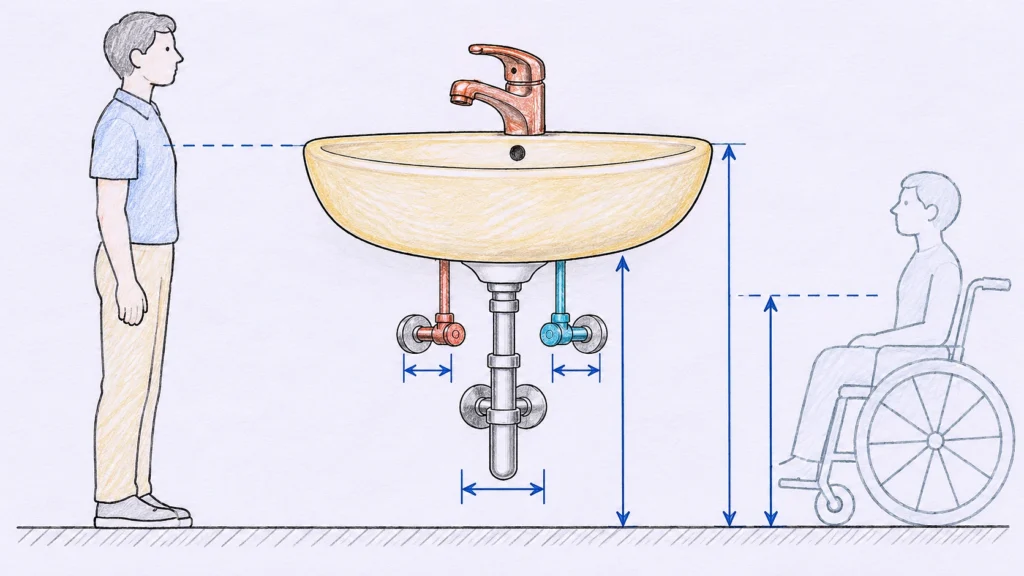
The National Kitchen and Bath Association allows a wide range, 32 to 43 inches, because the right height depends on who is using the basin. Most households aim for a rim somewhere between 34 and 36 inches. In a public or accessible bathroom, the ADA Standards set a firm limit: the rim or counter, whichever is higher, can be no more than 34 inches above the floor, and a bowl sitting on top of the counter makes that hard to meet.
The same habit of measuring around the person, and not the cabinet catalog, is the backbone of good kitchen planning as well, as this guide to ergonomic kitchen layout rules shows.
A Standard Faucet Won’t Clear The Bowl, So You Need A Taller One
An ordinary bathroom faucet is built to pour into a sink that sits at counter level. Mount one beside a table top basin and its spout ends up level with the rim, or below it. That leaves two workable choices:
- a tall vessel faucet mounted on the counter beside the bowl.
- a faucet fixed to the wall above the bowl.
Two numbers decide whether a faucet works. The first is spout height. Wayfair’s bathroom faucet buying guide suggests at least 6 inches from the bottom of the bowl to the spout, which leaves room for both hands. The second is reach, meaning how far the spout sticks out. Kallista advises choosing a faucet whose spout reaches the center of the sink, since water that strikes a sloping side wall bounces straight back at you.
There is such a thing as too tall, however. When the spout sits well above the rim, the stream falls further and hits the bowl harder. A gap of a few inches between rim and spout is usually enough.
Wall-Mounted Faucets Need Planning Before The Wall Is Finished
A wall-mounted faucet keeps the counter clear and makes wiping around the bowl easier. The catch is that its valve sits inside the wall. Its height and reach have to be fixed before the tile goes on, because moving it later means opening the wall again.
Expect A Little More Splashing And A Seam To Clean Around The Base
Because the whole bowl is exposed, drips run down its outside and settle in the joint where it meets the counter. A neat bead of silicone around the base keeps water from creeping underneath, though it will need cutting out and redoing every so often, much like the caulk around a tub. Adding that job to your preventative home maintenance list saves a soggy countertop later. Many table top basins have no overflow hole either, so pair the bowl with a drain made for basins without one, and never leave the water running with the stopper closed.
Guest Bathrooms And Powder Rooms Suit A Table Top Basin Best
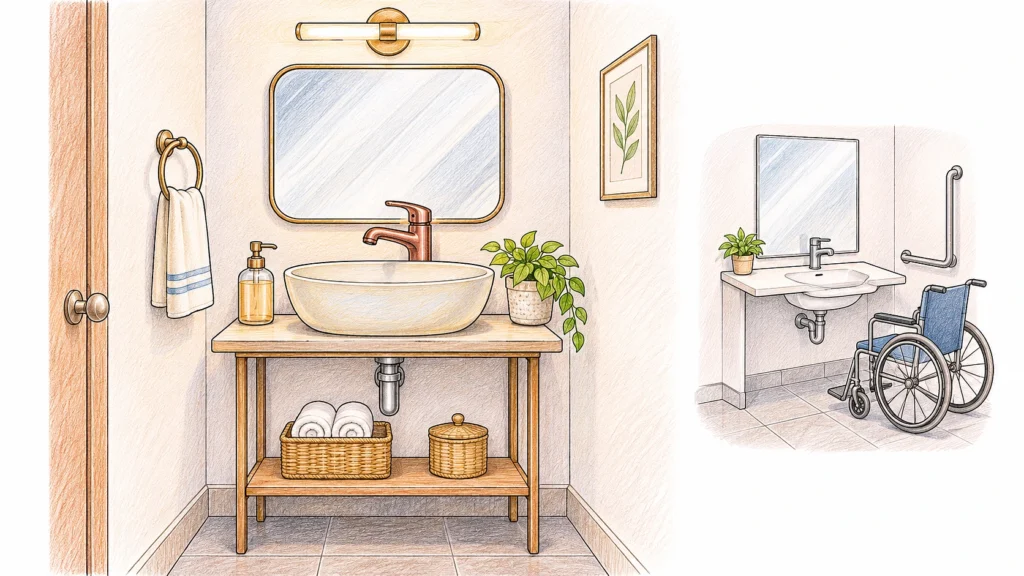
In a powder room, a basin only has to handle quick hand-washing, and a striking bowl can be the one thing guests remember about the room. A compact basin for hand wash use in a small half bath or beside a dining area keeps the footprint small, provided the counter beneath it is set low enough.
A busy family bathroom is a harder call, for a few reasons:
- children will struggle to reach a high rim.
- the seam around the base collects toothpaste and soap.
- the ADA’s 34-inch limit is hard to meet with a bowl on top of the counter.
For a bathroom that has to work for a wheelchair user, an undermount or wall-hung basin is the safer choice.
If you’re browsing ranges of table top basin shapes, look past the photo to the product drawing. It will give you the bowl height, the outside diameter and the drain position, and those three numbers decide the counter and faucet you’ll need.
Write These Numbers Down Before Ordering Anything
Take them to the shop, or keep them open on your phone while you browse:
- the rim height you want, usually 34 to 36 inches.
- the bowl’s height from base to rim.
- the counter height, worked out by subtracting one from the other.
- the bowl’s depth inside, so the faucet leaves 6 inches or so for your hands.
- the distance from the faucet hole to the drain, to check the spout’s reach.
Order the basin first and the faucet second, once the bowl’s real measurements are in hand. The vanity can then be cut or chosen to suit both.