

Megan Reep was selling candles and room sprays under the name Mavwicks Fragrances and turning over three or four hundred thousand dollars a year. Then she put the shop inside TikTok. “The first year we were on TikTok Shop, we jumped to $32 million in sales,” she told Modern Retail in May 2026, and the thing to notice about that sentence is not the number, large as it is, but where the buying happened. Nobody left the app. They watched a video, tapped the orange cart on it, paid with the card already saved, and went back to scrolling. That is social commerce, and it has stopped being a trend piece and started being a line in the national retail figures.
Americans spent about $87 billion through social apps in 2025 and will pass $100 billion in 2026, on Emarketer’s count. TikTok Shop is the part that does the buying in-app; Instagram, after a false start, mostly sends you to the brand’s own site. The money is real, the returns window is 30 days, and the scams follow the money.
How Much Is Being Spent, And By How Many People
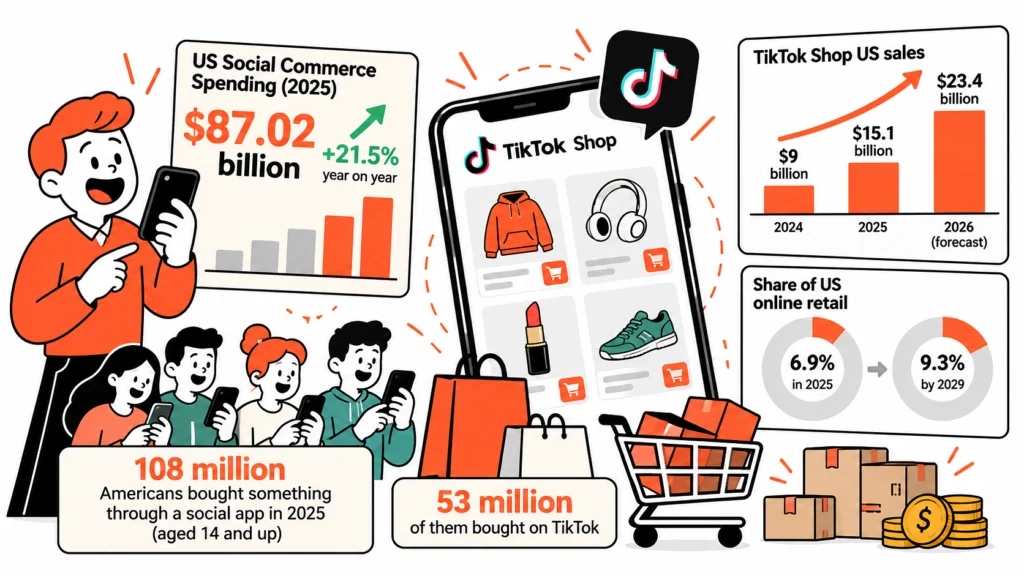
Emarketer’s December 2025 figures put US social commerce at $87.02 billion for the year, up 21.5 percent, with 2026 forecast to grow another 18 percent and cross $100 billion. That is about 6.9 percent of all US online retail, heading for 9.3 percent by 2029. Some 108 million Americans aged 14 and up bought something through a social app in 2025, close to half of everyone who uses one, and 53 million of them bought on TikTok. “TikTok’s ability to blend shopping and entertainment is turning the platform into an e-commerce powerhouse,” Emarketer’s retail analyst Rachel Wolff told Retail Dive, which is the polite version of what the numbers say.
TikTok Shop itself only launched in the US in September 2023. Momentum Works has its US sales at $9 billion in 2024 and $15.1 billion in 2025; Emarketer’s estimate is a little higher and forecasts $23.4 billion for 2026, which would make a three-year-old shopping tab bigger online than Target or Best Buy. For perspective, Douyin, TikTok’s Chinese sibling, did around 3.5 trillion yuan in 2024, something like 30 times the American business. The US is early in this, not late.
What “Without Leaving The App” Means On Each Platform
On TikTok the phrase is literally true. A product tag sits on a video, a Shop tab sits in the navigation, and a livestream can pin items under the host’s face. Tap any of them and checkout opens inside TikTok with cards, PayPal, Apple Pay or Google Pay saved from last time. Momentum Works splits 2025 US sales as half from short video, 36 percent from the Shop tab and 14 percent from live. In October 2026 TikTok added a conversational shopping assistant and one-click checkout straight from the For You feed, with Shopify and Stripe behind it, so the gap between seeing a thing and owning it is now a single tap.
Instagram and Facebook went the other way. Meta forced every US Shop onto in-app checkout in 2023, then in June 2025 quietly reversed it: Shops were moved back to website checkout, and Meta’s own payments, order management and returns handling were shut down by the end of that August. What Meta announced instead, in April 2026, was product tagging for creators, up to 30 tags on a Reel, from a brand’s catalog or an affiliate link, with no commission taken. Nicola Mendelsohn, who runs Meta’s global business group, declared that “the era of link in bio is finally over.” True, but tap one of those tags and you land on the brand’s website, not an Instagram cart. On Meta you shop through the app; on TikTok you shop in it. Pinterest, with 619 million monthly users and a record $4.2 billion revenue year, mostly points outward too, and Amazon shut its own TikTok-style Inspire feed in February 2025.
TikTok Shop keeps the whole purchase inside the app. Instagram and Facebook now hand you to the retailer’s site at the moment of paying, which matters for returns, receipts and who you complain to.
Why Live Selling Converts So Much Better Than A Product Page
Live is the smallest slice of TikTok Shop by volume and the one the brands are pouring people into. e.l.f. Cosmetics runs about fifteen livestreams a month, two to six hours each, and launched a hair line on a four-hour live a week before it reached Target shelves, Fast Company reported in August 2026. The reason is the conversion rate: around 10 percent of live viewers buy, against 2 to 3 percent on an ordinary e-commerce site and 1 to 4 percent on in-feed video, by Social/Tale’s figures in the same piece. A boutique owner named Dani Morgan is credited with $100,000 from a single fifteen-hour stream using countdown bidding.
It is QVC with the phone lines removed, and it works on the viewer the same way QVC did. A PartnerCentric survey in early 2025 found US shoppers under 60 who use TikTok Shop spend about $708 a year there at $59 an order, and nearly a quarter admitted an impulse buy they regret. The old advice still holds: make yourself wait twenty-four hours and see how badly you “need” it, which is harder when the cart is one tap away and the host is counting down.
Where The Money Goes Wrong
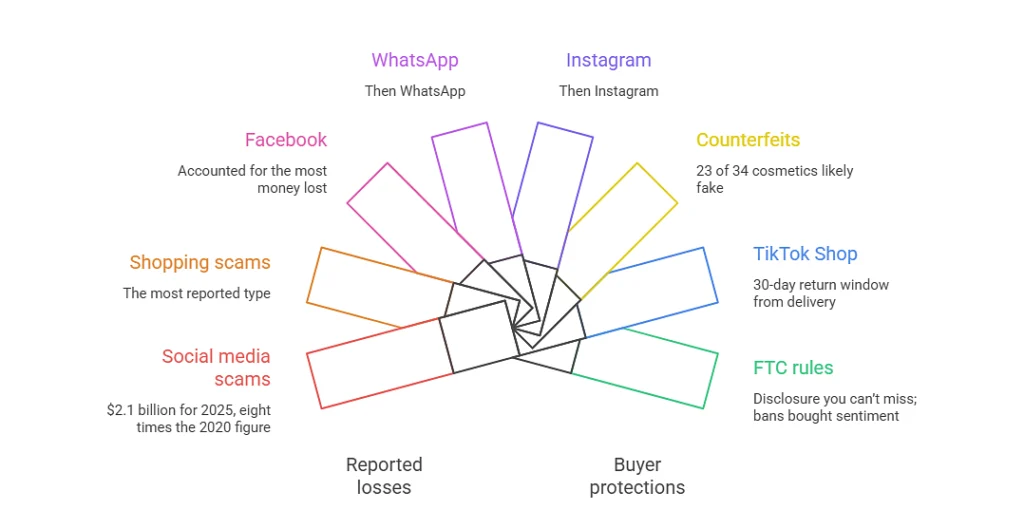
The FTC’s April 2026 data put losses to scams that began on social media at $2.1 billion for 2025, eight times the 2020 figure. Shopping scams were the most reported type, and more than 40 percent of the people who lost money said it started with ordering something they saw in a social media ad. Facebook accounted for the most money lost, then WhatsApp, then Instagram. The BBB’s 2025 Scam Tracker tells the same story from the other side: 146,000 reports, online purchase scams nearly 30 percent of them, and about nine in ten of those people out of pocket.
Counterfeits are the other leak. Which? bought 34 cosmetics from third-party marketplace sellers in June 2025 and judged 23 of them likely fake, including five of the six bought on TikTok Shop, with Charlotte Tilbury, CeraVe and The Ordinary among the brands copied. TikTok’s answer was that counterfeits are “strictly prohibited” and that it blocked over 40 million listings for IP violations in the first half of 2025, which is a lot of blocking for a problem that is supposedly prohibited. The buyer’s protection on TikTok Shop is a 30-day return window from delivery, and the platform’s Patrick Nommensen says refunds are made “very seamless.” On Instagram the return goes through whichever website took the money, under that site’s terms.
Two rules worth knowing. The FTC’s 2023 endorsement guides say a creator’s paid tag or shoppable video needs a disclosure you can’t miss, in the same medium as the pitch, and the 2024 rule on fake reviews bans bought sentiment, AI-written testimonials and paid followers, with civil penalties attached. Neither stops a bad product reaching you. Both give you something to cite when it does.
Where The Smaller Networks Fit
Not every social shop is a feed of a billion people. LookBerry is a fashion network where members post their outfits, vote in live “fashion battles,” and buy the pieces through a Shop the Look button or from brand boutiques inside the app; its App Store listing is published by Lookberry FZE, it offers the site in English, Ukrainian, Polish, Italian, Russian and Romanian, and it claims twenty thousand-odd members, a number the company supplies and nobody has audited. The model is the same as TikTok’s at a hundredth of the scale: the looking and the paying in one place, with the community doing the recommending.
What these smaller apps share with the giants is the pull. A feed built to show you people you admire wearing things you can buy in one tap asks a lot of a teenager’s evenings, and the question of how much social commerce feeds the comparison habit rather than the wardrobe is a fair one to put to any of them, LookBerry included.
What A Sensible Shopper Does With All This
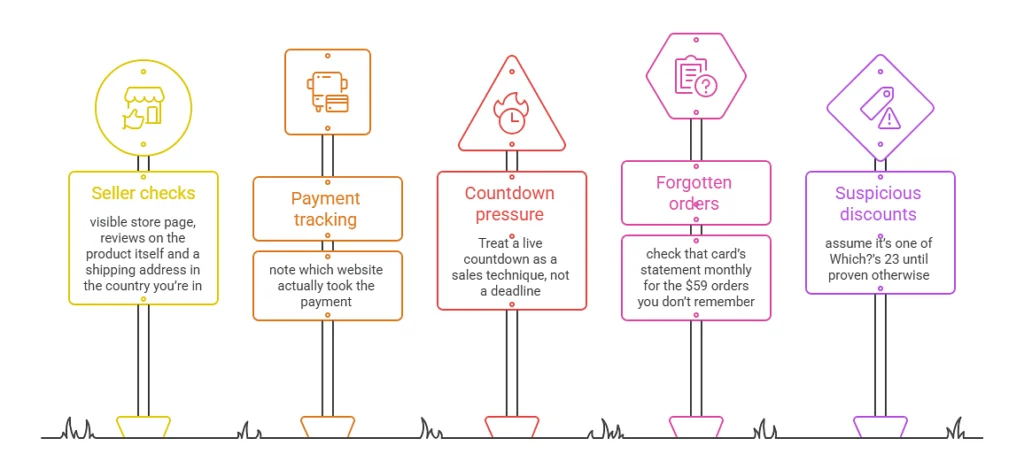
- Buy inside TikTok Shop only from a seller with a visible store page, reviews on the product itself and a shipping address in the country you’re in.
- On Instagram and Facebook, note which website actually took the payment, since that is where the return and the dispute will go.
- Treat a live countdown as a sales technique, not a deadline; the stock is rarely as limited as the host says.
- Keep social buying on one card and check that card’s statement monthly for the $59 orders you don’t remember.
- If a branded cosmetic is a third off the brand’s own price from a seller you’ve never heard of, assume it’s one of Which?’s 23 until proven otherwise.
The small recurring orders are the ones that get away, and they belong on the list of everyday habits that soak up a rising cost of living next to the subscriptions nobody cancelled. Anyone running two or three of these apps from the same account might also ask whether their bank still fits the way they spend, because a bank that flags a $59 TikTok charge at midnight is doing more for you than one that doesn’t.

