


A surgery goes wrong. The complication was on the consent form, the surgeon did everything a competent surgeon would have done, and the patient is permanently worse off anyway.
That is a tragedy. In legal terms, it is usually not a case, and the distance between those two sentences is where a great deal of grief, anger and wasted money lives.
I want to walk through the actual standard, because it is narrower than most people assume and knowing it early saves families from either chasing a claim that was never viable or, just as commonly, dismissing a real one because they assumed nothing could be done.
The Four Elements, All of Which Must Be Present
| Element | What it requires | Where claims commonly fail |
|---|---|---|
| Duty | A provider patient relationship existed, creating an obligation of care | Rarely disputed once treatment occurred |
| Breach | The care fell below the professional standard | Known complications and reasonable judgment calls are not breaches |
| Causation | The breach directly caused the injury | The hardest element, since pre existing illness often explains the outcome |
| Damages | Measurable harm resulted | An error caught before it harmed anyone leaves nothing to compensate |
Causation is where most viable seeming cases die. Consider a delayed diagnosis of an aggressive cancer. The delay may well have been a breach. But if the disease would have taken the same course regardless, the delay did not cause the outcome, and there is no claim in the eyes of the law however painful that reads.
Compare that to a retained surgical instrument causing perforation and abscess. But for the instrument, none of it happens. That is causation you can point at.
The Law Asks About the Process, Not The Result
What The Standard of Care Actually Means
Medicine is not judged on outcomes. It is judged against what a similarly qualified provider would have done in the same situation, which is the definition of the standard of care medical progress.
This is the point most people miss. A doctor can do everything correctly and the patient can still die. A doctor can also make a genuine error and the patient can recover completely. Neither of those facts, on its own, tells you whether malpractice occurred, because the question is about conduct measured against professional norms rather than about how things turned out.
That is also why these cases are so heavily dependent on expert testimony. Somebody with equivalent qualifications has to say, under oath, what a competent practitioner would have done, and whether this practitioner did it.
What The Outcome Data Actually Shows
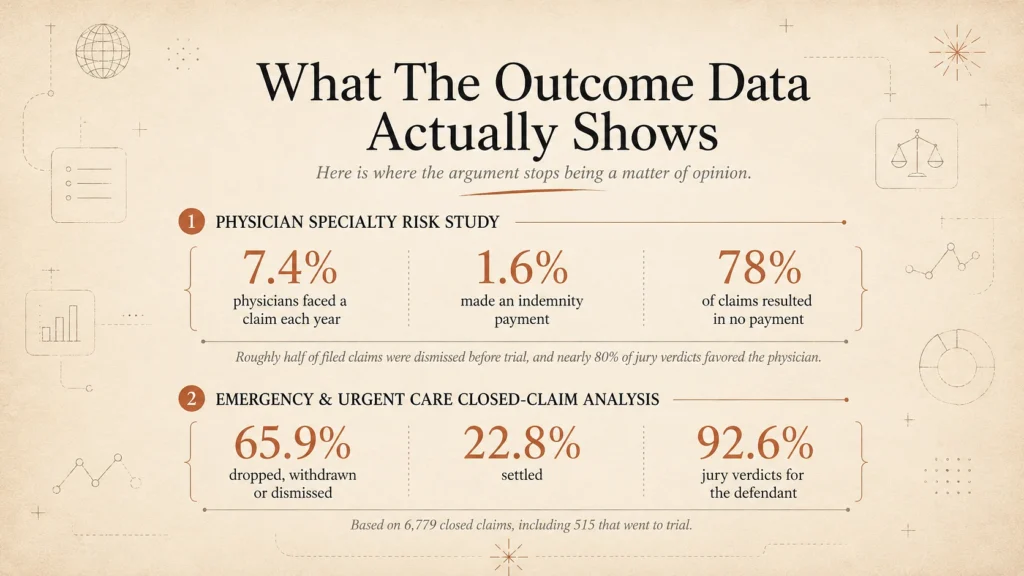
Here is where the argument stops being a matter of opinion.
In the landmark specialty risk study covering 40,916 physicians and 233,738 physician years, 7.4% of physicians faced a claim each year while only 1.6% made an indemnity payment, meaning 78% of claims resulted in no payment at all. Roughly half of filed claims were dismissed before trial, and of those reaching a jury verdict, nearly 80% were decided in favour of the physician.
A closed claim analysis in emergency and urgent care produced a sharper version of the same pattern. Of 6,779 closed claims, 65.9% were dropped, withdrawn or dismissed, 22.8% settled, and of the 515 that went to trial, juries found for the defendant in 92.6% of cases.
The Honest Counterpoint, Because This Cuts Both Ways
I am not going to present that data as proof that the system works, because the same research literature says something less comfortable.
The major NEJM study on claims and errors found that roughly one third of claims were without merit in the sense that the outcome was not attributable to error. Fine, that supports the title. But it also found that a substantial share of claims involving genuine error went unpaid, leaving injured patients carrying the cost of preventable harm. And an earlier study found that severity of disability, rather than the presence of negligence, was the only significant predictor of payment.
So the accurate summary is uncomfortable in both directions. Most bad outcomes are not malpractice, and the litigation system is a rough instrument for telling the difference. Some meritless claims get paid. Some meritorious ones do not. Anyone selling you certainty in either direction is selling something.
What Tends Not to Be Malpractice
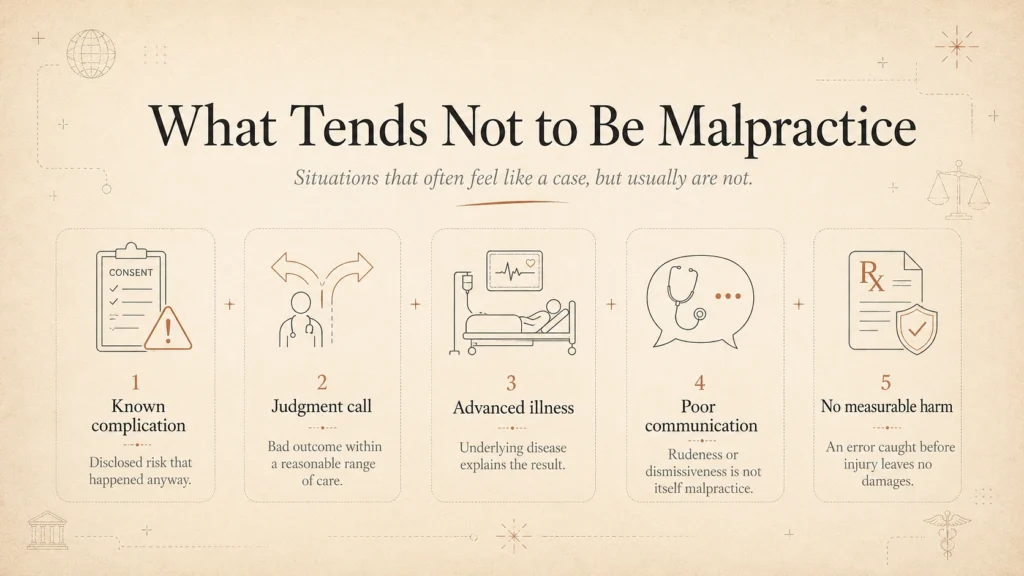
These are the situations families most often arrive with, believing they have a clear case.
- A known complication that was disclosed and occurred anyway. Consent forms exist precisely because medicine carries irreducible risk.
- A judgment call that turned out badly but sat within the range a competent practitioner might have chosen.
- A poor outcome from an advanced illness where the underlying disease, rather than the treatment innovations, explains the result.
- Rudeness, poor communication or a doctor who seemed dismissive. Genuinely awful, frequently the reason people call a lawyer, and not itself a breach of the standard of care.
- An error that caused no measurable harm, such as a wrong prescription intercepted by a pharmacist.
What Genuinely Warrants a Look
Equally, some patterns should not be shrugged off.
- Surgery on the wrong site or the wrong patient, and retained instruments or sponges.
- A clearly abnormal test result that nobody acted on, particularly where the record shows it was received.
- Medication given despite a documented allergy or a known dangerous interaction.
- Symptoms repeatedly reported and repeatedly not investigated, where the eventual diagnosis was one the symptoms plainly suggested.
- Birth injuries following abnormal foetal monitoring that went unaddressed.
If your situation is on that second list, get the records and speak to a lawyer promptly, because statutes of limitation are strict and vary considerably by state, and a strong case can be lost entirely to a missed filing deadline.
The Practical Route Through, Whichever List You Are On
Understand that most malpractice firms work on contingency and will evaluate a case at no cost, which means a consultation costs you nothing and gives you an informed read rather than an internet one.
Expect a long road if a case does proceed. The research puts the average time between injury and resolution at around five years, with one in three claims taking six or more.
And separate the two questions that get tangled together in the worst weeks. Whether something went wrong, and whether something was done wrongly. They feel identical when you are living through the aftermath. Only one of them is a legal claim, and finding out which one you have is worth an hour with someone qualified to tell you.
None of this is legal advice, and the answer in any specific situation depends on the records, the jurisdiction and expert review that no article can substitute for.

