


Key takeaways
- The single biggest factor is the one you can’t change: age. A healthy 30-year-old has about a 20% chance of conceiving per cycle by 40 it’s about 5%, driven by egg quantity and quality, not effort or health.
- The modifiable factors are real but smaller. Obesity, smoking, and heavy alcohol each raise infertility risk measurably (obesity roughly 20-36% higher odds), and, unlike age, they can be improved, often reversing their effect.
- Ranking matters because it prevents both false hope and false guilt. No amount of clean living cancels age, and no single lifestyle factor is usually “the reason” someone can’t conceive.
- Much infertility isn’t caused by anything you did. A large share is unexplained, genetic, or structural, and roughly half of cases involve a male factor, so this is rarely one person’s “fault.”
- This is information for decisions and timing, not a scorecard for blame. If you’ve been trying, the evidence-based move is evaluation, not self-recrimination.
Every “boost your fertility” article makes the same quiet mistake: it lists ten factors as if they carry equal weight and equal controllability, which leaves readers optimizing the small stuff while missing the big picture, or worse, blaming themselves for something no lifestyle change could have touched. So let me rank these honestly by two separate questions the research can actually answer: how strong is the evidence that this factor matters, and how much can you actually change it. Those two questions produce an uncomfortable but genuinely useful hierarchy, and getting it in the right order is how you spend your energy where it counts and forgive yourself for the rest.
1. Age (Strongest Evidence, And The One You Can’t Change)
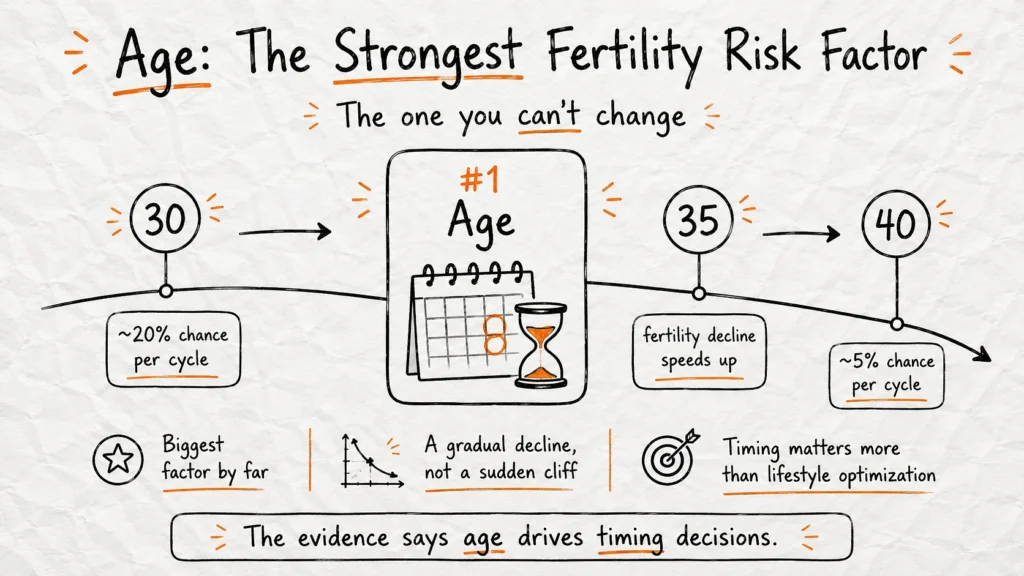
There’s no honest way around it: age is the most powerful and best-documented factor in fertility, and it’s the least modifiable. This is the one the other five combined can’t out-rank.
The numbers are stark and well-established. A healthy, fertile 30-year-old woman has about a 20% chance of conceiving in any given cycle. By 40, that drops to about 5%. Looked at over a full year of trying: before 30, roughly 85% conceive within twelve months; at 35, about 66%; at 40, about 44%. The driver is biology you can’t lifestyle your way out of, women are born with all the eggs they’ll ever have, and both the number and the chromosomal quality of those eggs decline with age, with the decline accelerating after 35 and steeply after 40 as a rising share of eggs become genetically abnormal.
One honest nuance, because the “fertility cliff at 35” gets overstated in a way that causes real panic. The drop is a gradual slope, not a trapdoor. A frequently-cited European study found only about a 4% difference in fertility between women aged 27-34 and 35-39, and a Boston University study found declines weren’t pronounced until after 35. So 35 isn’t a switch that flips, it’s a point where a gradual decline picks up pace. And age affects men too, just later and more gently, sperm quality declines somewhat with age, but there’s no comparable cliff.
Why rank the unchangeable factor first? Because it’s the one that should drive your timing decisions, and timing is something you can act on: if children matter to you and you’re in your mid-30s, the evidence says don’t spend two years optimizing your diet before seeing a doctor, because the clock is the bigger variable. Knowing age is number one is what makes people seek evaluation at the right time instead of the wrong one.
2. Body Weight, At Both Extremes (Strong Evidence, Genuinely Modifiable)
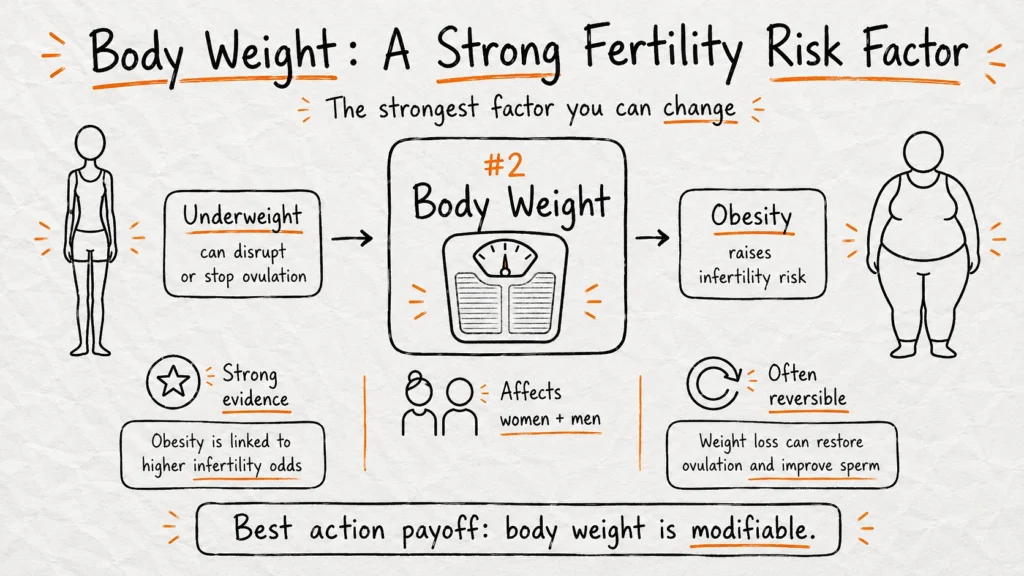
After age, body weight has some of the most solid evidence, and it’s the strongest of the factors you can actually change.
The data is consistent: obesity raises infertility risk in both partners. In men, overweight carries roughly a 19% higher odds of infertility and obesity about 36% higher, with a Mendelian randomization study, which is better at showing causation than ordinary observation, putting the odds ratio for BMI around 1.24. In women, excess weight disrupts ovulation through hormonal and insulin pathways, and it’s a central feature of PCOS, one of the most common causes of female infertility. Being significantly underweight matters too, at the low extreme it can stop ovulation altogether.
The reason this ranks high on the action list even though its effect is smaller than age: it genuinely reverses. Weight loss in people with obesity-related infertility can restore ovulation and improve sperm parameters, the effect isn’t permanent damage, it’s a functional state that responds to change. This is the factor where effort has the clearest payoff.
3. Smoking (Strong Evidence, Fully Modifiable)
Smoking has strong, established evidence against it, and it’s completely within your control, which is a rare and useful combination on this list.
The American Society for Reproductive Medicine’s committee opinion is clear that smoking has substantial harmful effects on fertility in both sexes, active smoking is associated with increased failure to conceive within both 6 and 12 months of trying. In women it accelerates the loss of eggs and can bring menopause earlier; in men it degrades sperm count, motility, and DNA integrity. The committee also flags that this applies to marijuana, not just tobacco.
The encouraging half: much of the damage is reversible on quitting, particularly the sperm effects, since men produce new sperm roughly every two to three months. Of all the factors here, this is arguably the highest-value single change, strong evidence, fully controllable, and reversible.
4. Heavy Alcohol Use (Moderate-To-Strong Evidence, Modifiable)
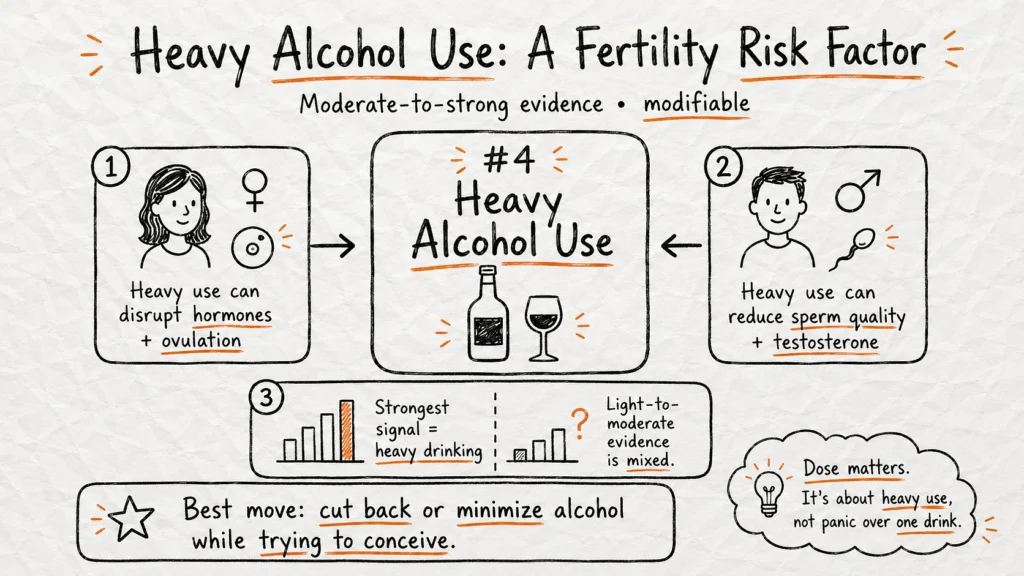
Alcohol lands solidly in the modifiable tier, with the important caveat that dose matters a great deal and the evidence is cleaner at the heavy end.
Heavy drinking is associated with reduced fertility in both partners, disrupting hormones and ovulation in women and lowering testosterone and sperm quality in men, and the Mendelian randomization data flagged alcohol as a causal risk factor for male infertility. Where the evidence gets genuinely murky is light-to-moderate drinking, the research there is inconsistent, and this is a place to be honest rather than alarmist: the strong signal is about heavy use. Many providers still advise minimizing alcohol while trying to conceive, partly for fertility and partly because of the risks once pregnancy begins, but the “one glass of wine ruins your chances” framing overstates what the data actually shows.
5. Underlying Medical Conditions (Strong Evidence, Partly Modifiable)
This tier is a bit different because it’s not one factor but a category, and it’s the one that most often turns out to be the actual explanation.
Conditions like PCOS, endometriosis, thyroid disorders, uterine fibroids, blocked fallopian tubes, and diabetes are strongly linked to infertility, and on the male side, low sperm count, varicoceles, and hormonal problems. These aren’t lifestyle choices, but many are treatable, which is exactly why they matter so much: PCOS-related ovulation problems often respond well to medication, thyroid issues are correctable, some structural problems are surgically fixable. This is the category that most rewards actual medical evaluation over self-directed lifestyle tinkering, because if one of these is the issue, no amount of kale changes it, but the right treatment might.
6. Diet, Stress, Caffeine, And The “Everything Else” Tier (Weakest Evidence, Mixed)
Here’s where most fertility articles spend most of their words, and where the evidence is genuinely thinnest, so I’ll rank it last on purpose.
Diet quality shows modest associations, some fatty-acid patterns showed causal links in the Mendelian data, and there’s reasonable evidence that a Mediterranean-style diet is mildly helpful, but the effects are small next to weight, smoking, and age. Caffeine at high doses may have a slight association with reduced fertility, but moderate intake (a cup or two of coffee) has weak and inconsistent evidence against it. And stress, the one everyone fixates on, is the most overstated: while severe stress can affect cycles, the popular belief that “just relax and you’ll get pregnant” is not well supported, and telling a struggling couple to relax is both unhelpful and quietly cruel, since it implies they caused their own problem by worrying.
The reason this tier ranks last isn’t that these factors are worthless, a healthy diet and moderate habits are worth having. It’s that optimizing them while ignoring the top of the list is like polishing the hubcaps while the engine needs work.

