


Two quotes land in your inbox for the same job. Five hundred cotton totes, one-color logo, delivered before your trade show.
Supplier A: $2.10 a bag. Supplier B: $6.40 a bag. Same quantity, same print, a $2,150 difference on one order.
Most people assume Supplier B is padding the number, sign with A, and then spend the week of the show watching handles pull loose from bags that feel like dishcloths. Sometimes A really is the better deal. The gap between those two quotes is never random, though, and it’s almost always hiding in three places nobody reads carefully the minimum order structure, the print method, and about four lines of fabric spec. Take those apart and you can tell within thirty seconds which quote is cheap and which one is just underbuilt.
Why The MOQ Exists, And Why Fighting It Usually Backfires
Suppliers don’t set minimums to be difficult. They set them because a chunk of the cost on any custom order happens once, no matter how many bags you buy.
Screen setup is the clearest example. Every ink color in your design needs its own screen, and that screen gets coated, exposed, and washed out by a person before a single bag runs. Industry setup fees land around $25 to $50 per color, and shops confirm that math bites hardest at low volume. At $35 a screen, a one-color job spread across only six pieces carries $5.83 per unit in setup alone, before fabric, before ink, before labor. That’s the entire reason a shop would rather set a 50 or 100 piece minimum than take your order for twelve.
Typical minimums by decoration type look roughly like this:
- Screen printed cotton totes: commonly 50 to 100 pieces, sometimes 25 with a small-order surcharge.
- Overseas manufactured bags with custom construction: often 500 to 1,000 pieces, because you’re paying for a production run, not a decoration job.
- Digital print and heat transfer: frequently no minimum at all, which is exactly why they exist.
- Embroidery: low minimums, since there’s no per-color setup, only a one-time digitizing fee to convert your logo to a stitch file.
The thing worth understanding is that a minimum is a threshold, not a price. Ordering exactly 100 when your real need is 250 means paying the setup twice later, and reorders rarely come back at the same unit price because the shop has to re-burn screens. If you know a second wave is coming, buying it in the first run is usually the single cheapest decision on the whole project.
Per-Unit Cost By Print Method, With The Crossover Points That Matter
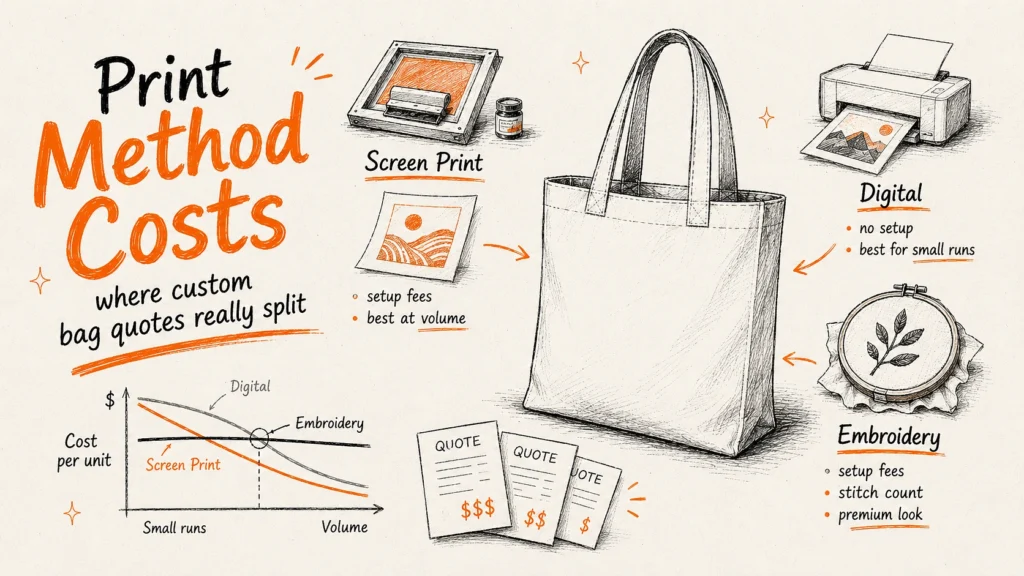
Here’s where quotes diverge most, and where a little arithmetic saves real money.
Screen Printing
Cheapest per unit at volume, full stop. One color on a standard canvas tote at 100 pieces typically runs $4.00 to $6.00 per bag all-in, and that figure keeps sliding as quantity climbs, because the fixed setup keeps spreading thinner. On apparel the same curve shows a one-color job at $10 to $15 each in tiny quantities dropping under $3 at 250 to 500 pieces.
The catch is color count. Every added color is another screen, another setup fee, another registration step. A four-color logo is four times the setup, which is why so many brands quietly simplify their mark to one color for merch. That isn’t cheapness. That’s someone who read the quote.
Digital And Direct-To-Garment
No setup fees, unlimited colors, and it prints photographic artwork that screens struggle with. The tradeoff is a higher per-unit cost that never drops much with volume, since each piece takes roughly the same machine time.
Shops put the crossover in a fairly narrow band. Below about 12 pieces, digital almost always wins. Above roughly 24, screen printing takes over for simple one to three color designs, and the advantage widens fast after that. So if you’re ordering 30 bags with a two-color logo and someone quotes you digital, ask why.
Embroidery
Priced by stitch count rather than color, plus a one-time digitizing charge, usually somewhere around $50 to $100 to convert artwork into a stitch file. That makes embroidery surprisingly competitive at small quantities, since there are no per-color screens piling up, and it stays competitive longer on complex multicolor designs. A six-color mark can favor embroidery well past 70 pieces where a one-color mark favors screens by 24.
It also just reads as more expensive to the person holding it, which matters if the bag is a client gift rather than a giveaway. Thread on canvas signals money in a way flat ink doesn’t. What it can’t do is gradients or fine Photography detail, so a logo with soft shading needs to be redrawn or printed instead.
Heat Transfer And Vinyl
Fast, cheap for tiny runs, good for names and numbers, and the least durable of the four on a bag that will be loaded, folded, and washed. Fine for a one-weekend event. A poor call for anything meant to last years.
The Specs That Actually Decide Whether The Bag Survives
This is the part that explains our $2.10 versus $6.40 gap more than anything else, and it’s four lines on a spec sheet.
| Spec | Giveaway grade | Built to last | Why it matters |
|---|---|---|---|
| Fabric weight | 4 to 6 oz cotton, or 80 gsm non-woven polypropylene | 10 to 16 oz cotton canvas | Weight is the closest thing to a durability number you get. Light cotton sags and stretches under a load; heavy canvas holds shape for years |
| Handle attachment | Single row of stitching, handles sewn to the top hem only | Handles sewn down the body of the bag, reinforced with bar tacks or an X-box stitch | Handles almost never break. The stitching that holds them does |
| Construction | Flat, unlined, raw seams | Gusseted base and sides, bound or double-turned seams | A gusset is what lets a bag carry volume without splitting at the corner |
| Handle length | Whatever the catalog default is | 20 to 22 inches for shoulder carry, shorter for hand carry | A bag people can’t sling over a shoulder gets left in a drawer |
Fabric weight deserves a second look because it’s the number suppliers are most likely to leave off a quote. Cotton is sold in ounces per square yard, and the difference between 5 oz and 12 oz is not a nuance, it’s the difference between a bag that reads as disposable and one that ends up as somebody’s grocery bag for a decade. If a quote doesn’t state a weight, that’s information in itself.
Ask for a physical sample before signing anything over a few hundred units. Not a photo. A sample. Load it with four bottles of water and carry it around the office for an afternoon, which sounds ridiculous and has saved more merch budgets than any spreadsheet.
The Sustainability Math Almost Nobody Quotes Correctly
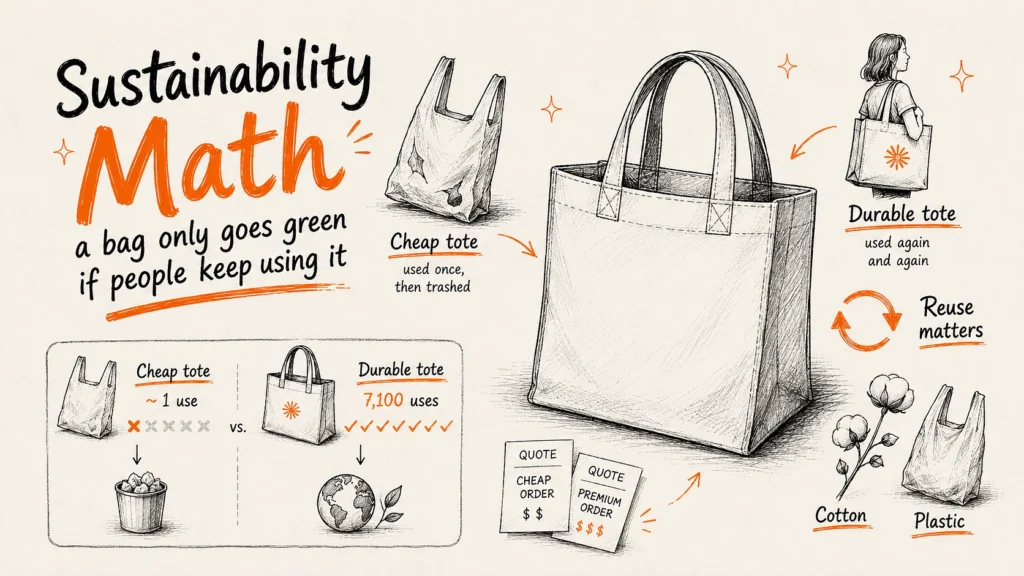
If your bag order comes with an eco story attached, know the actual research, because the marketing version of it is usually wrong in a way that will embarrass you.
The most cited study in this space is the Danish Environmental Protection Agency’s life cycle assessment of grocery carrier bags, published in 2018. Its headline finding traveled fast and lost its context on the way: a conventional cotton bag needs roughly 7,100 uses to beat a single-use plastic bag across all fifteen environmental indicators measured, and an organic cotton bag needs about 20,000.
Those numbers get thrown around as proof that cotton totes are a fraud. Read the report itself and it’s more interesting than that. Measured on climate impact alone, the figure for conventional cotton drops to about 52 uses, which is roughly one shopping trip a week for a year. The gigantic numbers come from a small set of indicators, particularly ozone depletion and water use, where cotton farming scores badly. Both figures are accurate. Only one of them is usually quoted.
The practical takeaway for anyone ordering promotional bags is uncomfortable and useful. A cheap tote handed out at a booth, used twice, and thrown away is genuinely worse for the environment than the plastic bag it was meant to replace. The bag only becomes the greener choice through repeated use, which means durability and design appeal aren’t just quality issues, they’re the entire environmental argument. Spending more per unit on a bag people actually keep is the sustainable option. Ordering two thousand flimsy ones with a giant logo is not, no matter what the product page says.
Which loops back to those two quotes. Supplier A at $2.10 is selling a lightweight bag that will do its job for an afternoon. Supplier B at $6.40 might be selling 12 oz canvas with bar-tacked handles that someone carries for years. Or B might be selling the same bag as A with better margins, and the only way to know is to make both of them put fabric weight, stitch construction, and print method in writing. Any supplier who won’t is answering the question.

