


There is a sentence in most patient leaflets on this subject that gets buried near the bottom, usually in small print under a heading like additional notes, and it deserves to be the first thing anyone reads instead.
Taking folic acid when the actual problem is a vitamin B12 deficiency will fix your blood test. It will not fix your nerves, and the nerve damage carries on quietly underneath the improved numbers. The MSD Manual states it plainly, that folate supplementation can mask B12 deficiency and relieve the anaemia while allowing neurological deficits to progress or even accelerate.
That single interaction explains why these two deficiencies are always discussed together despite being fairly different conditions, and it is the reason nobody should be self treating either one on the strength of a supplement aisle guess.
Why They Get Grouped Under One Heading
Both vitamins are needed to build DNA, which means both are needed for cells to divide properly. Red blood cells divide constantly in the bone marrow, so a shortage of either shows up there first.
When the marrow runs short, it releases cells that grew but never divided. They come out oversized, misshapen and short lived, which is what megaloblastic anaemia describes. Under a microscope, a B12 shortage and a folate shortage produce a picture close enough to be indistinguishable, and a full blood count showing large red cells cannot tell you which vitamin is missing.
That is the whole reason for the grouping. Same appearance in the blood, and from there the two conditions part company.
The Bit That Separates Them

B12 does a second job that folate does not. It maintains the myelin sheath wrapping your nerves, which is why a shortage produces numbness, pins and needles in the hands and feet, unsteadiness on the feet, memory trouble and mood changes. Folate deficiency does not do this.
So the consequences of getting the diagnosis wrong run in one direction only. Treat a folate deficiency with B12 and nothing much happens except that the folate deficiency continues. Treat a B12 deficiency with folate and the blood improves while the neurological damage continues, and some of that damage does not reverse once it has gone far enough.
There is also a timing difference that matters more than it sounds. Your liver holds enough B12 to last several years, so a B12 problem develops slowly enough that people adapt to it and often cannot say when it started. Folate stores are small and empty within a few months, so folate deficiency arrives comparatively fast.
The Symptoms Nobody Connects to a Vitamin
Fatigue, weakness, breathlessness on stairs, palpitations, Pale skin and trouble concentrating are the shared symptoms, and they are useless diagnostically because they describe about forty other conditions. People live with them for years and put them down to work, age or poor sleep.
The ones worth paying attention to are the neurological signs, since those point specifically at B12. Tingling or numbness in the hands and feet. Balance that has become unreliable, particularly in the dark. Memory lapses that feel out of character. Mood changes with no obvious trigger. Occasionally vision problems from optic nerve involvement.
Folate deficiency tends toward mouth ulcers, a sore swollen tongue, irritability and digestive upset instead.
Here is the part that catches clinicians out. Tissue deficiency can precede the anaemia, so it is entirely possible to have neurological symptoms from B12 deficiency while your full blood count looks normal. Waiting for anaemia to appear before investigating is a reasonable sounding approach that misses cases.
Where The Testing Goes Wrong
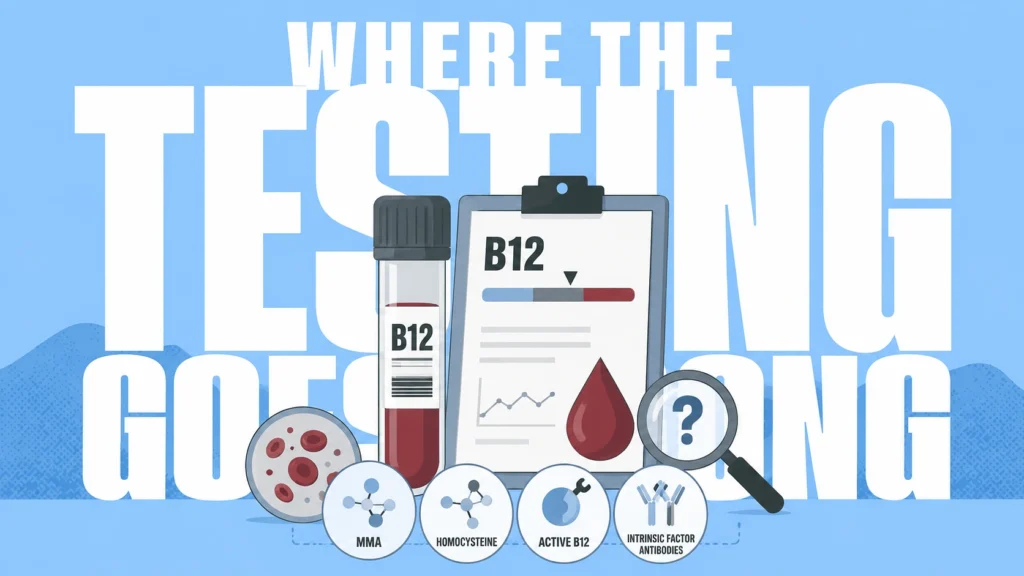
Most people assume a serum B12 test settles the question. It often does not, and this is the second thing worth knowing before anything else in the article.
A serum B12 below 200 pg/mL indicates deficiency clearly enough. The difficulty sits in the range above that, because only a fraction of the B12 measured in that test is metabolically available to your cells. Someone can return a result in the low normal band, roughly 200 to 350 pg/mL, and still be functionally deficient with symptoms to match.
When the clinical picture suggests B12 deficiency and the level comes back low normal, there are better tests available:
- Methylmalonic acid, which rises when B12 is insufficient and is treated as the more specific marker, though it also rises in kidney impairment.
- Homocysteine, elevated in both deficiencies, and worth knowing that folate supplementation alone will normalise it, which is another route to a falsely reassuring result.
- Holotranscobalamin, sometimes called active B12, which measures the portion actually available to cells.
- Intrinsic factor antibody testing where pernicious anaemia is suspected.
There is even a documented failure mode where the serum test reads falsely high. Antibody interference in some pernicious anaemia patients can produce spuriously elevated B12 results, so a patient with clear megaloblastic changes on their blood film has been reported with a B12 above 2000 pmol/L. Rare, though it illustrates that the number is not the diagnosis.
What Causes It
Diet is the obvious answer and the least common one for B12. Vegans and strict vegetarians genuinely are at risk, because B12 comes from animal products, and fortified foods or a supplement handles it easily enough. Folate deficiency from diet is more common, particularly where fresh vegetables and pulses are scarce.
Absorption is where most B12 deficiency actually comes from. Pernicious anaemia, an autoimmune condition that destroys the stomach cells producing intrinsic factor, makes absorption impossible regardless of intake, and it requires lifelong treatment. Coeliac disease, Crohn’s disease and any surgery removing part of the stomach or small bowel do similar damage to the absorption pathway.
Medication is the cause that gets overlooked most, and two of the drugs involved are among the most prescribed in the world. Metformin reduces B12 absorption over time, and proton pump inhibitors do the same by suppressing the stomach acid needed to release B12 from food. Anyone taking either long term is a reasonable candidate for periodic monitoring, and monitoring frequently does not happen.
Then there is increased demand, which is mostly pregnancy and adolescence, and alcohol, which both reduces folate absorption and increases how much of it you lose.
The Fortification Problem
Worth a mention because it affects whole populations rather than individuals.
Many countries now fortify flour and cereals with folic acid, and it worked, in the sense that neural tube defects in newborns fell considerably. The unintended consequence is that a lot of people are now consuming enough folic acid to partially mask a developing B12 deficiency without ever taking a supplement deliberately.
Research comparing groups has found that people with low B12 and elevated folate score worse on cognitive testing, and show higher homocysteine and methylmalonic acid, than people with low B12 and normal folate levels. The evidence there is largely correlational and the mechanism is still argued over. It is enough to justify checking both vitamins together rather than one, especially in older adults.
Treatment
For B12, injections are standard where absorption is the problem or the deficiency is severe, typically hydroxocobalamin in the UK. Where the gut still absorbs normally and the cause is dietary, high dose oral supplementation works. Pernicious anaemia means treatment for life, since the absorption defect does not go away.
For folate, oral folic acid tablets alongside dietary improvement, continued until levels normalise.
The rule that ties back to the opening of this article is that B12 status should be established before folate treatment starts. Not afterwards, and not on the assumption that a combined supplement covers both, because the masking effect is precisely what happens when folate is given to someone whose real problem is B12.
Neurological symptoms deserve prompt attention rather than a watch and wait approach. Blood counts recover within weeks of starting treatment. Nerve recovery is slower, less complete, and depends heavily on how long the deficiency ran before anyone caught it.
Who Should Ask For a Test
Anyone with unexplained fatigue that has lasted months, and particularly anyone with numbness, tingling, unsteadiness or memory changes alongside it. Long term metformin or proton pump inhibitor users. People following vegan diets without supplementation. Anyone with coeliac disease, Crohn’s, or previous stomach or bowel surgery. Older adults, since absorption declines with age and the neurological presentation gets mistaken for ageing.
If you are already taking a folic acid supplement or a general B complex, mention it when you go, because it changes how your results should be read.
None of this is a substitute for seeing a doctor, and the tests involved are ordinary blood tests that any GP can arrange.

