


On the end of a long, flexible cable sits a small waterproof camera with its own lights. A plumber feeds it into the pipe and watches a live picture on a screen above ground. Plumbers call this tool a drain camera or a sewer scope, and it lets them look inside a pipe that is buried under a floor, a lawn or a driveway without digging any of it up.
Most clogs never need one. Hair in a shower trap or a toy in a toilet gets pulled out, and the trouble ends there. A drain that backs up again a few weeks after it was cleared is different. Something further down the line is catching waste every time, and clearing the clog does nothing about it.
Why A Cleared Drain Blocks Up Again Within Weeks
A plunger pushes a clog along. A drain snake, the coiled cable plumbers also call an auger, bores a hole through the middle of it. Water runs again in both cases, and the sink or toilet seems fixed.
Neither tool changes the pipe itself. If roots have grown in through a joint, the snake trims a path through them and they grow back. If a length of pipe has sagged, waste settles in the dip again after the next few loads of laundry. Grease on the pipe wall stays on the wall, with a narrow channel cut through it.
How To Tell A One-Off Clog From A Repeat Problem
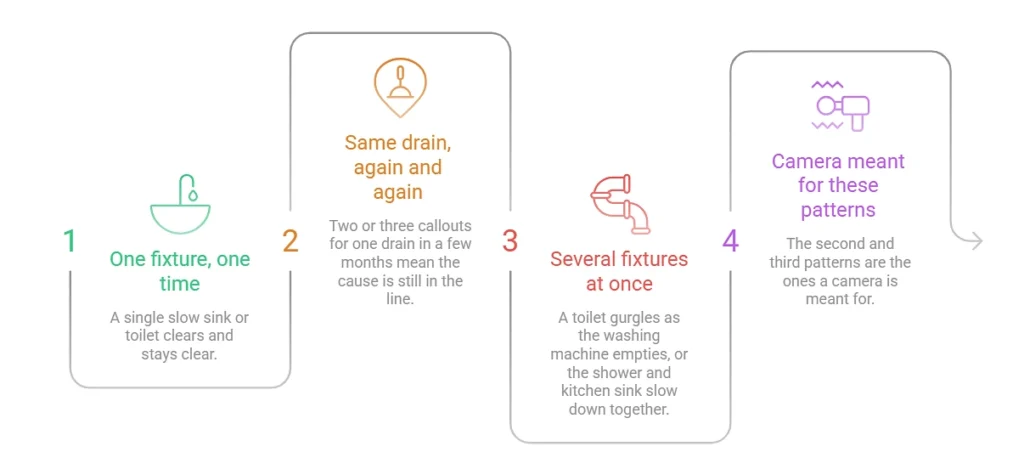
Plumbers look at where the backups happen and how often:
- One fixture, one time. A single slow sink or toilet that clears and stays clear was almost certainly a local clog.
- The same drain, again and again. Two or three callouts for one drain in a few months mean the cause is still in the line.
- Several fixtures at once. When a toilet gurgles as the washing machine empties, or the shower and the kitchen sink slow down together, the main sewer line that serves the whole house is the likely place.
The second and third patterns are the ones a camera is meant for.
The Five Causes A Camera Finds Inside The Pipe
Tree Roots Growing Through A Joint
Roots head for the moisture that leaks from a sewer pipe, and olSigns That Tell You To Book A Camera Inspectionder clay and cast iron lines give them plenty of joints to enter. An NC State Extension agent makes a point many homeowners miss: tree roots cannot create cracks in your sewer pipe, they can only use gaps that were already there. So roots on the screen also mean the pipe was leaking before they arrived, and cutting them out will not seal it.
Grease Hardened On The Pipe Wall
Cooking fat goes down the kitchen sink as a warm liquid and sets hard further along. An EPA fact sheet on sewer overflows reports that grease from restaurants, homes and industrial sources is the most common cause (47%) of reported blockages. On camera it looks like a pale crust that narrows the pipe.
Wipes Caught On A Rough Spot
A wipe that leaves the toilet bowl has not necessarily left the house. Ryerson University’s Flushability Lab tested 23 products labeled flushable, and not one single wipe was able to fall apart or disperse the way sewers need. Wipes snag on roots, grease or a rough joint and build into a plug.
A Sagging Or Broken Pipe
Soil settles, and sometimes a pipe was laid badly in the first place. A sagging section, which plumbers call a belly, holds standing water where solids sink and collect. Cracks, collapsed lengths and joints that have slipped out of line all catch waste in a similar way.
Each of these needs a different repair, which is why seeing the cause comes before choosing the fix.
| What is in the pipe: | What the camera shows: | Usual fix: |
|---|---|---|
| Tree roots | Fine roots or a thick mass coming through a joint | Cut the roots out, then reline or replace the damaged section |
| Grease | Pale buildup narrowing the pipe | High-pressure water jetting |
| Wipes and other solids | A wad caught at one spot | Pull or jet it out, then check what it caught on |
| Belly (sagging section) | Standing water the camera dips under | Dig up and re-lay that length |
| Crack, collapse or shifted joint | A visible break, a step between pipes, or soil in the line | Reline the pipe or replace the section |
What Happens During A Camera Inspection And What It Costs
The visit is simple to follow, and a homeowner can stand beside the plumber and watch the whole thing.
- The plumber opens a cleanout, a capped access point on the drain line, or takes out a toilet if the house has no cleanout.
- The camera goes in on its cable and travels toward the street while the screen shows the inside of the pipe.
- A counter on the screen records how far the camera has gone, so each problem has a distance attached to it.
- At a trouble spot, a locator held above ground picks up a signal from the camera head, and the plumber marks the place on the floor or the lawn.
- The footage is saved, and you can ask for a copy.
Keep that recording. It lets you get a second quote for the repair without paying for a second inspection, and it is useful proof if a neighbor’s tree or a recent building job is involved.
Typical Prices In The US
HomeGuide, drawing on 1,991 projects reported by its members, puts the price of a sewer camera inspection at $125 to $500 on average, with a national average of $280. The site notes that this fee covers looking only, so clearing the line or repairing it is billed separately. HomeAdvisor quotes a wider range of $270 to $1,731, which shifts with the type of camera, the length of the sewer and any repairs included.
Set beside the bill for a line replacement, which can run to several thousand dollars, a few hundred for a clear diagnosis is money well spent. A plumber who knows the cause can also quote for one repair instead of guessing at three.
Signs That Tell You To Book A Camera Inspection
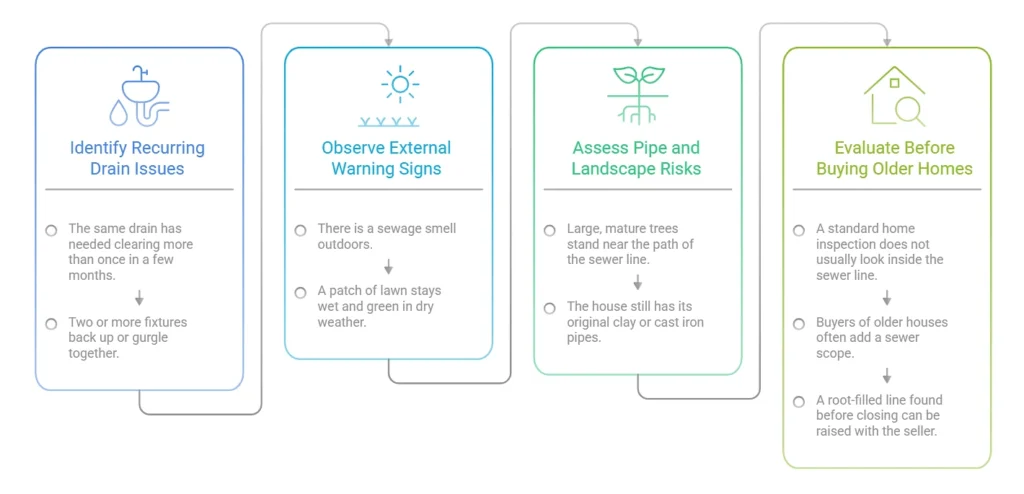
A camera is worth asking for when any of these apply:
- the same drain has needed clearing more than once in a few months.
- two or more fixtures back up or gurgle together.
- there is a sewage smell outdoors, or a patch of lawn that stays wet and green in dry weather.
- large, mature trees stand near the path of the sewer line.
- the house still has its original clay or cast iron pipes.
Blocked drain repair goes faster when the plumber has already seen the inside of the pipe, so it makes sense to ask for the camera at the same visit as the clearing. The footage also leaves you with a record of what was found and where.
Before Buying An Older Home
A standard home inspection does not usually look inside the sewer line. Buyers of older houses often add a sewer scope for that reason, and it belongs on the same checklist as the steps for comparing neighborhoods before buying. A root-filled line found before closing can be raised with the seller while the price is still open.
Habits That Keep The Line Clear After The Repair
Once the cause is fixed, a few changes at home stop the pipe from filling up again.
In The Kitchen
Pour cooled cooking fat into a can or jar and put it in the trash. Wipe greasy pans with a paper towel before washing them. A garbage disposal is no help here, and the City of Tampa’s wastewater department is blunt about it: garbage disposals do not stop grease from getting into pipes, they only break solids into smaller pieces. A sink strainer and a scrape-first routine do more for the drain than any cleaner, and both fit easily into a kitchen that stays calm and clean.
In The Bathroom
Flush toilet paper and nothing else. Wipes, cotton pads, dental floss and paper towels go in a bin beside the toilet, whatever the packet says.
In The Yard
Find out where the sewer line runs before planting, and keep large, fast-growing trees well away from it. Where roots were the problem and the old pipe is still in the ground, ask the plumber how often to recheck it. HomeAdvisor suggests a yearly or twice-yearly inspection for properties with mature trees near the line.
Add the recheck date to the rest of your preventative home maintenance list, next to the gutters and the water heater. A drain that has been seen, repaired and looked after should not need an emergency call again for a long time.

