


In September 2023 SmileDirectClub filed for Chapter 11, and three months later, in the middle of December, the company told a bankruptcy judge that the sale process it had been chasing was not going to work and began winding down. Undelivered orders were canceled and customer support ended and the Lifetime Smile Guarantee that had been a centerpiece of the marketing no longer existed.
There is no reliable count of how many people were partway through treatment when that happened. Myron Guymon, then president of the American Association of Orthodontists, estimated tens of thousands, and said that having spent time and money on a treatment only for the rug to get shoved out from underneath them was going to be very frustrating for those patients.
The detail that stayed with me is the one Axios reported in December of that year. About a month after filing for bankruptcy protection, SmileDirectClub was still offering discounts to new customers who paid the full cost up front rather than financing it over time, which means people handed over the entire price of their treatment to a company already in Chapter 11 and in some cases did so only weeks before it shut down. Customers who were on the payment plan were meanwhile told they should keep making payments.
The Timeline
SmileDirectClub launched in 2014 and served over two million people, and when it went public in 2019 it carried a valuation of roughly 8.9 billion dollars. It never turned a profit, lost 86.4 million dollars in 2022 alone, and was in bankruptcy by September of the following year.
The business part of this is fairly ordinary, since companies burn through investor money and fold all the time. What makes it worth writing about is that the product was a medical treatment and the people left holding the bag were in the middle of having their teeth physically moved.
What The AAO Said
On December 14, 2023 the American Association of Orthodontists issued formal guidance for stranded patients, and the core of it was one sentence:
The best thing SmileDirectClub patients can do at this point is to book an in-person exam with a licensed orthodontist in their area.
Guymon’s clinical objection, which he repeated in several interviews at the time, had nothing to do with the bankruptcy. It was that SmileDirectClub patients had never had an x ray or an in person examination before treatment began. The American Dental Association separately restated that it maintained its opposition to the direct to consumer model.
Joyce Kahng, a cosmetic dentist in Costa Mesa, told Refinery29 that she had been warning people about the company for years and that dentists had seen the model as unsafe.
What An Exam Catches That a Mail Order Kit Cannot
This is worth slowing down on, because the objection sounds procedural and it is actually clinical.
Suppose you have some crowding on your lower front teeth and you want it fixed. You order an impression kit, take molds at your kitchen table, mail them off, and a treatment plan comes back a few weeks later. That plan is built entirely on the shape of your teeth, because the shape of your teeth is the only information anybody has about you.
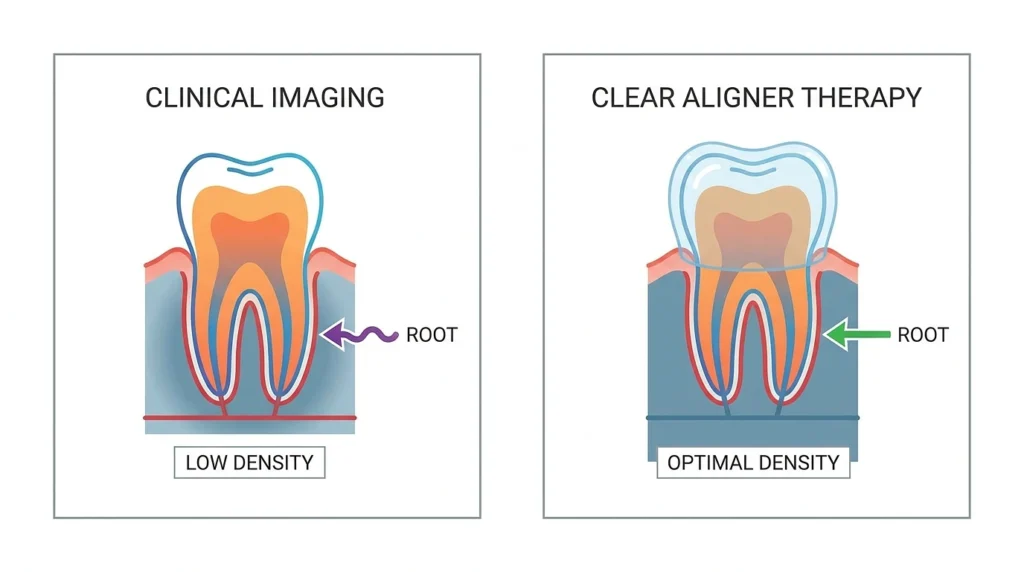
Consider what that shape does not tell them. It says nothing about the length or condition of your roots, nothing about bone loss around any of those teeth, nothing about an infection sitting at the tip of a root or an impacted tooth lodged somewhere it should not be. It does not reveal early gum disease, it does not show how your jaw joints are behaving, and it cannot tell anyone whether the crowding at the front is actually the visible end of a bite problem happening further back.
Teeth move because sustained force is applied to them and the bone around them remodels in response, and that process happens whether or not the surrounding tissue is healthy enough to tolerate it. If you apply that force to a tooth sitting in bone already compromised by periodontal disease, you are not straightening it so much as accelerating the underlying problem, and neither the aligner nor the person wearing it has any way of detecting that from a bathroom mirror.
Thikriat Al Jewair, who chairs the orthodontics department at the University at Buffalo, told Fortune that it is very easy to cause harm when a case is not being properly monitored.
Root Resorption
The complication that comes up most often in this conversation is root resorption, where the roots of teeth shorten during orthodontic movement.
Some degree of it occurs in a lot of orthodontic treatment, including treatment carried out properly by specialists, and it is usually minor enough to be clinically irrelevant. The reason it matters here is that identifying it requires imaging partway through treatment compared against imaging taken before treatment started, so if nobody took a baseline x ray and nobody takes a follow up, a case where resorption is becoming significant looks identical to a case where nothing is happening, and the patient feels no difference either way.
Where The Evidence is Thinner Than The Rhetoric
I want to be careful here, because it would be easy to write this as though all two million customers were harmed, and the record does not support that.
For genuinely mild cosmetic crowding in someone with healthy gums and no underlying bite problem, simple aligner therapy does sometimes produce a perfectly acceptable outcome, and some proportion of those customers finished with teeth they were happy with and never had a complication at all. The before and after photographs in the marketing were not all fabricated.
What is far harder to establish is how large that proportion was, since there was no systematic follow up and no obligation to report anything, and the complaints that did surface went to the Better Business Bureau and to journalists rather than into any clinical registry. So when the AAO says that corrective treatment after unsupervised aligner therapy frequently costs more than doing it properly would have cost in the first place, I find the direction of that claim credible while nobody, including the AAO, can put a reliable figure on it. The absence of usable outcome data is part of what the story is about.
If You Were Left Mid Treatment
The advice circulating at the time, from orthodontists including Shin Jung Hsieh, was to stop advancing through the aligner series and hold at whichever tray you were wearing, which prevents further unsupervised movement while you work out what to do next.
The step after that is an actual examination with imaging, which will tell you three things you currently have no way of knowing. Where your teeth ended up compared with where the original plan said they would go, whether anything happened to the roots or the supporting bone during the movement that already occurred, and whether the plan you were sold was ever appropriate for your case in the first place.
That examination belongs with an orthodontic specialist rather than a general dentist, and the distinction is a practical one rather than professional snobbery, since orthodontists complete two to three years of residency after dental school devoted entirely to tooth movement and jaw development. Practices that have been running for decades tend to be the ones willing to take on salvage cases, which are messier and less predictable than starting fresh with a new patient. In Austin, for instance, Kunik Orthodontics has been in practice since 1991 and works on the complex end of aligner treatment, which is the category most abandoned cases fall into.
Bring whatever documentation you still have when you go, including your original treatment plan, any scans you were given copies of, and your payment records, since some of that matters clinically and some of it matters if you end up pursuing anything through the bankruptcy process.
Why Two Million People Signed Up in The First Place
They were not being reckless. Orthodontic treatment in the United States is expensive, taking time off work for repeated appointments is genuinely difficult for a lot of people, and a company spent an enormous amount of money telling them there was a way around both problems. The offer was accurate about cost and convenience and silent about whether anyone qualified was checking that the treatment suited their particular mouth.
If you are weighing a similar offer now, from whichever company happens to be running the advertisements, the useful question is not what it costs. It is who examines you before treatment begins, who reviews your x rays, and who carries responsibility if something goes wrong halfway through.
Sources
- Associated Press, via NBC New York, on the shutdown and its effect on customers
- Axios, December 12, 2023, on stranded patients and prepayment discounts
- American Association of Orthodontists, guidance to SmileDirectClub patients, December 14, 2023
- Fortune, December 29, 2023, on direct to consumer aligner safety concerns
- Refinery29, December 2023, interviews with practicing dentists and the AAO president

