


Walk into enough garages with a hoist in them and the problems repeat. The clamp sits on a joist that was sized for a roof. The hoist was chosen for the number printed on its box. The rope has been dragged sideways until the strands at the drum have started to open. The power cord runs to an extension lead and from there to an outlet shared with a chest freezer. And at no point has anyone put a known weight on the hook to find out what the setup can carry, so what it has lifted so far is all anyone knows about it.
Each of those is a step that got skipped, and the steps go in order.
The structure, not the hoist, sets the limit. Have the beam rated before buying, keep the hoist’s rating under it, mount it so the pull stays vertical, give it a circuit that can carry the motor, and load test it at no more than 125 percent of rated load, with the result on paper, before the first real lift.
The Joist Over The Garage Was Sized For A Roof, Not A Transmission

In a typical US house the garage ceiling joists are 2x8s or 2x10s on 16-inch centers, holding up roof load and a layer of drywall. A transmission swinging from the middle of one is a point load those joists were not calculated for, and they can carry it for a long time before anything shows. In an industrial building nobody gets to find out the hard way, because hoists only go on engineered, load-rated structures there, and where the beam, the trolley and the hoist have different ratings, the system is rated at the lowest. The University of Rochester’s hoist and crane safety procedures set that out for their labs, and the math is no different at home: a 2,200-pound hoist on a 1,500-pound beam is a 1,500-pound system, provided the clamp is good for 1,500 as well.
Since there’s no plate on a residential joist, the number has to be calculated from the span, the lumber size and the spacing. A structural engineer does that for a fee and gives you a letter, and you keep the letter. If the joists won’t carry what you need, the fix is a steel I-beam on posts or a freestanding gantry, and whoever designs it should be the one who signs for it.
Four things to settle before anything is ordered: the heaviest load you expect to lift, including the hook block and slings; whether the hoist will stay in one place or travel on a trolley, because a traveling load shifts where the stress goes; the beam’s flange width, so the trolley or clamp will fit it; and how much lift height remains once the hoist body and the hook have taken their share of the headroom.
The Number On The Box Is Not The Number That Matters
With the beam rated, you choose the hoist to sit below that rating with margin for the heaviest planned lift. For occasional use the consumer market is a sensible place to look. A VEVOR electric wire rope hoist is offered in ratings from 440 to 2,200 pounds, runs on 110 to 120-volt household current, carries about 40 feet of rope, and ships with a wired pendant or a wireless remote; the listings state that limit switches and emergency stops are fitted across the range, and at the time of writing the prices ran from $80 to $195.
Read the duty cycle before the capacity. A light-duty motor will pull an engine once without complaint and overheat if asked to do it ten times in an hour. Then read how the capacity is quoted. Many small hoists give their top figure on a double line, where the rope runs down through a pulley block and back up to the hoist, halving the speed and the lift height. On a single line, with the block left off, the figure can be half of what’s printed, so a hoist sold as 2,200 pounds may be an 1,100-pound hoist in the way you’ll actually rig it, and 1,100 is the number to hold against the beam.
Compare the single-line capacity, not the box figure, against the structure’s rating, and buy under it.
A Load Pulled Sideways Damages The Rope, The Trolley And The Beam
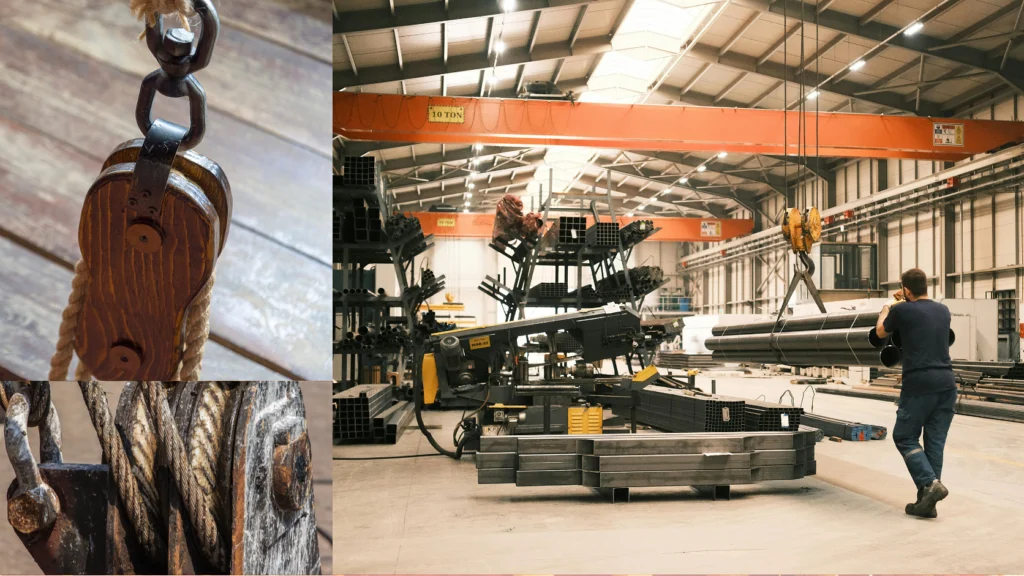
A wire rope hoist is designed to lift vertically. Mounting it well mostly means making sure it never has to do anything else.
How It Hangs
A hook-mounted hoist hangs from one eye or a beam clamp and stays put. A trolley-mounted hoist runs along the bottom flange of an I-beam. The clamp or trolley has a rating of its own, has to match the flange width, and gets torqued to the figure in the manual rather than by feel. A trolley needs end stops on the beam.
What Side Pulling Does
Dragging a load across the floor until it swings under the hook bends the rope over the drum flange, pushes the trolley sideways and puts a bending load on the beam that was never in the calculation. When the load isn’t under the hook, the hoist moves or the load moves; the rope is left out of it.
The Two Ends Of Travel
With the hook fully lowered, two full wraps of rope should remain on the drum. With the hook fully raised, the upper limit switch should stop the motor before the block reaches the housing, because driving the block into the housing is how wire ropes get parted. Both ends get checked with an empty hook before the first lift and before each use after.
A Shared Circuit And An Extension Cord Will Trip The Breaker Or Cook The Motor
The larger consumer hoists draw 1,500 to 1,600 watts, which at 120 volts is 13 to 14 amps running and more at start-up. On a 15-amp circuit already feeding the garage lights and a freezer, that trips the breaker, and an extension cord makes it worse, because a long thin cord drops voltage and the motor pulls extra current to make up the difference. The sensible minimum is a dedicated 20-amp circuit with wire sized to match and a grounded outlet the hoist’s own cord can reach. An electrician can tell in a few minutes whether the panel has space for it. The pendant hangs where the operator can stand clear of the load, and the emergency stop gets pressed with the motor running the first time the power comes on, to prove it kills the motor.
A Hoist That Has Never Been Load Tested Has Only Been Hung
OSHA’s overhead crane standard caps the test load at 125 percent of rated load unless the manufacturer says otherwise, and an OSHA interpretation letter on hoist load testing adds that the working rating afterward may not be more than 80 percent of the heaviest load held during the test. The industry groups behind the ASME hoist standards put the test at 100 to 125 percent of rated load for any hoist that is new, reinstalled, altered or repaired, done dynamically, with the load lifted, lowered and, on a trolley, traveled, and the report kept for the life of the equipment.
- Hang a known weight between the rated load and 125 percent of it, from scale-checked plates or something whose weight can be proved.
- Lift it a few inches, hold it for a minute, watch the brake for drift, listen to the beam and the clamp.
- Lower it, run it to full height, lower it again, and on a trolley travel it the length of the beam.
- Look at how the rope spooled, whether the hook opened, and whether the beam, clamp and bolts look unchanged.
- Write down the date, the weight, what was seen and who was there.
A recorded load test at 100 to 125 percent of the hoist’s rating, lifted, held, lowered and traveled, is what completes the installation.
Inspections After That Take A Few Minutes A Month
Industry practice is an initial inspection at install, a frequent one roughly monthly, a periodic one roughly yearly, and a short look before each use that starts with running the empty hook into the upper limit switch to prove it still cuts the motor. The before-use look covers the brake (does the load drift when the button is released), the hook (does the latch close, has the throat opened), the rope (broken wires, kinks, crushing, loss of diameter) and the controls. A rope with broken wires in it gets replaced rather than monitored.
The monthly and yearly checks can go on the calendar that already holds the home maintenance jobs that cost little when done early, with the engineer’s letter, the manual, the load test record and the inspection dates kept in one folder. A hoist that is left alone behaves the way a timber window frame does, where the signs it needs attention appear long before it needs replacing if anyone is checking. And where the hoist is what brings the generator and the sandbags down when you’re getting the house ready for storm season, it makes sense to know the rope was clean at the last inspection before the forecast gives you a reason to care.

