


A small living room usually looks old because of three things, and the furniture is not one of them. It is the light bulbs, how low the curtain rod sits, and what has been left lying on the sofa. All three of those can be changed over a weekend for under $200, and this post goes through them in the order it makes sense to do them.
The sofa stays. The rug stays, or comes up, but a new one is not on the list. Basically the money goes on the things that change how the room looks and not on the things that are expensive to move.
The full list is a curtain rod, two longer curtain panels, a pack of light bulbs, four pillow covers and one can of paint, and it comes to somewhere around $180, give or take, depending on whether a lamp is needed.
The prices below are normal US prices for the plain version of each item at places like Home Depot, Target and IKEA. They are rough. Your store may be a little higher or a little lower.
Move The Curtain Rod Up
First of all, the curtain rod. In most apartments and most first houses the rod is sitting an inch or two above the window frame, because that is where the last person put it and the holes were already there. A rod that low makes the ceiling look low, and it has usually been doing that for years without anyone noticing.
The rod should go about 4 to 6 inches above the top of the frame. If there is a lot of wall between the frame and the ceiling, then about halfway up that gap is fine. The rod should also go wider than the window, about 4 to 6 inches past the frame on each side, so that when the curtains are open they are hanging in front of wall and not in front of the glass. The window looks taller and wider than it did, and nothing about the window has changed.
An extendable rod with a middle bracket is about $25 to $30. The middle bracket matters on anything over 5 feet or so, because a long rod with no support in the middle starts to sag after a while. You will also need wall anchors, because at least one of the brackets is going to miss the stud, and a level, because measuring up from the floor does not work in an older house where the floor is not level either.
If there are two windows on one wall, the rods go at the same height even if the windows themselves are not quite at the same height.
Buy 96 Inch Panels
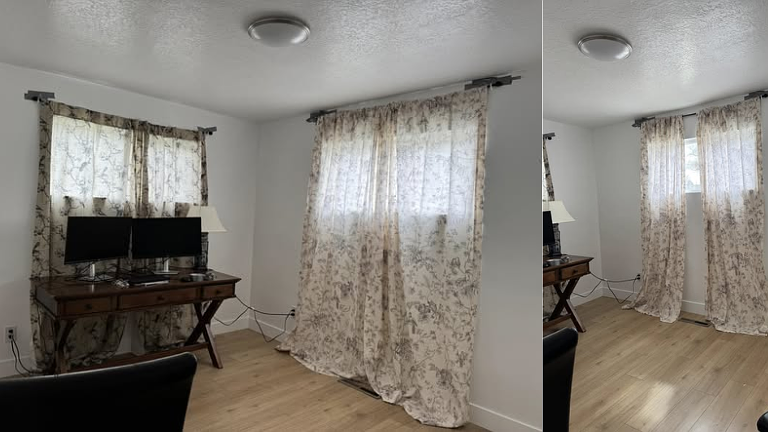
Once the rod has moved up, the old curtains will be too short. This is the part that catches people out. The standard curtain panel on the shelf is 84 inches long, and 84 inches was fine when the rod was sitting on the frame in an 8 foot room, but with the rod 5 inches higher the same curtain now stops 5 inches off the floor, and curtains that stop short look worse than the low rod did.
So measure from the new bracket height down to the floor before buying anything. In most 8 foot rooms it comes out at 94 to 96 inches. Buy the 96 inch panels. They can touch the floor, or be hemmed, or sit half an inch up if there is a robot vacuum going around under them.
- Two plain 96 inch panels in cotton or a linen type fabric: about $40 to $50 for the pair.
- Rod with middle bracket: about $25 to $30.
- Wall anchors: a couple of dollars.
Plain is better than patterned here. A patterned curtain on a small window makes the window the main thing in the room, and the whole reason for moving the rod was to make the wall look bigger.
Same Bulb In Every Socket
The light bulbs are the cheapest thing on the list and they make the biggest difference, so if only one thing gets done, it should be this one.
Look at the box the bulbs came in, or the writing on the bulb itself. There will be a number with a K after it. In a lot of living rooms that feel cold or washed out, the number is 4000K or 5000K. Those are the bulbs sold as daylight or bright white, and they usually got into the living room because someone bought a pack for the kitchen and used up the rest around the house. Under that kind of light a beige wall looks a bit green and a brown sofa looks gray.
For a living room the number to buy is 2700K, which is the old warm bulb color, and the same number should go in every single socket in the room, lamps included. Mixed bulbs are the real problem. One warm lamp in the corner and one cool bulb in the ceiling means two different colors of light in one room, and the room never looks right no matter what else gets changed.
A 6 pack of 2700K LED bulbs is about $15 to $20.
The Lamp Question
If the room only has one lamp, a plain floor lamp with a fabric shade is about $35 to $50. Do not spend money on the base, because the base ends up behind the sofa. The shade is what people see. Whether the lamp gets bought this weekend or next month depends on when the room is used. In a room that is only used in the evening, the lamp should come before the paint. In a room used mostly in the daytime, it can wait.
Either way, after dark the ceiling light goes off and the lamps go on. That costs nothing.
New Pillow Covers, Old Inserts
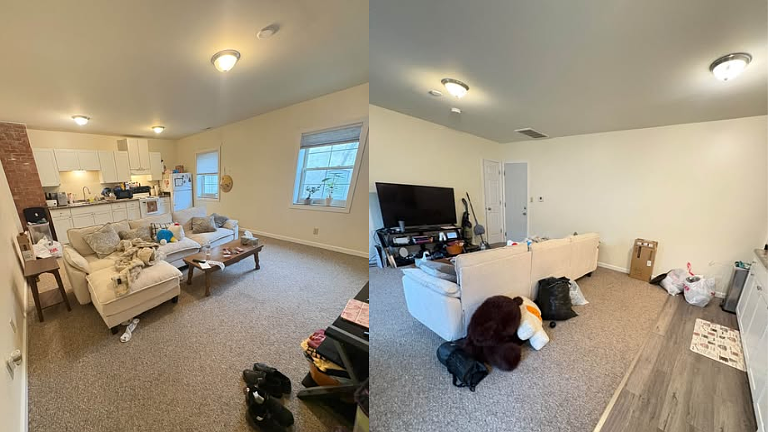
The sofa is not getting replaced on this budget and it does not need a slipcover either. A slipcover that fits properly costs about as much as everything else here put together, and a cheap one looks like a sheet over a couch. What people actually see when they look at a sofa is what is sitting on it, and in most living rooms that is the shiny pillows that came free with the sofa, a fleece throw from some winter, and the remote controls.
The pillow inserts are fine. Keep them. It is the covers that make the pillows look cheap, because the ones that come with a sofa are thin polyester with a shine on them, and the shine shows from across the room. Pillow covers on their own, in cotton or linen or a knit, are about $7 to $10 each, so four of them is about $30 to $40. Two colors across the four is enough, one plain and one with a bit of texture. If the inserts have gone flat, buy inserts that are 2 inches bigger than the covers, so a 20 inch insert goes into an 18 inch cover and the corners fill out.
The remotes go in a basket or a box on the side table. A sofa with nothing on the seat looks tidy even when the rest of the room is still half done.
The Blanket
The fleece throw draped over the arm of the sofa in a triangle was the thing to do around 2012 and it also slides onto the floor within an hour. A proper wool blanket, folded in thirds and laid flat along the back of the sofa or over one arm, is heavy enough to stay where it is put, and the plainer the color the better it looks. The reason it works where the throw does not is the weight. A blanket is made to bed size and a throw is the smaller decorative version, so a folded blanket has more body to it and holds a clean edge.
There is no blanket line in the budget because most houses already have a wool blanket in a closet somewhere. If yours does not, a good wool blanket costs more than the rod and the curtains together, so it is a separate purchase for a separate month.
Paint The Trim Or One Wall
There is enough money left for one can of paint, and it is either a gallon for one wall or a quart for the trim. Not both. Both can be done later.
One Wall
One gallon is more than enough to do the wall behind the sofa twice over, with paint left in the can for touch ups. Behr Premium Plus at Home Depot is about $20 to $40 a gallon depending on the finish. Benjamin Moore is more, around $58 for Regal Select, and it does cover a bit better. Add about $15 for a roller, a tray, a small angled brush and tape.
One thing about the wall. A dark gray wall behind the TV was the cheap trick around 2009 and it looks like 2009 now. If one wall is getting painted, keep it close to the color of the other three, a shade or two off, so it looks like the light is falling differently on that wall and not like a stripe. In a lot of small rooms all four walls in one calmer color would be better, but that is two gallons and a longer day, so it depends on the room and the time.
The Trim
If the baseboards and the door frames have gone yellow, which happens to any oil based white paint after 10 or 15 years, then the trim is the better buy. A quart of white semi gloss trim paint is about $20 and does a whole small room. Fresh white trim makes the walls next to it look cleaner than they are, because you judge the wall against the trim without really thinking about it. In a room where the walls are still an ok color and the woodwork is what has aged, do the trim and leave the walls.
The trim option also keeps the weekend under $200 with the lamp included. The gallon of wall paint plus the lamp pushes it a little over, so one of those two waits.
Leave The Rug For Now
The rug is the thing most people would buy first, and on $200 it is the wrong thing to buy. A rug that fits a small living room has the front legs of the sofa and the chairs sitting on it, and that means an 8 by 10 at the smallest. An 8 by 10 that is not a thin printed one starts at about $150 and goes up quickly. The 5 by 7 that fits in this budget ends up floating in the middle of the floor with nothing touching it, and a rug like that makes a small room look smaller than a bare floor would.
If the old rug is already too small, roll it up and put it in the garage. The floor looks bigger straight away. The right size can come later, when there is $150 or so set aside for it, and that is a separate month and a separate list. If money is tight across the board and not just for this room, these everyday habits for the rising cost of living do more over a year than any one room project does.
One last thing on the budget. A second window on the same wall doubles the curtain line and adds a second rod, which is around $70 more, and that is usually how a $200 room ends up a $300 room. Price the whole list first, before the first thing goes in the cart.

