



A common scene at a Medicare DME supplier in any US suburb. A family picks up a rollator for their mother on a Tuesday. The handle height has been adjusted to her wrist crease, with her elbow at the proper 15-to-20-degree bend. Her grip strength was tested the week before. A physical therapist ran a gait analysis and signed off. The HCPCS code on the paperwork (E0143, folding wheeled walker) is clean. The device fits her perfectly.
By Wednesday afternoon, it’s pushed into a corner of the living room and she’s gripping the wall on the way to the bathroom. The doorway is 27 inches. The rollator at it’s widest point is 28. Nobody measured the doorway.
This is the failure mode the family-facing articles don’t talk about. The cane-fitting tutorial, the rollator-versus-walker comparison, the standard “start with the doctor” advice: all of those focus on the body. The body assessment is usually fine. The home assessment is usually nonexistent. And buried in the actual Medicare coverage criteria is a line most families never see.
Medicare’s Coverage Criteria Already Include the Home
The Local Coverage Determination for manual wheelchair bases (LCD L33788) lists the general coverage criteria for a standard manual wheelchair. One of them, almost verbatim: the beneficiary’s home provides adequate access between rooms, maneuvering space and surfaces for use of the wheelchair.
That’s part of the medical necessity test. Not a recommendation, not a soft note. If the home doesn’t allow the device to work, the device fails the standard. The Walker LCD (L33791) frames it the same way: a walker is covered when the patient has a mobility deficit that impairs activities of daily living “in customary locations within the home”. The Mobility-Related Activities of Daily Living (MRADLs) Medicare keeps returning to are toileting, feeding, dressing, grooming and bathing in customary locations in the home. If a parent can’t get to the toilet because the device won’t fit through the bathroom doorway, the device isn’t doing it’s job and a clean reading of the LCD says it shouldn’t have been the device prescribed.
In practice almost no one applies this part of the standard until after the fact. The PT or OT doing the gait analysis sees the parent in a clinic. The DME supplier sends a delivery driver. The Medicare claim goes through. The home becomes something the family deals with afterwards, on their own, usually by trial and error.
Dimensions an old American House Almost Never has
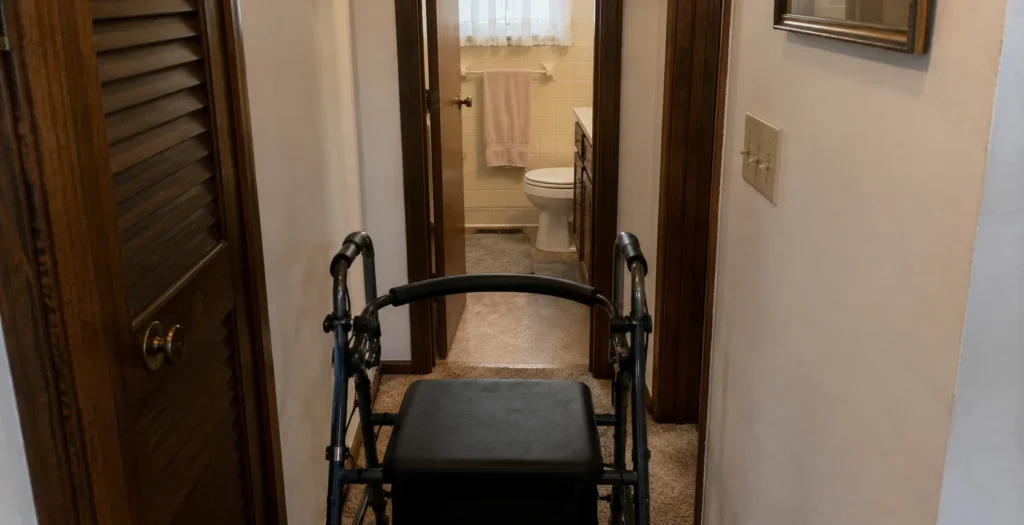
The ADA standards don’t legally apply to private residences, but they’re a useful reference for what a mobility device actually needs to function. The minimum clear width for a single wheelchair is 32 inches at a point and 36 inches continuously, a 180-degree turn requires a 60-inch diameter or T-shaped space and the minimum clear floor space for a stationary wheelchair is 30 by 48 inches. Walkers need at least 32 to 36 inches of clearance to navigate comfortably and thresholds higher than half an inch start to be a fall risk.
Now consider a typical American home built before 1990. Standard interior doors are 28 inches, bathroom doors are often narrower than that and only exterior doors hit 36 inches. A standard manual wheelchair has a 16 to 20 inch seat width with an overall width of 24 to 28 inches. The narrowest standard chair sits within an inch of a typical interior doorway. A typical bathroom door is too narrow for any of them. Hallways run 30 to 33 inches. The bathroom has no 60-inch turning circle anywhere in it.
That’s the gap. The clinical decision happens in a 36-square-foot exam room with linoleum and grab rails. The reality happens in a 1972 ranch house with carpeted thresholds, 28-inch doorways and a bathroom shaped like a closet.
Where to Insist on the Home Assessment
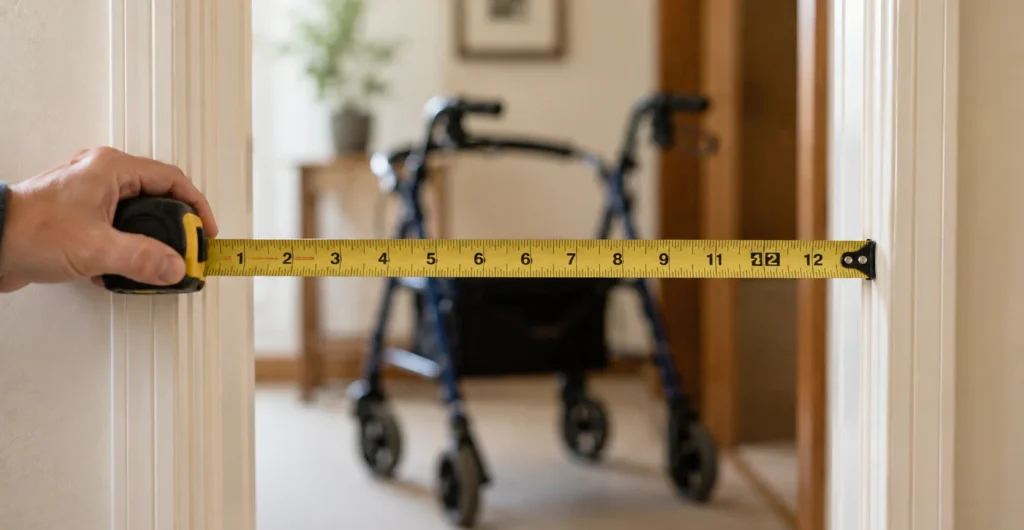
A genuine mobility assessment is supposed to cover both. Three things make sure it does.
When the PT or OT does the formal mobility evaluation, ask for a home visit to follow the clinic visit. This can be done by an occupational therapist as a separate appointment or by an Assistive Technology Professional (ATP) employed by the DME supplier. Medicare’s complex rehab supplier requirement is that the supplier employs at least one qualified ATP or Certified Rehabilitative Technology Supplier (CRTS) per location. For complex equipment like heavy-duty electric wheelchair, the LCMP evaluation has to document the home environment. For simpler equipment like walkers and canes, families have to ask for it specifically because it’s not built into the workflow.
Take a tape measure to the home before the DME appointment. Measure every interior doorway clear opening with the door at 90 degrees, the narrowest hallway point, the bathroom floor space, the threshold heights at the front door and any room transition and the turning radius at the toilet and shower.
Give the clinician and the supplier those numbers, not descriptions. A PT who hears “the bathroom door is 28 inches” will rule out a rollator and consider a narrow indoor cane or a transport chair (HCPCS E0137 or E0138). A PT who hears “the bathroom is small” will assume the room can be modified and the family ends up with a device that doesn’t fit.
The Device Hierarchy, With the Parts That get Glossed Over
Medicare uses a hierarchical approach: cane, then walker, then manual wheelchair, then power wheelchair, with each higher tier requiring documented justification that the lower tier won’t work. The descriptive part of this hierarchy is in every guide. The documentation part is what most families miss.
A cane suits mild balance issues or asymmetric leg weakness. Fit: standing in shoes, wrist crease meets the top of the cane, elbow bent 15 to 20 degrees. A poorly fit cane shifts posture and reduces what little support it offers.
A standard walker provides more stability but has to be lifted with each step, which suits someone who moves slowly and has the upper body strength for repeated lifting. A rollator is easier to push and includes a seat and brakes, but it rolls with the user, which is exactly the wrong characteristic for someone with serious balance loss.
The wheelchair tier is where documentation density jumps. A standard manual wheelchair (HCPCS K0001) requires the patient’s mobility limitation to be unresolvable with a cane or walker, plus a home that provides adequate access. A high-strength lightweight wheelchair (K0004) requires documented evidence the patient self-propels frequently in the home or needs nonstandard seat dimensions and spends at least two hours per day in the chair. Each step up requires more documentation, not just a prescription.
Power scooters (POVs) and power wheelchairs handle patients who can’t ambulate or self-propel. Group 2 power scooters with enhanced features designed for outside-the-home use are covered only when the basic criteria are met and the outdoor features are needed for school or employment; otherwise the outdoor features are treated as convenience and not covered. This is the “scooter for the mall” problem. Medicare won’t pay for it. Families do.
Where the Money Goes Wrong?
After the 2025 Part B deductible of $257, Medicare covers 80% of approved DME costs and the beneficiary pays 20% coinsurance, assuming the supplier accepts assignment. That’s the simple version of what families expect.
The version that costs money: in 2024, the improper payment rate for wheelchair options and accessories was 35.4%, with a projected improper payment amount of $106 million and 95.3% of those improper payments came from medical necessity documentation gaps. For walkers the improper payment rate was 14.3%. What that means in practice: the most common reason a claim is denied or clawed back is that the clinical record didn’t paint a strong enough picture of the patient’s mobility deficit and the home environment. Not that the family did anything wrong. Not that the supplier billed wrong. The documentation wasn’t tight enough.
This is why the supplier and clinician choices matter more than the device price comparison. A walker is a walker. The paperwork around the walker, including documentation that the home actually accommodates it, is what decides whether the family pays $50 or $400 for the same equipment.
The setup that ends with a parent moving from couch to bathroom without holding the wall is not the most advanced device available. It’s the one where the body assessment and the home assessment happened together, by people who know what Medicare’s coverage criteria actually require. A tape measure in the bathroom belongs in the medical workup, the same as a gait analysis. Both readings describe the same patient.