


Start with the one thing that actually matters before any of the rest of this, because it is the part people get wrong in the direction that hurts them. Most leg circulation symptoms build up slowly and give you time to book an ordinary appointment. A few arrive suddenly and are genuine emergencies, and the whole point of knowing the difference is so you do not sit at home googling while something time-sensitive gets worse.
So this piece works backward from the usual. The red flags come first, because they are the ones that cannot wait for you to finish reading. Then the slower patterns, what leg pain tends to mean versus swelling versus cold feet, and how the same symptom can point to completely different plumbing depending on the details around it.
I am not a doctor and this is not a diagnosis. It is a map for reading your own legs well enough to know how fast to move.
The Ones That Can’t Wait
Three situations belong in this section, and each one has a distinct feel.
- Sudden swelling in one leg. If a single leg swells over hours or a day, especially with a deep calf ache, warmth, and skin that reddens, that pattern can mean a deep vein thrombosis, a clot in a deep leg vein. It matters because a piece of that clot can break loose and travel to the lungs. Do not walk it off, do not wait a few days to see, and do not massage the leg. That is a same-day medical call.
- A leg that suddenly turns cold, pale and painful. When a limb goes abruptly cold, pale or bluish, and painful all at once, that can be acute limb ischemia, an artery blocked so completely that the tissue below it is starving right now. This is an emergency room situation measured in hours, not days, because the leg is on a clock.
- Any leg symptom paired with chest pain or breathlessness. Sudden shortness of breath, chest pain, or coughing that shows up alongside a swollen or painful leg can mean a clot has already reached the lungs. That is a call-emergency-services moment, not a wait-and-see one.
Now the Slower Story: What Each Symptom Tends to Mean
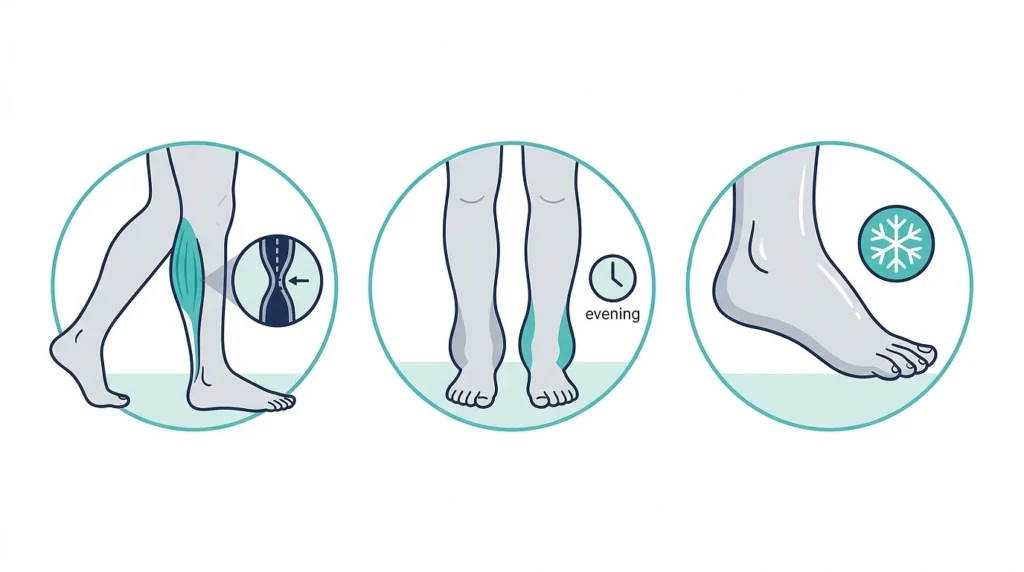
Most people reading this do not have an emergency. They have a symptom that has been nagging for weeks, and they want to know what it is pointing at. Here the trick is that leg pain relief, swelling and cold feet are not three separate conditions. They are three windows onto the same circulatory system, and which window you are looking through hints at which part is struggling.
Leg Pain That Comes With Walking
Does your calf, thigh or buttock cramp up predictably when you walk a certain distance, then ease off within a few minutes of standing still?
That specific pattern has a name, claudication, and it is the classic sign of peripheral artery disease, where narrowed arteries cannot deliver enough oxygen to the working muscle. The tell is the rhythm: pain on exertion, relief on rest, repeat at roughly the same distance each time. It is the muscle complaining that its supply line is too narrow for the demand.
There is a worse version worth naming plainly. When that arterial pain starts showing up at rest, often in the toes or foot, waking you at night, that has crossed into advanced territory and needs prompt vascular attention rather than a wait. Pain that used to only come with walking and now comes lying down is a sign the problem has progressed.
Swelling That Builds Through the Day
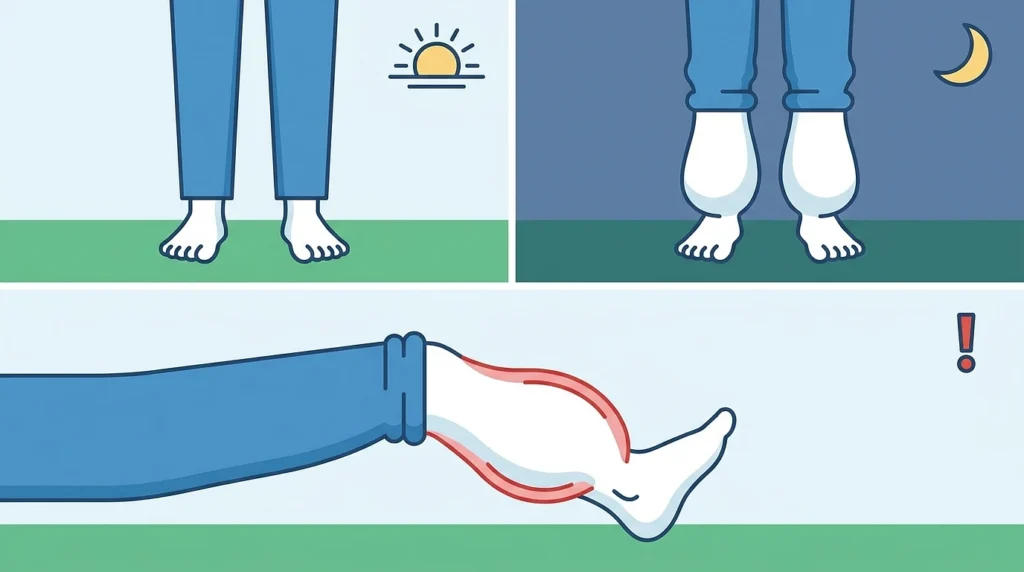
Swelling tells a different story, usually a venous one. When the veins struggle to pump blood back up out of the legs, fluid pools, and the classic pattern is puffiness that is mild in the morning and worse by evening, worse after long standing or sitting. Both legs are often involved. That points toward chronic venous insufficiency, the veins failing at the return trip rather than the arteries failing at delivery.
The reason the emergency section flagged one-sided swelling so hard is this exact contrast. Venous insufficiency swelling tends to be gradual and on both sides. A clot’s swelling tends to be sudden and on one side. Same symptom, opposite urgency, and the difference is in the timing and the symmetry.
Cold Feet and Skin That’s Changing
Cold feet get dismissed as just being cold, and often that is all it is. But feet or a lower leg that feel genuinely colder than the rest of you, even in a warm room, can signal restricted arterial flow, the same underlying issue as claudication seen from another angle.
Look at the skin nearby for the supporting evidence. Poor arterial circulation over time tends to leave shiny, hairless skin on the legs, slow-growing toenails, and a pale or bluish tint. Sores or scrapes on the feet that are slow to heal belong in this picture too, and they deserve real attention, because non-healing wounds are how small circulation problems turn into big ones.
The Distinction That Trips Everyone Up
Here is where two conditions get confused constantly, and the confusion is worth clearing because they need opposite responses.
Artery problems and vein problems can both cause leg pain, but they feel different. Arterial pain is cramping, comes with activity, eases with rest, and the limb runs cool and pale. Clot pain is more constant, arrives with swelling, and the limb runs warm and red. Cold and pale leans arterial; warm and swollen leans clot, and that single contrast sorts a large share of leg symptoms into the right lane.
Chart One: Reading the Pattern
| What you notice | Leans toward | The giveaway detail |
|---|---|---|
| Calf pain when walking, gone with rest | Peripheral artery disease | Predictable, exertion-linked, repeatable distance |
| Puffy legs worse by evening, both sides | Venous insufficiency | Gradual, symmetrical, standing makes it worse |
| One leg suddenly swollen, warm, aching | Possible clot (DVT) | Sudden, one-sided, warm and red |
| Foot or leg colder than the rest of you | Arterial restriction | Cold plus shiny, hairless, pale skin |
| Leg pain at rest, worse at night | Advanced arterial disease | Pain without activity is a progression sign |
Chart Two: How Fast to Move
| The situation | How urgent | What it usually means |
|---|---|---|
| Sudden one-sided swelling, warm, painful | Same day, do not wait | Possible DVT |
| Limb suddenly cold, pale, painful | Emergency, hours matter | Possible acute limb ischemia |
| Leg symptoms plus chest pain or breathlessness | Call emergency services | Possible clot reached the lungs |
| Cramping on walking, eased by rest, ongoing | Book an appointment soon | Likely PAD, treatable |
| Evening puffiness building over months | Routine appointment | Likely venous insufficiency |
| Slow-healing sore on foot or leg | Prompt, do not ignore | Poor circulation, infection risk |
What to Actually Do With This
If anything in the first section describes you right now, stop reading and make the call. That is the entire reason it went first.
If you recognized yourself in the slower patterns, the move is a real appointment rather than more searching, because these conditions are diagnosed with quick, often painless tests a vascular clinician does in the office, and most of them are very treatable when caught before complications set in. Bring specifics to that visit: which symptom, on which side, how long, what makes it better or worse, whether walking triggers it or rest does. Those details are exactly what separates one diagnosis from another, and you are the only person who can observe them over time.
One last honest note, since circulation problems tie into the rest of your health. Smoking, diabetes, high blood pressure and high cholesterol drive most of the artery side of this, and the same steps that protect your heart protect your legs. That overlap is not a coincidence. Your legs are often where the body shows a circulation problem first, which makes a nagging leg symptom less an annoyance to dismiss and more an early message worth reading, and worth taking to someone who can check it properly.
If any of this hits close to home and you are worried, the right next step is a conversation with a healthcare provider who can actually examine you, not a reassurance from an article. This is a topic where getting looked at early genuinely changes outcomes.

