


Sometimes your evening plans get broken by a stray elbow in a weekend football game, a sudden slip on a wet sidewalk, or an unlucky bite into an unpopped popcorn kernel. In just a moment, a dental crisis can turn your entire day upside down. The metallic taste of blood fills your mouth and your heart races as you suddenly realise you have an adult tooth that is loose, fractured or missing completely from its socket.
Unlike bones that can knit themselves back together over time, permanent adult teeth cannot heal themselves. The first reactions you have when dental trauma occurs determine the survival of that tooth. Your worst enemy is panic, your best asset is organised, educated action.
Knowing the individual steps of dental first aid bridges the important gap between an accident and medical intervention. Understanding how to save damaged oral structures in those initial moments greatly increases the chances that a specialist can restore your smile to its full form. This guide will show how prompt thought and quick use of first aid can prevent permanent loss of an adult tooth when confronted with a sudden dental emergency in Singapore.
The Clock Is Ticking: The Importance of Time in an Oral Emergency
When a permanent tooth is completely knocked out, a phenomenon that clinicians refer to as an avulsion, the biological clock immediately starts ticking. The periodontal ligament is a fine network of living tissue, fibres and blood vessels that attaches the root of the tooth to your jawbone. These living cells are still attached to the surface of the root, when the tooth is forced out by trauma. They can live outside the human body for an incredibly short window.
Clinical studies show that the chances for successful replantation of a knocked-out permanent tooth are greatest if it is repositioned by a professional within 30 to 60 minutes of the injury. Every minute after this golden hour reduces the viability of the cells drastically. If the cells on the root die, your jawbone will reject the tooth and you will lose the tooth permanently.
The tight deadline highlights the importance of knowing where to find a dedicated clinic for a dental emergency in Singapore. You can’t afford to spend hours trawling the web or waiting in a generic outpatient queue while the living tissues on your tooth die.
What To Do With A Knocked-Out Permanent Tooth
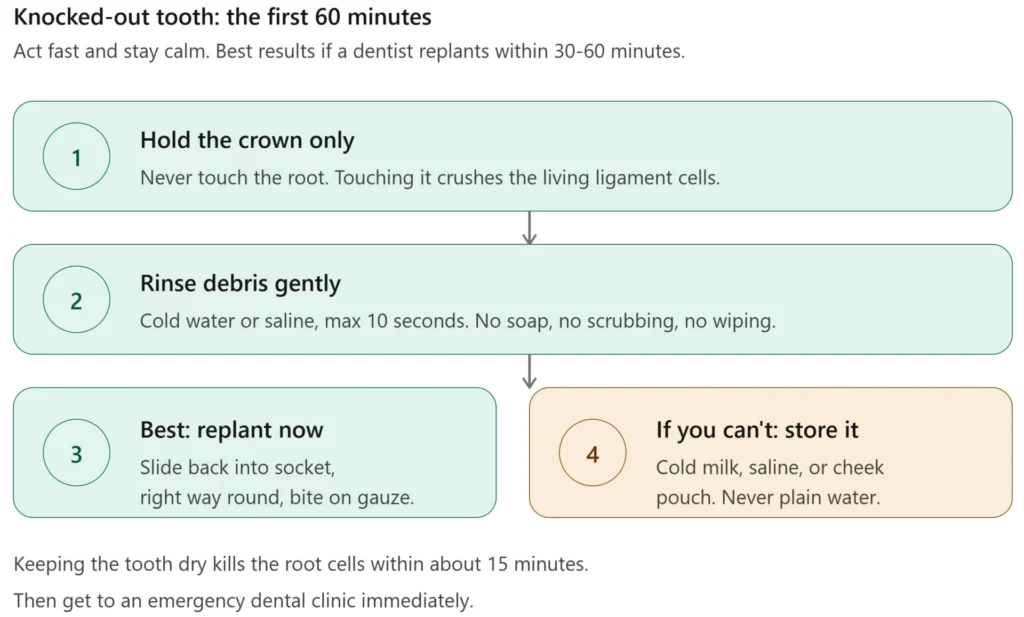
If a blow knocks a mature adult tooth clean out of its socket, there is a systematic, disciplined routine of first aid that gives the dentist the raw materials he needs to save the tooth.
The following structural workflow is derived from validated emergency medical standards for maximised cellular preservation.
Step 1: Crown by Itself
Find the tooth right away. When you pick it up, only touch the crown, the chewing surface you normally see in your mouth. Never touch, scratch or grab the root. The root is covered by the aforementioned microscopic periodontal ligament cells. If the root is grabbed these cells are crushed and any chance of successful reattachment is lost in an instant.
Step 2: Carefully Remove Debris
If the tooth fell on the ground and picked up dirt or grit, rinse it gently under a stream of cold tap water or sterile saline solution for no more than 10 seconds.
- Do not use soap, alcohol or chemical disinfectants.
- Don’t wipe the tooth with a cloth, tissue or brush.
- Do not strip off any tissue fragments attached to the root surface.
Step 3: Try Immediate Replantation
If the patient is conscious and alert, the best medium to store the knocked-out tooth in is the socket. Carefully slide the clean tooth into the empty space, making sure it is facing the right way. Have the patient place a clean piece of gauze or a moist tea bag between the teeth and bite down gently to keep it in place. This immediate replacement keeps the periodontal fibres alive and insulated in their natural environment.
Step 4: Application of Advanced Liquid Preservation Media
If you cannot re-insert the tooth due to severe pain, swelling or risk of the patient swallowing it, you MUST place it in an appropriate liquid medium immediately. Keeping the tooth dry kills the cells in the root within 15 minutes as they dry up and die.
Emergency storage options include:
- Cold Fresh Milk: Whole milk has a neutral pH and some proteins to keep root cells alive an hour or two.
- Saline Solution: sterile saline is a good mimic of body fluids.
- Saliva: If nothing is available, place the tooth in the patient’s cheek pouch (if the patient is old enough not to swallow it).
- Never store in plain water: Do not keep a knocked-out tooth in plain water. Tap water is hypotonic and causes water to flow into the delicate root cells until they swell and burst .
Treatment for Other Severe Dental Injuries
Not all oral trauma results in clean avulsions. Severe fractures, structural displacements and soft tissue lacerations all have their own unique hazards requiring their own targeted first aid management.
Fractured, Chipped or Severely Cracked Teeth
A large fracture exposes the dentin and the highly sensitive pulp chamber in the center of the tooth. If you have a serious break, rinse your mouth with warm water to clear away any debris and small fragments. Collect any pieces of broken teeth and put them in milk or saline because if they are modern bonding methods, your specialist might be able to glue the original segments back onto the bottom of the tooth.
To help reduce localised swelling and numb the throbbing pain, use a cold compress on your outer cheek or lip. If the remaining tooth stub has a razor sharp edge that cuts your tongue or the inside of your cheek, temporarily seal it off with some sterile dental wax or sugarless chewing gum until you can get to a specialist clinic.
Luxation: Partially dislodged teeth out of alignment
Sometimes an impact will move a tooth sideways or drive the tooth deeper into the jaw, or pull it partially out of the socket without actually falling out. This displacement is known as a luxation injury.
Do not try to force a tooth that is out of line back into place by pulling, pushing or twisting it yourself. This is probably going to cause the other blood vessels feeding the pulp to snap. Do not touch or chew the tooth. Do not leave the tooth in the socket. Leave the tooth as is and go to a professional immediately to be assessed.
Soft tissue lacerations and uncontrolled haemorrhage from the mouth
The facial region contains a large number of blood vessels and heavy bleeding can occur from injuries to the lips, tongue, cheeks and gums. To stop the bleeding:
Flush with a weak salt-water solution to find the origin of the cut.
Apply direct pressure with a clean moistened sterile gauze pad or a caffeinated tea bag for 15 to 20 minutes. The tannins in tea are natural and they act as a mild vasoconstrictor to constrict the local blood vessels and stop the bleeding.
Sit up and lean forward slightly to keep from swallowing blood, which often causes nausea and vomiting.
Selecting a Suitable Clinic for a Dental Emergency in Singapore
General medical doctors or generic accident wards are often not well equipped to deal with complex tooth restoration in cases of severe oral trauma. In order to save a compromised permanent tooth, the facility needs to have special endodontic and maxillo-facial trauma infrastructure.
Singapore has a very developed medical network but it is important to select a clinic that has a comprehensive multidisciplinary approach to emergency diagnostics. Providers like Nuffield Dental have dedicated emergency dental pathways with experienced clinicians who can manage complex avulsions, root fractures and immediate splinting procedures.
They have several strategically positioned clinics on the island, and use high definition digital radiography and advanced splinting matrices to immediately stabilise loose or replanted teeth. With access to a fully equipped facility, you receive advanced root canal monitoring, structural stabilisation and surgical care under one roof, preventing permanent adult teeth loss.
Essential Things to Avoid in a Dental Emergency
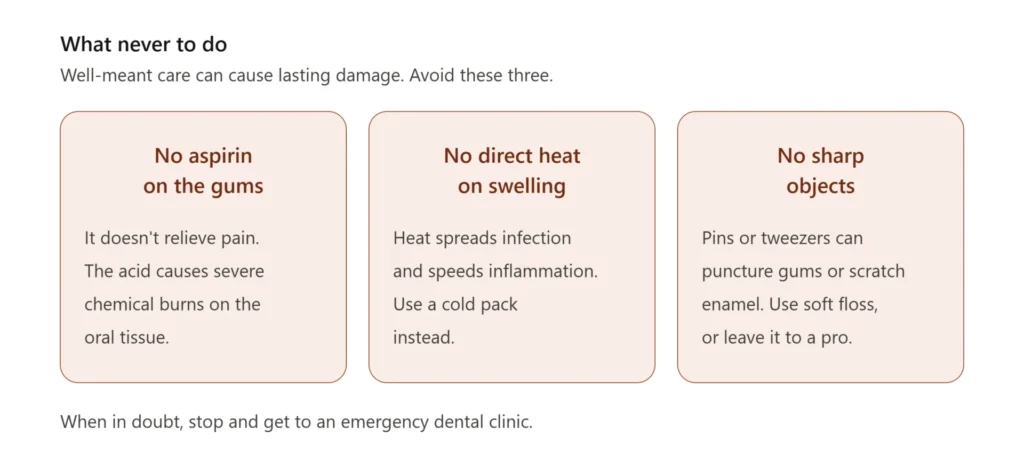
Knowing what not to do is as important as doing proper first aid procedures. Well-intentioned care can destroy long-term structural viability through missteps.
- Never Put Aspirin In Right on the Gums: No, placing an aspirin tablet on the gum tissue next to a sore or broken tooth does not provide localised relief. Instead the acid level of acetylsalicylic acid is so high it causes severe chemical burns on your sensitive oral mucosa that makes your eventual recovery more difficult.
- Do Not Use Direct Heat: Never place a hot water bottle or heating pad on your face if you have severe facial swelling. Heat causes blood vessels to expand and the inflammatory response to accelerate, and can cause dental infections or abscesses to spread much more rapidly through the facial tissues. Always use cold packs.
- Don’t Use Sharp Objects at Home: If something gets stuck painfully between your teeth from an accident, don’t use pins, needles or metal tweezers to get it out. You may puncture the gums or permanently scratch your protective tooth enamel. If the object remains stuck, leave it to a professional. Use only soft dental floss.
Prevention and Proactive Protection Strategies
The best dental first aid is to prevent trauma before it ever happens. Accidents are unpredictable by nature but there are certain situations where the risk is high and accidents can be prevented.
If you or your children play contact sports such as rugby, basketball, martial arts or cycling then a custom made mouthguard from your dentist is the ultimate protection. A custom guard is moulded specifically to your unique dental arch, and not the generic over-the-counter “boil-and-bite” options. It distributes the mechanical force of a direct blow over your entire jaw bone, reducing the chances of crown fractures, concussions and tooth avulsions by more than 90 percent.
Similarly, regular dental checkups allow your clinician to identify micro-fractures, structural issues or big, ageing fillings that are structurally compromised. Catching these quiet vulnerabilities early on helps to make sure your teeth can handle the mechanical stresses of daily life without breaking apart unexpectedly.
Strategic Summary for Long-Term Oral Conservation
The ultimate outcome of an unforeseen blow, which menaces dental health, hinges entirely on the implementation of prompt and disciplined first aid. Treating an oral injury as a real medical emergency, protecting the delicate root surface of an avulsed tooth, using proper liquid preservation storage and avoiding common mistakes such as applying direct heat or scrubbing tissue fragments protects the living elements of your smile.
Equally important is an understanding of your local healthcare system so that you can move quickly from simple first aid to advanced clinical care. By remaining calm, systematic and acting quickly to get professional help, a temporary accident will not result in the permanent loss of an adult tooth.
FAQs
What is considered an urgent dental emergency in Singapore?
An immediate emergency situation includes severe, uncontrolled pain, rapid swelling of the face or jaw, bleeding from the mouth that cannot be stopped, a permanent tooth that has been knocked out completely or a fractured jaw. These conditions need prompt assessment to halt infections and preserve structural tissues.
Can a dentist put back a tooth that has been knocked out after a few hours?
The odds drop significantly after the first 60 minutes, but sometimes the tooth can be saved if it has been kept continuously moist in a suitable preservation fluid like cold milk. The dentist will check the condition of the root to see if splinting is possible.
I have a cracked tooth and I’m not in pain, should I see a dentist?
Yes. A deep crack will weaken the internal structure of the tooth and allow oral bacteria access to the inner pulp chamber, even if you do not experience immediate pain. An assessment within 24-48 hours to prevent silent decay and future root infections.
What if a dental crown or filling pops off unexpectedly?
Gently clean the crown and then put a small dab of over-the-counter temporary dental cement or sugar-free chewing gum on the inside of the crown and slide it back over the exposed tooth stub as a temporary protective covering. Do not use regular household glues. Make an appointment for a proper dental appointment immediately.
Is there any subsidy for emergency dental procedures in Singapore?
Medisave accounts can be used to pay for certain surgical dental procedures, such as wisdom tooth extraction, dental implant placement or surgical removal of impacted teeth. Standard non-surgical treatments such as fillings, root canals and the fabrication of crowns are generally not covered under MediSave claims.

