


Go to an emergency room now, not tomorrow, if you have any of these:
- Numbness in the saddle area. The parts that would touch a bicycle seat. Inner thighs, buttocks, groin.
- Sudden trouble urinating. Especially the inability to go despite a full bladder, or not feeling the urge at all.
- New loss of bowel control, or losing the sensation that tells you you need to go.
- Weakness in both legs at once, particularly if it’s getting worse by the hour rather than by the week.
- A foot you can’t lift, or a leg that’s rapidly losing strength.
That cluster can signal cauda equina syndrome, compression of the nerve bundle at the base of the spine, and it is one of the few true surgical emergencies in spine care. The window that matters is measured in hours, with roughly 48 hours cited as the period where decompression gives the best odds of full recovery. Everything else in this article is about a slow, considered decision. That list is the exception. Nothing below applies if you’re reading it with those symptoms.
Leg Pain And Back Pain Are Two Different Problems Wearing The Same X-Ray
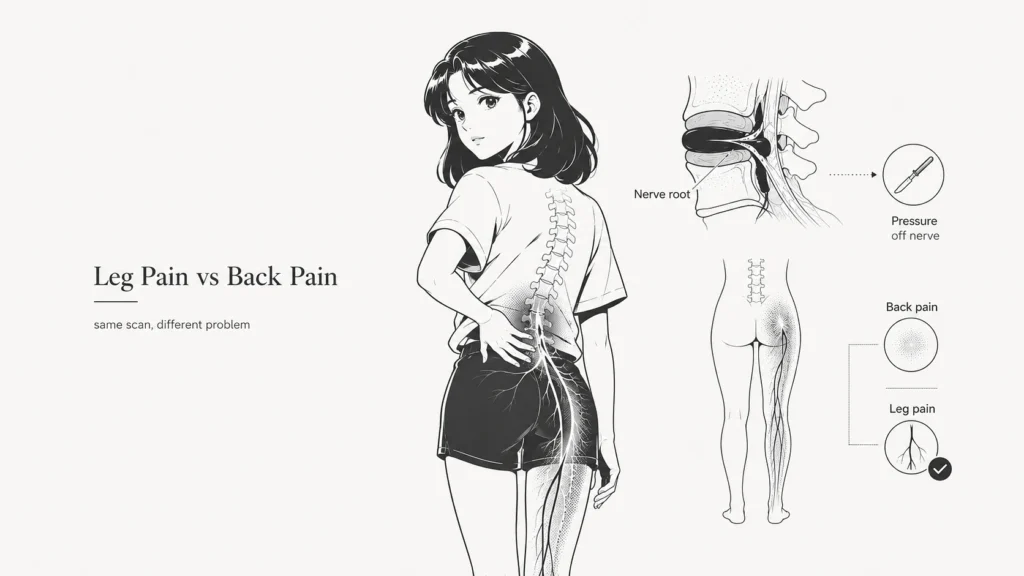
This is the single most useful thing to understand before any surgical conversation, and it explains why two people with nearly identical scans get completely different advice.
A herniated disc causes trouble in two separate ways. The displaced disc material can press on and inflame a nerve root, which sends pain, numbness, or weakness down the leg along that nerve’s path. That’s radicular pain, what most people call sciatica, and it has a clear mechanical cause with a clear mechanical fix. Take the pressure off the nerve, the nerve settles down.
Back pain is a different animal. It comes from the disc itself, the surrounding joints injury, the muscles, the ligaments, and a nervous system that’s often been irritated for a long time. There’s no single structure to remove. So when a surgeon performs a microdiscectomy, they’re clearing material off a nerve root. They are not repairing your back.
That mismatch is where most surgical disappointment comes from. Someone with 80% leg pain and 20% back pain tends to walk out of surgery thrilled. Someone with 80% back pain and a herniated disc that happens to show on imaging often gets a technically perfect operation and feels roughly the same afterward, because the operation addressed a problem that wasn’t their main problem. Any surgeon worth seeing will ask you to separate the two before they ever discuss a date, and if nobody has asked you which pain is worse, that’s a question to raise yourself.
Why Six Weeks, And What The Disc Does While You Wait
The standard advice is to give conservative care about six weeks before considering surgery for a disc herniation, and that number isn’t arbitrary or an insurance invention. It exists because of what herniated discs do on their own, which is one of the more surprising findings in spine medicine.
They shrink. Your immune system treats displaced disc material as something foreign, sends in macrophages, and gradually breaks it down. A systematic review published in Clinical Rehabilitation quantified how often this happens, and the pattern runs against every intuition a patient has when they see their own MRI:
| Herniation type | Rate of spontaneous regression |
|---|---|
| Sequestration (fragment fully separated) | 96% |
| Extrusion (material pushed through the outer wall) | 70% |
| Protrusion (bulge with the wall intact) | 41% |
| Disc bulge | 13% |
Read that column twice. The worse the herniation looks, the more likely it is to disappear on its own. The big scary sequestered fragment your scan report described in alarming language is the one with a 96% chance of regressing, while the modest-looking bulge is the one least likely to change. Complete resolution occurred in 43% of sequestered discs and 15% of extruded ones.
So the six-week wait is not doctors stalling. It’s giving a genuinely self-resolving condition a chance to resolve itself, while symptoms are managed with medication, physical therapy, activity modification, and sometimes an epidural steroid injection. Most people improve in that window. Surgery gets considered for the meaningful minority who don’t, generally cited somewhere in the range of 10% to 40% of symptomatic herniations that fail conservative care.
Two caveats keep this honest. Six weeks is a guideline, not a law, and severe unrelenting leg pain or progressive weakness can shorten it. And “conservative care” has to mean actual care. Six weeks of doing nothing while hoping isn’t a trial of treatment, it’s just six weeks.
What The Biggest Trial Actually Found, Including The Messy Part
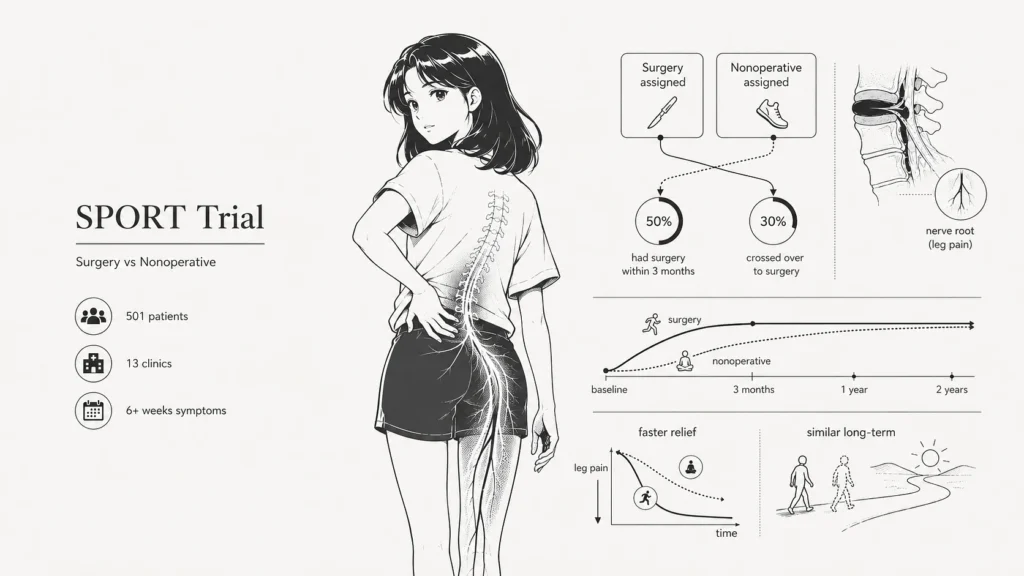
The reference study here is SPORT, the Spine Patient Outcomes Research Trial, published in JAMA in 2006. It randomized 501 patients across 13 spine clinics in 11 states, all with imaging-confirmed lumbar disc herniation and radiculopathy symptoms lasting at least six weeks, to standard open discectomy or individualized nonoperative care.
Here’s where it gets interesting, and where most summaries of this trial oversimplify. Adherence fell apart. Only 50% of patients assigned to surgery had surgery within three months, while 30% of those assigned to nonoperative care crossed over and got operated on anyway. People in severe pain do not stay in their assigned group for the sake of clean data, which is completely understandable and statistically ruinous.
The result was that the strict intent-to-treat analysis showed both groups improving substantially with no significant difference between them, while the as-treated analysis favored surgery. Both readings are legitimate, and the honest interpretation sits between them: surgery works, particularly for leg pain, and it mainly buys you faster relief rather than a better destination. The four and eight-year follow-ups found carefully selected surgical patients maintained greater improvement, with little degradation in either group over time.
The practical translation is worth stating plainly. If your leg pain is severe and you want it gone sooner, surgery has real evidence behind it. If you can tolerate the pain and it’s slowly improving, waiting is a defensible choice that often lands you in a similar place eventually. That’s a values decision as much as a medical one, which is exactly why it belongs in a conversation with a spine specialist who knows your specific symptoms rather than being settled by a scan.
Two Things People Get Wrong About The MRI
- The scan does not decide. Disc herniations show up on the MRIs of plenty of people with no symptoms whatsoever. A finding on imaging only matters when it correlates with your actual pain pattern, your neurological exam, and the nerve root that should logically be affected. Treating the picture instead of the patient is how people end up with surgery they didn’t need.
- A bad-looking scan is not an urgent scan. Given the resorption data above, dramatic imaging with improving symptoms is often the best combination there is. Improving symptoms outrank scary pictures nearly every time.
The frustrating truth underneath all of this is that spine care has an incentive problem, and patients arriving in pain with an alarming MRI are the easiest people in medicine to talk into an operation. The protection against that isn’t distrust of surgeons, most of whom are careful. It’s knowing which questions make the decision clear: Is my pain mostly leg or mostly back? Has conservative care actually been tried? What does this specific surgery fix, and what does it leave alone? Ask those three, and the right answer usually announces itself.

