


Aisles can eat up to 60% of the floor in a conventionally racked warehouse, which is the single largest piece of unproductive real estate most operations own. Mobile racking puts entire rack bays on motorized carriages running along floor rails, collapses all those aisles into one that opens where you need it, and typically lifts storage capacity somewhere between 80 and 120% inside the same building. It also costs roughly three to five times more per pallet position than selective racking, and it caps your throughput because only one aisle is open at a time. Adoption is climbing anyway, and the reason has almost nothing to do with the racking itself. Cold storage now runs $130 to $350 per square foot to build against roughly $85 to $150 for dry, and when a square foot gets that expensive, paying a premium to avoid buying more of them starts to make sense.
I have walked through more racking proposals than I care to count, and the thing that gets me every time is how vendors lead with the density number and go quiet on the throughput number. Both matter. Which one matters more depends entirely on what your building is doing, so here is the honest breakdown.
Aisles Against Pallets
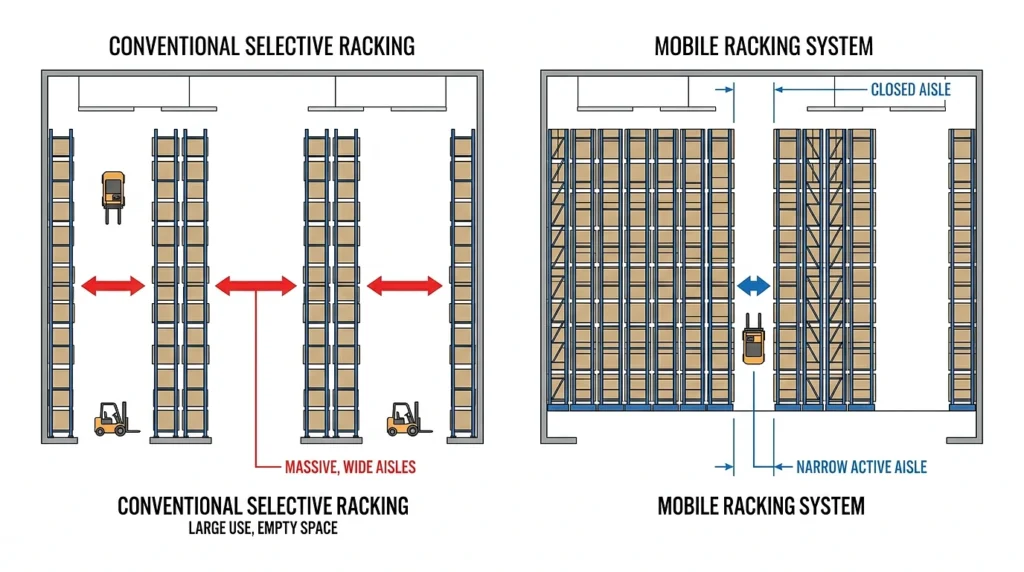
Start with what you are actually buying when you buy conventional racking, because it clarifies everything downstream.
In a selective racking layout, every pallet is directly accessible, which is genuinely valuable. The price of that access is aisle width for forklifts on both sides of every run. Add it up across a building and access aisles can occupy as much as 60% of warehouse floor space, which means well over half your rent, your heating, your cooling and your insurance is being spent on empty lanes so a forklift can drive somewhere.
Mobile racking attacks exactly that. The rack bays sit on powered carriages that ride floor mounted rails, and the whole block sits compressed until an operator opens the one aisle they need, either from a control panel or remotely from the forklift so it is already open when they arrive.
What you get back is most of that 60%. Published figures put the capacity gain at 80 to 120% over conventional pallet racking, and one documented installation reported a 41% capacity increase alongside a 22% efficiency improvement.
The part I find genuinely satisfying about this system is that nothing clever is happening. You are not automating anything or adding software. You are just refusing to pay for aisles you use a few minutes a day.
Capital Cost Against Rent
Here is where most conversations about mobile racking go sideways, because people compare the wrong two numbers.
Mobile racking is expensive. It runs three to five times more per pallet position than standard selective rack once you account for the carriages, the rail system, the electrical work and a considerably more involved installation. Anybody telling you otherwise is leaving something off the quote.
What A Square Foot Actually Costs You Now
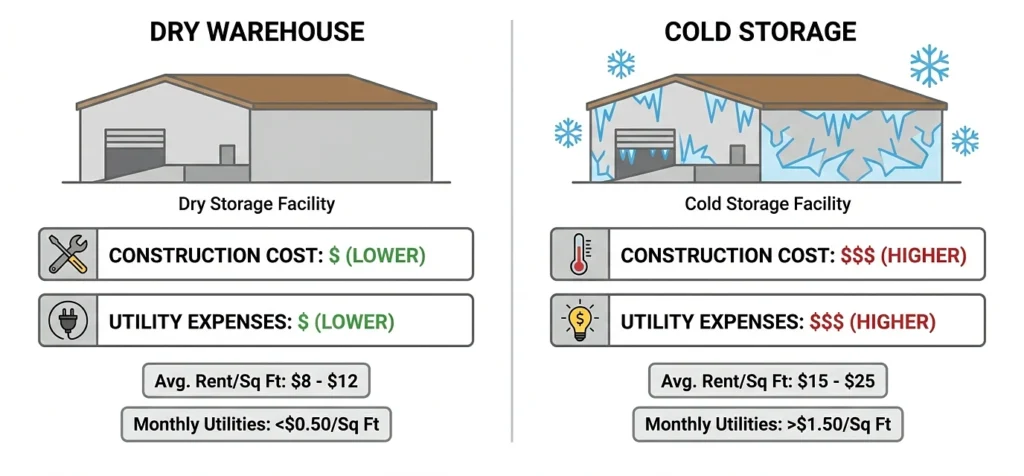
That number only means something next to the price of the space it saves. And that is the shift driving adoption, because square feet got expensive:
- Dry warehouse construction now runs roughly $85 to $150 per square foot for shell plus basic mechanical, electrical and plumbing.
- Cold storage construction sits at $130 to $350 or more per square foot, two to three times the dry equivalent, driven by insulation, refrigeration systems and reinforced floors.
- Refrigerated space commands around $12 to $15 per square foot in rent against $8 to $10 for ambient, and Los Angeles triple net cold storage rents run $28 to $32.
- Electricity alone for a 10,000 square foot cold storage facility lands somewhere around $8,000 to $12,000 a month.
Run those against each other and the arithmetic flips. One case study cited construction and racking coming to $1,493 per pallet position with mobile racking against $2,000 per position for a conventional footprint, a 45% saving despite the racking itself costing far more. The building you did not have to build is where the money went.
Typical payback in cold storage and other high cost environments lands in the two to four year range, and that is the number worth asking a vendor to show you their working on.
Density Against Throughput
Now the trade-off that gets buried in the sales deck, and the one that makes me irritable.
Only one aisle in a mobile block is open at a time. That is the whole mechanism. It also means that when two operators need pallets from opposite ends of the same block, one of them waits, and moving a rack run takes time even on a well maintained system.
For a slow moving operation this is nothing. For a facility running heavy picks per hour across many locations, it is a hard ceiling that no amount of layout tuning removes.
Where It Fits And Where It Does Not
The fit is fairly predictable once you say it plainly.
- Good fit: buffer storage, seasonal inventory, high SKU counts with low velocity per SKU, and cold storage where the space premium is severe enough to justify slower access.
- Poor fit: high velocity fulfillment, cross docking, and anything where several operators need simultaneous access to the same block.
How It Compares To The Other Dense Options
Worth putting next to the alternatives while you are choosing, because mobile is not the only way to get density.
| System | Density gain | Access | Rotation |
|---|---|---|---|
| Selective | Baseline | Full, every pallet | FIFO friendly |
| Drive-in | Up to 75% more than selective | Low, no random access | LIFO |
| Push-back | Two to six pallets deep | Moderate | LIFO |
| Mobile | 80 to 120% more | Full selectivity retained | FIFO friendly |
That last row is the whole argument. Mobile racking is the dense option that keeps full selectivity, and that combination is why it keeps winning specification battles it used to lose on price.
Cooled Air Against Cooled Product
This is the part that explains why cold storage is where mobile racking took off first, and the mechanism is simple enough that it took me embarrassingly long to think about properly.
A refrigeration system is not cooling your pallets. It is cooling a volume of air, and your pallets happen to be sitting in it. Every cubic foot of open aisle in a freezer is being chilled to minus ten Fahrenheit and holding nothing.
Compress the aisles and you shrink the volume that needs conditioning. Reported cooling cost reductions for mobile installations run 40 to 50%, with some vendors claiming up to 60% versus static racking.
Apply that to a facility spending ten thousand a month on refrigeration and you are looking at meaningful annual savings on the energy line alone, running alongside the space savings rather than instead of them. That stacking effect is why payback works so much faster in cold storage than in ambient.
Refrigerated warehousing is also projected to grow at close to a 10% compound annual rate through 2031 as pharmaceutical cold chain requirements and grocery e-commerce keep expanding, so this is not a niche that is about to shrink.
The Floor Underneath All Of It
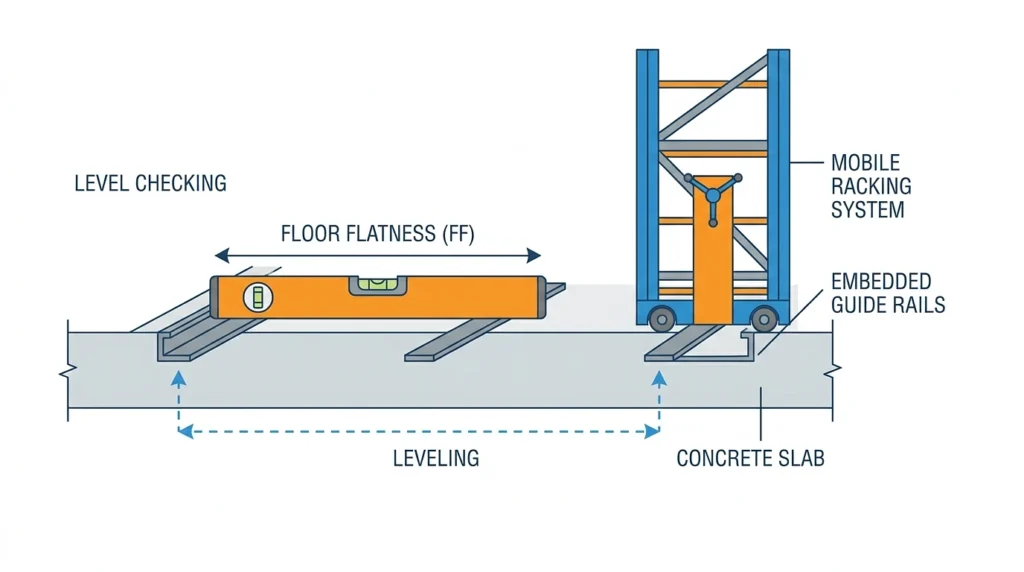
One practical thing that never makes the brochure and kills more projects than cost does.
Mobile racking runs on rails embedded in or fixed to your slab, and rails need a floor that is flat and level within tight tolerance across the entire run. Existing slabs frequently are not, particularly in older buildings, and remediation is not cheap.
A few things worth knowing before anybody quotes you:
- Installation takes longer than people plan for, with complex configurations like mobile and pallet flow needing extra time for precise alignment on top of the one to three weeks a mid sized facility already runs.
- You now own motors, drives, control systems and safety sensors that a static rack does not have, so there is an annual maintenance line that did not exist before.
- A proposal that does not mention floor flatness is a proposal from someone who has not looked at your building.
None of that is a reason to avoid the system. It is a reason to get the slab surveyed early.
Where I Would Actually Start
Pull your own numbers before you talk to anybody, because two figures decide most of this.
First, work out your fully loaded cost per square foot, meaning rent or amortized construction, plus energy, plus insurance and maintenance. Then count how much of your floor is currently aisle. If you are in ambient storage at eight dollars a square foot with modest energy costs, conventional racking probably still wins and the mobile premium will not come back to you fast enough. If you are in cold storage paying two to three times dry construction, plus refrigeration on every cubic foot of empty aisle, the case builds itself.
Second, be honest about throughput, and I mean genuinely honest rather than optimistic. Count picks per hour at peak, not average, and think about how many operators need to be in the same block at once. That single question has sunk more mobile racking installations than any cost overrun.
When you do get a proposal, three questions separate a real vendor from a salesperson:
- Show me the payback calculation with the assumptions visible.
- What did the floor survey find, and what does remediation cost if anything.
- What does the annual maintenance contract run.
A vendor who answers those clearly is worth talking to. One who keeps steering back to the density percentage is selling you a number rather than a system.

