


Plans that promise lasting health usually fail for a reason that has very little to do with willpower. They measure the wrong things. Someone will weigh their oats to the gram and then go to bed at a different hour every night of the week, or spend $80 a month on a supplement stack while never picking up anything heavier than a grocery bag.
The variables that actually show up in long term outcome research are unglamorous and there are only about five of them. None of them require a subscription. Most of them are free and slightly boring, which is exactly why they get skipped over in favour of whatever is trending.
Sleep Regularity Beats Sleep Duration In The Mortality Data

This one reorders how most people think about sleep. Windred and colleagues published a study in the journal SLEEP in 2024 using more than 10 million hours of accelerometer data from 60,977 UK Biobank participants, and they found that how consistent your sleep and wake times are predicted all cause mortality more strongly than how many hours you slept.
The gap between the most regular sleepers and the least regular ones was large. Across the top four groups compared with the least consistent group, all cause mortality risk was 20 to 48 percent lower, with similar patterns for cancer and cardiometabolic deaths. The authors made a practical point about it too, that asking people to keep similar sleep times day to day is probably an easier ask than telling them to carve out more hours in bed.
So the person getting a solid seven hours but at 11pm on weekdays and 3am on weekends is not doing as well as they think. Timing drift is doing damage that the hours total hides.
Fixing Regularity Without Rebuilding Your Whole Schedule
- Anchor the wake time first and let bedtime follow, because you control when the alarm goes off and you do not control when sleep arrives.
- Keep weekend wake time inside about an hour of the weekday one rather than sleeping in to catch up.
- Treat naps as part of the pattern, since the regularity score used in that research counts fragmented sleep and napping as irregularity.
- Move light exposure earlier in the day and dim it after dark, which shifts the timing without adding another rule to your evening.
The 10,000 Step Figure Was A Marketing Number
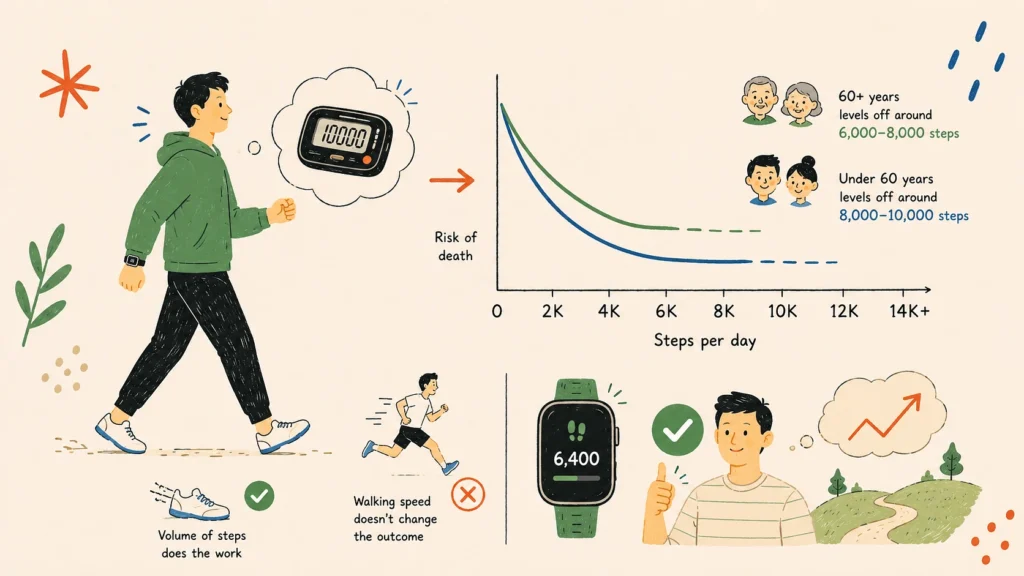
That target traces back to the name of a Japanese pedometer sold in the 1960s, not to a trial. The evidence points somewhere lower and it lands differently depending on age.
Paluch and the Steps for health and wellness Collaborative pooled 15 international cohorts covering 47,471 adults for a 2022 Lancet Public Health meta analysis. Risk of death dropped as steps rose, then flattened out. For adults aged 60 and over the curve levelled around 6,000 to 8,000 steps per day. For adults under 60 it levelled around 8,000 to 10,000. Compared with the least active quartile, the three more active groups showed roughly 40 to 53 percent lower mortality risk.
Walking speed did not carry the effect the way people assume. The volume of stepping did most of the work.
If you have been staring at a tracker that says 6,400 and feeling like the day was a write off, it was not. You were already inside the range where the benefit stops climbing steeply.
The Fiber Gap Is The Biggest Single Hole In The Average Diet
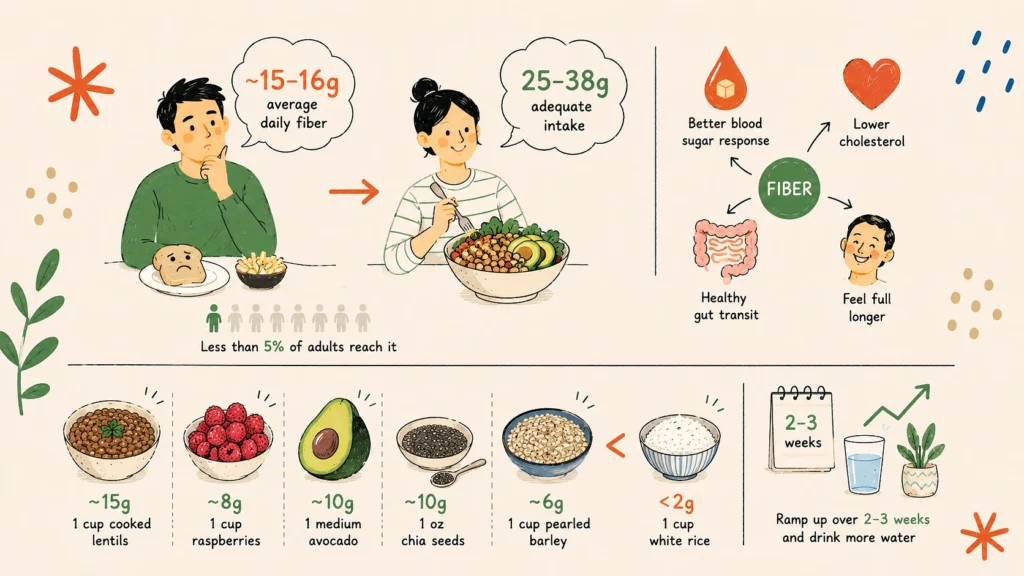
Adults in the United States average somewhere around 15 to 16 grams of fiber a day. The adequate intake sits at 25 to 38 grams depending on age and sex, and less than 5 percent of most age and sex groups actually reach it. That is not a marginal shortfall, it is roughly half.
Closing it does several things at once, which is unusual. Fiber affects blood sugar response, cholesterol, gut transit and how full you feel after eating, so the same change shows up across four different measures people normally chase separately.
Practical amounts, so this is not vague advice:
- One cup of cooked lentils gives you about 15 grams, which is a full day’s average intake in one bowl.
- A cup of raspberries carries roughly 8 grams.
- A medium avocado runs around 10 grams.
- Chia seeds sit near 10 grams per ounce.
- Pearled barley gives about 6 grams a cup, against under 2 grams for white rice.
Ramp it up over two or three weeks rather than in one day, and drink more water alongside it, or the first few days will be unpleasant enough that you quit.
Muscle Is The One Asset You Cannot Buy Back Later
Everything else on this list can be repaired reasonably fast. Sleep timing can be pulled back into shape inside a fortnight. Fiber responds to a single grocery trip. Muscle does not work like that, because it accumulates and disappears slowly, and the losses start decades before anyone notices them.
Strength is also what decides whether the last stretch of your life is independent or supervised. Grip strength keeps turning up in longevity research as a proxy for something broader, and the reason it works as a proxy is that it reflects total muscle and the nervous system’s ability to use it. Nobody loses their independence because their cholesterol was mildly elevated. They lose it because they fell, or because getting off the floor became impossible.
The dose that matters here is smaller than gym marketing suggests. Two sessions a week covering the main movement patterns, pushing, pulling, squatting, hinging and carrying something heavy, is enough to hold the line and enough to build for most people who have never trained. What it is not is optional, and treating cardio as a substitute for it does not work because the two adaptations are separate.
Plans Collapse In Week Three Because They Are Built For A Perfect Week
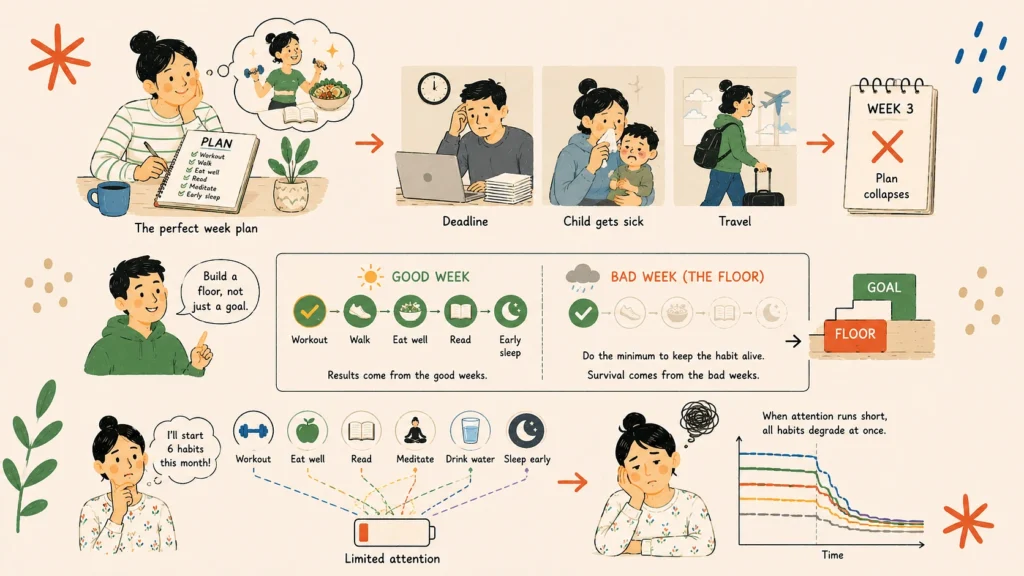
The design flaw is almost always the same. Someone builds a routine that assumes every week resembles the calm week they were having when they wrote it down. Then a deadline lands, or a child gets sick, or they travel, and the plan has no reduced version. It only has the full version and nothing, so it becomes nothing.
A plan that survives has a floor built into it. Not a goal, a floor. The minimum you do on the worst week of the quarter, which should be small enough that you feel slightly silly doing it, because the point of the floor is to keep the daily habit alive rather than to produce results. Results come from the good weeks. Survival comes from the bad ones.
This is also why stacking six new habits in January reliably fails. Each new habit competes with the others for the same limited attention, and when attention runs short they all degrade at once instead of one at a time.
What A Realistic First Month Looks Like
Pick one thing from this list, not four:
- Set a fixed wake time and hold it for thirty days, weekends included, and let bedtime sort itself out.
- Add a single high fiber item to a meal you already eat, so you are modifying an existing habit rather than inventing a new one.
- Book two strength sessions a week into the calendar as appointments with a time, not as a vague intention to go to the gym.
- Check your average daily steps for a week before changing anything, because a lot of people are closer to the plateau range than they assume.
Give it a month before adding the second thing. The pace feels slow and that is the entire point, since the thirty day version of this that covers everything is the one you will have abandoned by March.

