


Before anything else, a correction that montblanc leather reframes the whole subject, because I went in expecting to write about tanning and came out having written about painting.
Sfumato is not a tanning process. Nearly every retail listing calls it one, and even Montblanc’s own copy runs “tanning and finishing” together in a way that lets the confusion breathe. But what happens to a Sfumato wallet is finishing, the last act, performed on calfskin that has already been tanned by somebody else entirely. The name comes from Leonardo, whose sfumato was the painting technique of shading tones into each other so gradually that the transitions disappear, the reason the Mona Lisa’s smile has no hard edges. Montblanc borrowed the word because that’s literally what its craftsmen in Florence do to the leather they paint it. Four layers of color, applied by hand to each individual panel before the wallet is even assembled, building the shadowed, graded depth that makes no two pieces match.
Once you know that, the honest question in the title gets answerable. What does the process actually do to the wallet? Three real things, one thing people assume that it doesn’t do, and a price that’s paying for more than the paint. Let me take it in that order.
The Word, And Why Florence
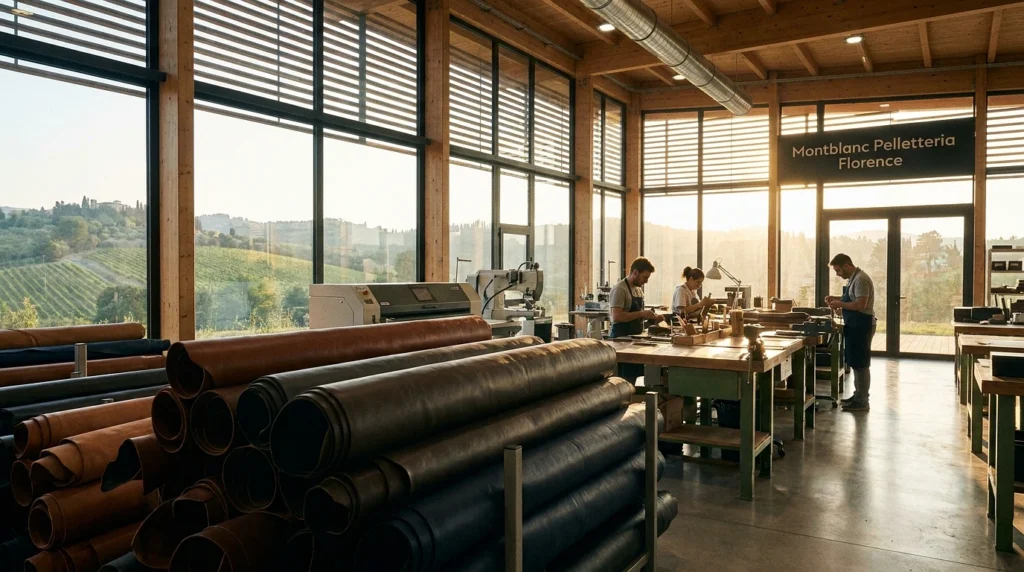
The setting is real and it matters. Montblanc’s leather operation started around 1935 near Offenbach, the old German leather town, and moved to a purpose-built Pelletteria in the Florence area in the early 2010s, in Scandicci, the unglamorous suburb where a startling share of the world’s luxury leather goods are actually made. The head of the facility, Giacomo Cortesi, gave the unromantic reason to Permanent Style when they visited: it’s simply more efficient, with around 150 tanneries in the district already supplying everyone, hardware suppliers included.
That’s the detail I’d hold onto, because it tells you what you’re really buying into. The hides come from Tuscan tanneries along the Arno, the same ecosystem feeding the other big houses. What’s proprietary is what happens after the design, the hand-finishing, and a German-inflected obsession with testing that we’ll get to. Sfumato is the finishing story, applied to the softest full-grain calfskin in three colors where the shading effect reads best, rich brown, anthracite, and navy.
What The Process Actually Does, Part One: It Keeps The Scars
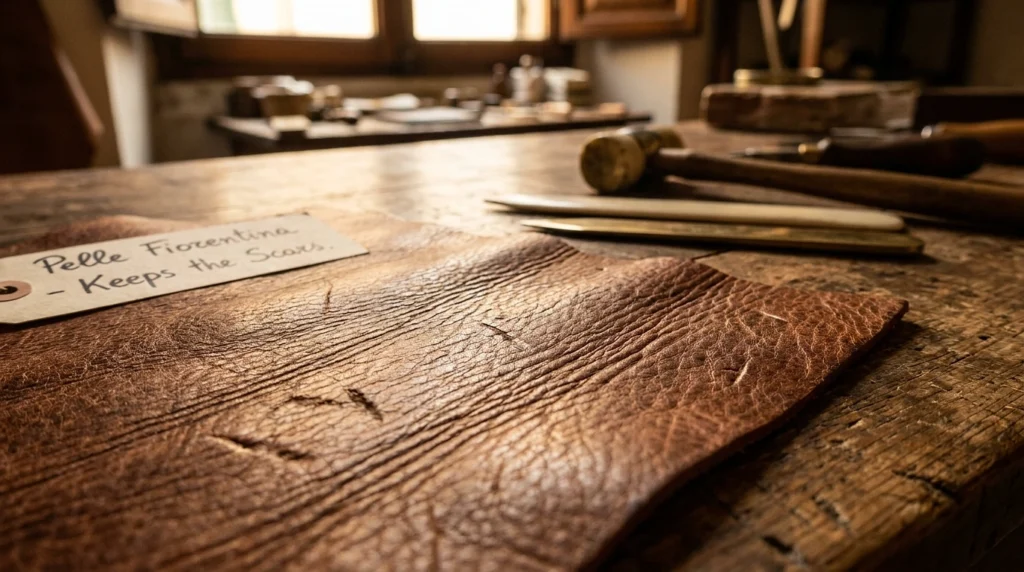
Here’s the quietly meaningful line in Montblanc’s own care notes: the Sfumato treatment intensifies not just the color but the natural characteristics of the calfskin itself, the wrinkles, veins, and growth marks.
To anyone who knows leather, that sentence is a flag planted. It means full-grain, the hide with its original outer surface intact. The cheap route in leather goods is the opposite sand off every scar and wrinkle, emboss a fake, uniform grain onto the corrected surface, and seal it under pigment so every wallet aesthetic looks identical. That surface is weaker, because the sanding removes the densest fibers, and it ages by cracking rather than developing character. A finish that celebrates the veins and growth marks can only be applied to a hide good enough to show them. So the first real thing the process does is force a materials standard. You can’t sfumato a corrected hide. There’d be nothing underneath to shade.
Part Two: The Paint Is Depth, And The Depth Is The Point
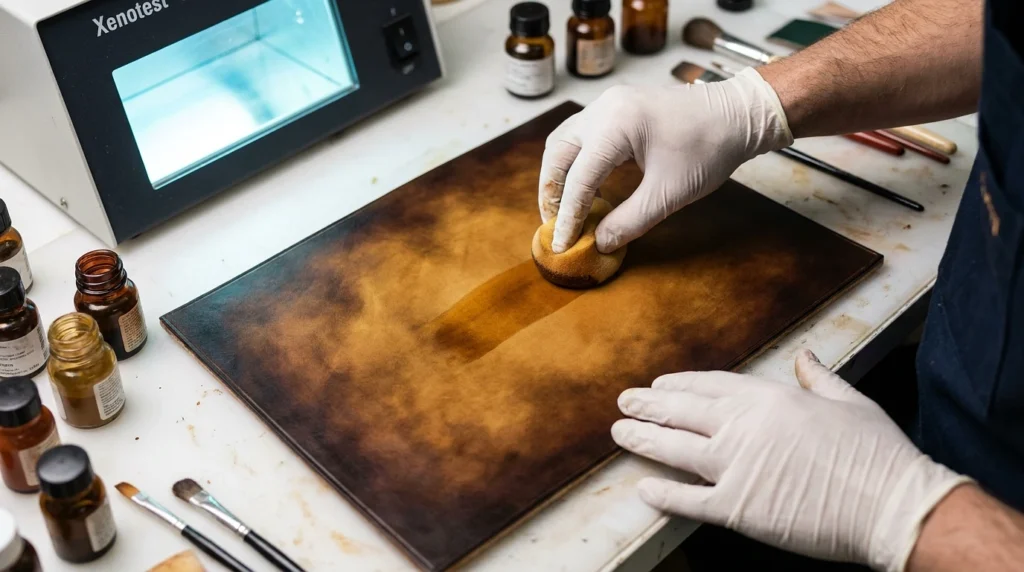
The four hand-applied layers do what layered translucent color always does and flat pigment never can, they create optical depth. Light goes partway into the finish and comes back differently at the burnished edges and the darker shadowed zones than it does at the lighter centers, which is the graded, smoky effect the Leonardo name is selling. Because human hands apply it panel by panel, the gradient falls differently on every piece, which is the “no two alike” claim, and for once it’s mechanically true rather than marketing.
The tradeoff comes with it, and Montblanc is unusually candid here. Hand-shaded, vegetable-influenced finishes shift with light and time. Cortesi told Permanent Style, essentially, that fading isn’t automatically a defect, it’s a known behavior of these leathers, and the job is to know it, control it, and communicate it. The facility even runs a xenotest, a machine that simulates sunlight to check how far the color drifts. So the second real thing the process does: it trades bulletproof color uniformity for depth and individuality, on purpose, and the patina your wallet develops in a back pocket is the finish continuing to do its job, not failing at it.
Part Three, And The Myth: Paint Is Not Armor
Now the assumption to kill. A $700 wallet with an artisanal finish must be more durable, right? Not because of the finish, no. Four layers of hand-applied color are an aesthetic system, not a protective one. The finish will scuff at corners and soften at fold points like any surface-dyed leather, faster than a thick pigmented coating would, and that’s the deal you signed up for in choosing shading over plastic-feeling armor.
The durability, where it exists, comes from the two boring places it always comes from: the full-grain hide underneath and the construction. This is where the Pelletteria’s German inheritance shows, and the testing regime, documented by The Bespoke Dudes on a factory visit, is genuinely something. A climate-controlled lab held at 23 degrees. A rub test, the strofinio, checking whether dye transfers off the leather onto fabric. A fleximeter folding samples to see how they behave under stress. A robotic arm that yanks straps through 1,500 cycles across eight to ten hours. That’s the machinery earning the price, quietly, while the paint gets the press release.
So Where Does The $700 Actually Go
Roughly, and honestly, into four buckets. The hide grade, because full-grain calfskin clean enough to display its own veins costs real money at the tannery. The hours, because four hand-applied layers per panel, in Italy, at Italian labor costs, is slow by design cover. The testing, which most of the wallets that cost a tenth as much never see. And the brand, which is the bucket nobody at the boutique will itemize for you but which is substantial, because Montblanc’s snowcap is doing some of the lifting in that price, the way it does on a fountain pen.
Which brings me to the only consumer advice this piece owes you, and I’ll give it straight. A well-made full-grain wallet, veg-tanned, sturdily stitched, can be had from small workshops for well under $100, and it will hold your cards for a decade. What it will not have is the sfumato depth, the Florentine hand-shading, the one-of-one gradient, or the snowcap. Whether those are worth several hundred dollars is a question about you, not about leather. The process is real, the craft is real, the materials standard it forces is real. It’s just that what you’re buying, at bottom, is a small painting that happens to hold your cards, and the honest price of a painting has never had much to do with what it does.

