


Agents who write small business policies will tell you the claim calls come in three flavors, and they can usually guess which one from the first sentence. A call that starts with “a lady fell” is general liability. One that starts with “we got an email from IT” is a breach. One that starts with “the client is saying” is professional liability, and that’s the coverage the caller most often never bought.
That’s the whole article, really. Fire, theft, a pipe that bursts over a long weekend, those are property claims. Your stuff got wrecked. Liability is when somebody else got hurt or lost money and they think it’s on you, and for a business with a handful of employees it’s nearly always one of those three calls.
Falls, data leaks and mistakes in paid work are behind most small business liability claims. They’re paid by three different coverages: general liability, data breach coverage and professional liability.
The Fall Numbers Have Doubled
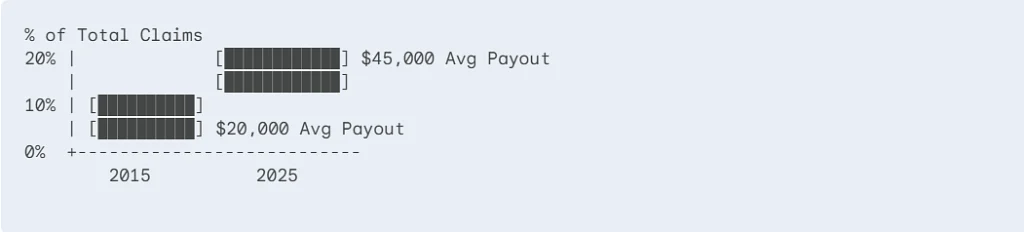
The Hartford puts out a count of what its small business customers claim for. In 2015, a customer slipping or falling was about 10 percent of claims. In its 2025 report it’s 20 percent, tied at the top with water damage and burglary, and the average payout has gone from $20,000 to $45,000. The company blames bigger jury awards, and more people suing in the first place.
Falls get expensive in stages. Medical bills first. Then lost wages. Then physical therapy. Then, maybe eight months in, a lawyer’s letter that puts a number on pain and suffering, and now there’s a lawsuit. The Hartford’s figures say roughly 35 percent of general liability claims end up as lawsuits, and those cost over $75,000 on average to defend and settle.
The fix is short. Mats, a mop, a camera, and a note of when you mopped. Footage from a $40 camera carries more weight with an adjuster than any statement, especially when it shows the person stepping over the wet-floor sign while looking at their phone.
Ransomware Hits Small Shops Harder Than Big Ones

There’s a stubborn belief that hackers don’t bother with a 12-person company. Verizon’s 2025 Data Breach Investigations Report says otherwise. Its small business numbers show 88 percent of breaches at small and midsize businesses involved ransomware, and about a third got in through a stolen password. Across all company sizes, breaches that came in through a vendor doubled from 15 percent to 30 percent in one year. Your bookkeeper’s software gets hit, and your clients’ tax files are the ones that leak.
The ransom, if you even pay it, is a fraction of the damage. Every state has a law that says you have to notify people when their personal information gets exposed, and the FTC’s breach response guide runs through the rest: lock down the systems, hire a forensics firm, call the police or the FBI, tell any other business whose data you were holding, and think about paying for credit monitoring. Letters alone, for a client list of 3,000 people, can run into five figures once you add printing, postage and a call center.
None of that is covered by a general liability policy. It’s a separate coverage, data breach or cyber, usually bolted onto a business owner’s policy, and it’s the one owners most often turn down to save a couple hundred dollars a year.
When The Client Says Your Work Cost Them Money
Nobody fell. Nobody hacked anything. A client just says the job was late, or wrong, and it cost them. A set of plans with a bad measurement. A tax return filed after the deadline. A website that launched in December instead of October, after the client had already bought ads for October.
The Small Business Administration’s insurance page draws the line this way. General liability is bodily injury and property damage to other people. Professional liability is financial loss from malpractice, errors and negligence in the services you sell. Anybody who gives advice, designs, writes code, or handles other people’s money or documents is in the second group, whether or not the word “professional” ever shows up on their business card.
These claims take their time. A tax mistake might not become a penalty notice for two years. Most professional liability is written claims-made, which means the policy has to be live when the claim arrives, not when the work was done. Freelancers drop it between contracts to save money, then the letter shows up about a job from 18 months ago and there’s nothing in force.
General liability pays when someone’s hurt or their property’s damaged. Professional liability pays when your work costs a client money. Data breach coverage pays for a leak. None of them covers the other two.
What A Business Owner’s Policy Does And Doesn’t Include
Most companies selling business insurance to small firms start with a business owner’s policy, which bundles general liability and property coverage, and then offer data breach and professional liability as add-ons. The Hartford, whose claims numbers appear above, sells it that way. So does nearly every other big commercial carrier, and an independent agent can price three or four of them from the same application.
Before the premium, look at two things. The general liability limit, because $1 million reads as a lot until a fall with a lawyer attached clears six figures. And the fine print on the data breach add-on, because some of the cheaper ones pay for a lawyer and nothing else, and the letters and the forensics stay on your tab.
One more thing people miss. Workers’ compensation is a different animal entirely. It’s for your own employees, it’s required by law in most states, and it doesn’t pay a nickel toward a customer who falls.
The Odds Over Ten Years Aren’t Great
The Hartford estimates that four in ten small businesses will file a property or liability claim in any ten-year stretch. Stay open 20 years and you’re more likely to file than not.
For falls, it’s mats, a spill log, a camera and handrails that don’t move. For data, it’s two-factor login on email and banking, no reused passwords, laptops that are encrypted and never left in a car, and a one-page plan for the first day after a breach that you write before you need it, the way homeowners get the house ready before storm season. For paid work, it’s a signed scope with dates and a change-order process, a second set of eyes on anything with numbers in it, and changes confirmed in writing the day they’re agreed. Treat it the way you’d treat preventative maintenance on a house: a small bill every year instead of one you can’t pay.
If you’re moving, recheck all three coverages while you’re at it. New address, new foot traffic, new equipment. It belongs on the office move checklist right next to the internet install.

