

On October 1, 2026, the day before Drishyam: The Conclusion opened, a judge in the Delhi High Court restrained nine websites from streaming it. One of the nine was a Vegamovies clone. Justice Purushaindra Kumar Kaurav wrote that the harm to the producer “may not be remedied in terms of money,” which is a formal way of saying that once a film is on a site like this on opening night, there is no getting the ticket sales back. It was the fourth time in four years the same court had put that name in an order. So the first thing to know about Vegamovies, before any guide to free films, is that it is a pirate site with a court record, not a streaming service, and this piece treats it that way: what it is, what the free page costs you, where the law stands, and where the free movies you were actually looking for are.
Vegamovies is on the US Trade Representative’s Notorious Markets list and has been blocked repeatedly by the Delhi High Court. Nobody is going to arrest a viewer, but the ads and downloads on sites of this kind carry malware and card fraud at rates the Digital Citizens Alliance measured at one attempt per six visits. The free legal services, Tubi, the Roku Channel, Pluto, Prime Video’s free tier and your library card, now carry more films than one person can watch.
What Is Vegamovies
The US Trade Representative’s 2025 Notorious Markets List, published in March 2026, gives it an entry of its own: “one of the most popular piracy streaming sites in India,” offering international and Indian films and series, earning from “multiple revenue sources including advertising,” and running on more than 40 associated domains because “the site frequently changes its domain name to evade enforcement efforts.” That last habit is why anyone searching for it finds a different address every few months. The old one has been blocked; the new one will be.
The blocking has been going on since 2022. Universal, Warner Bros., Columbia, Netflix, Paramount and Disney sued it in the Delhi High Court that April, and Justice Jyoti Singh ordered Indian ISPs to block the site and any mirror of it. Star India, the Hindi film and streaming rights holder, sued in 2024 and got the same from Justice Saurabh Banerjee, with 17 Vegamovies-branded domains added to the block list that November and nine more the following March. In September 2025 its successor JioStar got the first pre-release injunction ever granted for a Bollywood film, for Jolly LLB 3, and the lead defendant in that case was a Vegamovies address too. Then the Drishyam order this October. The court orders are public; the site’s operators are not. Nobody reputable has published who runs it or where.
What The “Free” Page Costs You
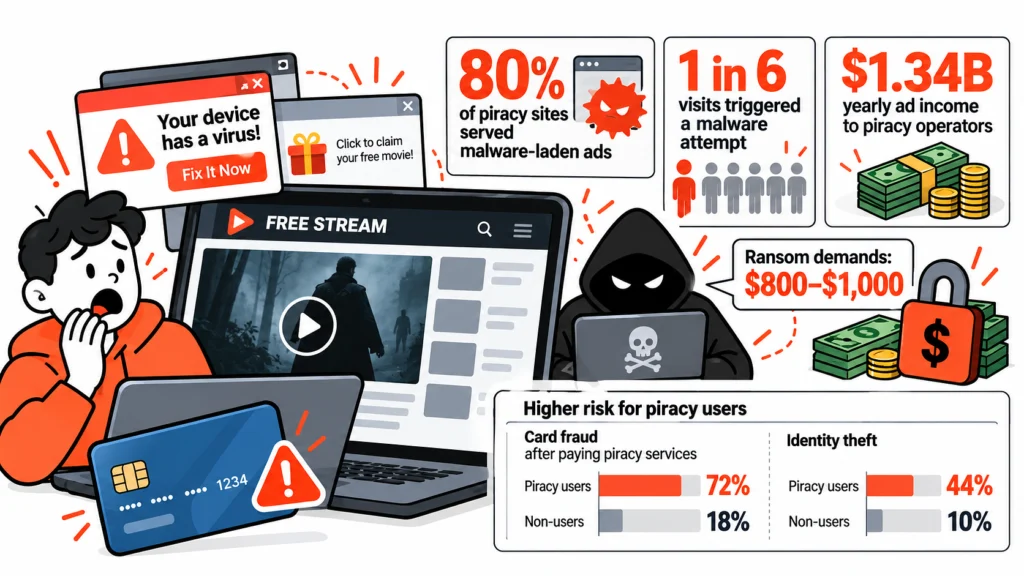
No security firm has published a teardown of a Vegamovies page by name, so what follows is about the class of site, and it comes from people who have measured it. The Digital Citizens Alliance and the ad-fraud firm White Bullet went through 500 piracy sites in 2022 and found about 80 percent serving malware-laden ads, roughly one visit in six producing a malware attempt, and the fake “your device has a virus” pop-up as the standard bait, leading to a bogus security tool, a ransom demand of $800 to $1,000, or a banking trojan. The year before, the same group had put advertising income to piracy operators at $1.34 billion a year. Tom Galvin, who runs the alliance, called ransomware “the most serious cyber threat” facing consumers and said plainly that “piracy operators dangle free content” as the hook.
The card side is worse than the malware side. In a 2023 survey of 2,000 Americans, 72 percent of people who had paid a piracy service by credit card reported card fraud afterward, against 18 percent of people who never visited such sites; identity theft ran 44 percent to 10. The FTC’s own consumer alert on illegal streaming, written by Alvaro Puig in 2019, ends with four words that have not needed updating: “don’t watch pirated content. Period.” Fake close buttons on overlay ads, a “Fix It Now” prompt claiming your browser is missing a component, a .exe file dressed as an HD copy: Malwarebytes found all three within hours of The Odyssey opening in July 2026, on sites doing exactly what Vegamovies does.
The price of a pirate stream is paid later and somewhere else: a locked phone, a cloned card, a login reused on your bank. The film was never the product. You were.
Where The Law Stands For A Viewer

Put simply the laws are aimed at the people running and feeding these sites, not the people watching them, and the gap between those two is where most of the confusion lives.
India’s Cinematograph (Amendment) Act of 2023 makes it an offense to record a film in a cinema or to exhibit an infringing copy for profit, punishable by three months to three years in prison and a fine from three lakh rupees up to 5 percent of the film’s audited production cost. That is the camcorder man and the site operator, not the viewer. In the United States, the Protecting Lawful Streaming Act of 2020 made running a commercial pirate streaming service a felony, up to ten years for repeat offenders, and its sponsors said in terms that it “will not affect the activities of ordinary internet users.” What is moving in Washington now is site blocking: Representative Zoe Lofgren’s bill from January 2025 and Senator Thom Tillis’s Block BEARD Act from July 2025 would let courts order US broadband providers to cut off foreign piracy sites the way Indian ISPs already do, and the two were reported in April 2026 to be merging their bills. At a House hearing in June, a witness from Amblin cited a 70 percent traffic drop to blocked sites in Portugal.
So a viewer in Ohio is not going to be prosecuted for watching a camrip. A viewer in Ohio may well find, within a year or two, that the address won’t load at all, which is the Indian experience already. Whether that counts as a legal risk or a convenience problem is up to you. The malware doesn’t care either way.
Where The Free Movies Really Are

This is the part the search was for, and the honest answer in 2026 is that the free legal shelf is enormous and almost nobody has finished it.
- Tubi passed 110 million monthly users in August 2026, carries more than 375,000 films and episodes, and took 2.3 percent of all US television viewing in April, more than Peacock. Its CEO Anjali Sud’s pitch is three sentences long: “No credit cards, no friction. You just start watching.”
- The Roku Channel reached 3 percent of all US TV viewing in March 2026, the first time any free ad-supported service has, and you don’t need a Roku to use it.
- Pluto TV is the channel-surfing one, hundreds of linear channels plus on demand, with Paramount promising its biggest overhaul in a decade this past summer.
- Prime Video absorbed Freevee when Amazon shut that app in August 2025; the free, ad-supported titles are still there for people without Prime.
- Plex runs over 800 free live channels in the US alongside its on-demand library.
- Kanopy and Hoopla come with a library card: Kanopy has around 30,000 films and most libraries give 5 to 10 tickets a month, Hoopla about a million titles with a monthly borrow cap, and a second card from a second library doubles both. Some systems have been trimming the limits since budget cuts started biting in early 2026, so check yours.
Two names to cross off. Crackle, the original free-movie app, went dark in April 2025 after its parent company’s bankruptcy and has not come back. Peacock’s free tier closed to new customers in January 2023; the cheapest Peacock is now $7.99 a month.
For the Hindi and South Indian films that make up most of Vegamovies’ traffic, the legal free route is older than Vegamovies. Shemaroo put full-length films on YouTube in 2008 and its FilmiGaane channel has passed 70 million subscribers; Rajshri uploaded a hundred features the same year. Both are ad-supported and free. Newer releases sit on paid services, ZEE5 Global in the US among them, and that’s where the honest trade-off is: a Bollywood film that opened last month is either paid or pirated, and there is no third shelf.
What The Pirate Copy Costs The People Who Made It
It’s worth knowing what the “free” is taken from. An EY report for India’s internet industry body put the country’s media losses to piracy at 22,400 crore rupees in 2023, about $2.7 billion, with 51 percent of consumers admitting to pirated content and 64 percent saying they would switch to legal if it were free with ads, which is Tubi’s whole business model in one survey line. Media Partners Asia counted $1.2 billion lost to online video piracy in India in 2024 alone and projected 158 million pirate users by 2029. When Salman Khan’s Sikandar leaked in HD the day before release in March 2025, the producers’ audit reportedly put the loss at 91 crore rupees, around $11 million, on one film in one weekend. Those are the numbers behind Justice Kaurav’s line about harm that money can’t remedy.
What A Sensible Viewer Does With All This
If you’ve been on one of these sites recently, run a malware scan, clear the browser’s notification permissions (the push-notification scam lives there), and look at the card statement for small charges you don’t recognize, the kind a good bank flags and a bad one lets through, which is one more reason to ask whether your bank still fits the way you live. Then install Tubi or the Roku Channel and give it a week. The ads are the price, and they are a cheaper price than the one the pirate page charges.
And if the point was money, there is more of it in the subscriptions nobody cancelled than in the streams nobody paid for. Three services at $8 to $17 a month, half of them unused, is the kind of leak the everyday habits that soak up a rising cost of living are written for. Cut two, keep one, and let the library card do the rest. The free shelf is longer than your evenings.
Sources:

