


A friend of mine spent close to fourteen thousand rupees over six months trying to fix her hair fall through shampoos. She started with a salon recommendation, moved to a luxury imported brand, then to a herbal one with a fancy founder story, then to two more. The hair fall didn’t change. What did change was her bathroom shelf, which had five expensive bottles on it, none of which had been used to the bottom.
This pattern is so common I’ve stopped being surprised by it. The shampoo market in India runs on the assumption that the next bottle is going to be the one that fixes things, and most people dealing with hair fall cycle through products for months before realising that the answer to their actual problem was never going to come from a shampoo bottle.
But that’s not the same as saying shampoo doesn’t matter. It does. Just not in the way most of the marketing implies. The honest version of what shampoo can and cannot do for hair fall is worth understanding, because once you accept the boundaries of what this one product can actually achieve, you stop wasting money chasing the next miracle bottle and start making the changes that actually move the needle.
What Shampoo Can Actually Do
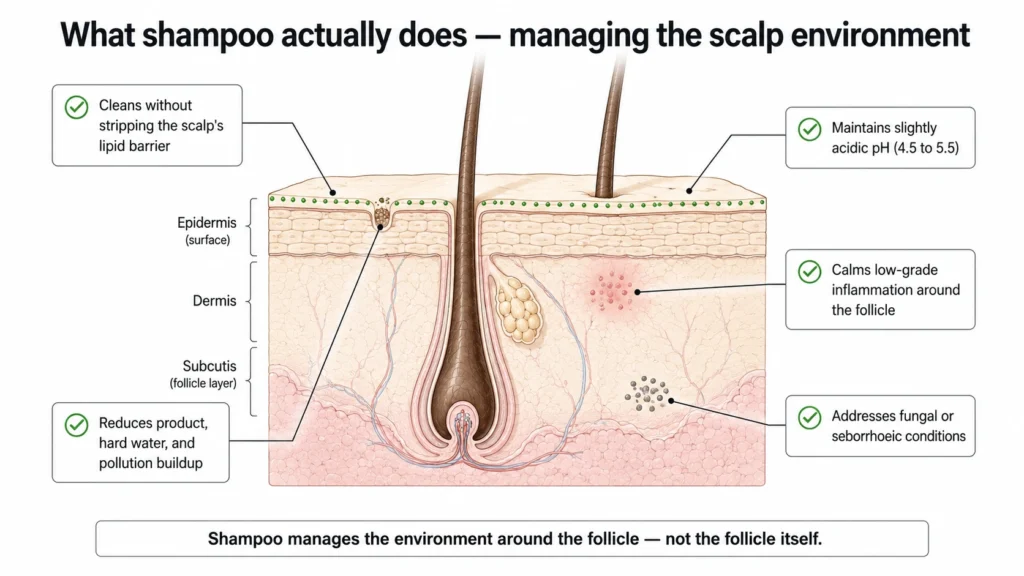
Shampoo’s real job is managing the scalp environment. When the scalp is healthy, follicles can do their work without interference. When the scalp is inflamed, dry, oily, or fungally colonised, follicles operate under stress, and that stress shows up in the form of hair that thins, sheds more easily, or fails to grow back as robustly as it could.
A well-formulated shampoo can:
- Clean without stripping the scalp’s lipid barrier
- Help maintain a slightly acidic pH (the healthy scalp sits around 4.5 to 5.5)
- Calm low-grade inflammation that may be contributing to follicle dysfunction
- Address specific conditions like seborrhoeic dermatitis or fungal involvement that are known to worsen hair shedding
- Reduce buildup from product residue, hard water minerals, and pollution exposure that can clog follicles over time
Those are real benefits. They’re worth pursuing. But notice what’s missing from that list. There’s nothing on it about regrowing hair, reversing genetic thinning, or fixing the underlying cause of pattern hair loss. Because shampoo doesn’t do those things, and no formulation is going to.
What Shampoo Cannot Do
Here’s where most articles in this space get vague, and where I think being direct serves the reader better than being polite.
Shampoo cannot reverse androgenetic alopecia, which is the genetic form of hair thinning that affects a large percentage of Indian adults. The mechanism of that condition involves dihydrotestosterone (DHT) shrinking hair follicles over time, and the medications that have actual evidence for slowing or reversing it work systemically or topically at concentrations and contact times that a shampoo, rinsed off in two minutes, simply cannot deliver.
Shampoo cannot fix hair fall caused by nutritional deficiency. If your ferritin is low, your vitamin D is low, or your protein intake is inadequate, no shampoo in the world will compensate for that. Hair follicles need raw materials, and those come from inside the body.
Shampoo cannot resolve hair fall caused by thyroid issues, PCOS, post-pregnancy hormonal shifts, or chronic stress. These are systemic problems that require systemic answers, often with medical input.
Shampoo cannot bring back hair from follicles that have already miniaturised past the point of recovery. Once a follicle has fully scarred or atrophied, it’s done. Catching things earlier matters far more than finding the perfect shampoo later.
What shampoo can do is stop making things worse, and at the margin, support the scalp environment so that whatever larger work you’re doing on the actual causes has a better chance of working.
The Ingredients That Actually Have Evidence
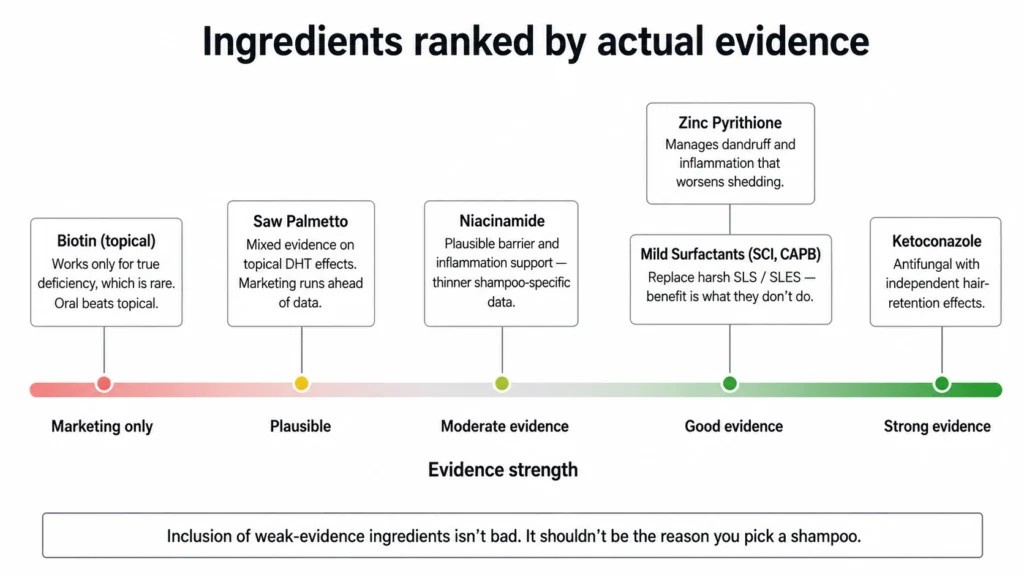
If you’re going to make a shampoo change as part of dealing with hair fall, it helps to know which ingredients have real evidence behind them and which are mostly marketing.
Ketoconazole is the strongest ingredient in this category. It’s an antifungal that, in addition to addressing seborrhoeic dermatitis, has shown some independent effects on hair retention in studies. It’s the one ingredient I’d say has the best evidence base for a shampoo-delivered hair benefit.
Zinc pyrithione has good evidence for managing dandruff and the scalp inflammation that often accompanies it. Inflamed scalps are not friendly environments for healthy follicle function, so this matters even if the mechanism is indirect.
Mild surfactants like sodium cocoyl isethionate and cocamidopropyl betaine are not active treatments but they replace the harsher SLS and SLES that strip the scalp barrier in long-term daily use. The benefit is from what they don’t do.
Niacinamide has some evidence for reducing inflammation and supporting the skin barrier when used topically. The evidence for it specifically in shampoo formulations is thinner than the evidence for it in other skincare contexts but the mechanism is plausible.
Saw palmetto and biotin are the two ingredients where the marketing gets ahead of the evidence. Saw palmetto has some research suggesting topical DHT-related effects but the evidence is mixed and far weaker than the marketing tends to imply. Biotin works for hair when there’s a genuine biotin deficiency, which is rare, and oral supplementation works far better than topical application. Their inclusion isn’t bad. Their inclusion shouldn’t be why you pick a shampoo.
Where a Shampoo Like Traya’s Fits
The framing that I think serves people best is treating shampoo as one variable in a larger picture, not as the picture itself. A shampoo that’s well-formulated for daily use during hair fall recovery should be gentle on the scalp barrier, include ingredients that calm inflammation, avoid the harsher surfactants and irritants, and not undo work that other parts of a recovery plan are doing.
Traya shampoo is positioned in line with this framing. It’s designed to be part of a system that includes internal supplementation, scalp treatments, and a structured protocol rather than a stand-alone solution. The brand’s approach treats the shampoo as the daily-use foundation that supports the rest of the plan rather than carrying the weight of the recovery on its own. For people who’ve spent years cycling through individual products hoping one of them was the answer, that framing is itself a useful course correction.
What Actually Moves the Needle
For most people dealing with sustained hair fall in India, the things that actually change outcomes look something like this. Get a blood panel done that includes ferritin, vitamin D, thyroid markers, and B12. Address whatever’s low. If the hair fall has been going on for more than three or four months and isn’t tied to a specific trigger like a recent illness or pregnancy, see a dermatologist who works specifically on hair, because there’s a meaningful difference between someone who diagnoses pattern thinning versus telogen effluvium versus alopecia areata. Improve protein intake and sleep. Reduce ongoing stressors where you can.
Then, alongside all of that, change your shampoo to something that isn’t actively making things harder. That’s the role shampoo plays. Important but supportive. Not central but not nothing.
The hair fall conversation is full of products promising more than they can deliver. Knowing what each piece actually does makes the whole problem easier to handle.

