


Take one of these tests and the result arrives with a small jolt of recognition, that pleasant shock of being seen. There you are. The impatience, the leaping before you look, the way you say the blunt thing to a friend a beat before you’ve decided to. Four letters, and they seem to have read your diary. I felt it myself the first time, and I’ve watched a room full of otherwise skeptical people feel it too, which is the part that interested me more than the test itself. The jolt is real. What it isn’t, is proof. That the description fits and that the category is true are two separate claims, and almost everything worth understanding about personality tests lives in the gap between them.
So it’s worth holding one of these the right way, which means knowing both what it can honestly give you and the precise point where it turns into something else.
Why The Result Feels So Uncannily Accurate
The jolt has a name, and an experiment behind it that’s almost too neat. In 1948 a psychologist named Bertram Forer gave his students a personality test, then handed each of them what he called their personal safety profile and asked them to rate its accuracy from zero to five. The average came back near the top, around 4.26. Every student had been given the identical profile, thirteen vague lines Forer had mostly copied out of a newsstand astrology column.
That’s the Barnum effect, sometimes the Forer effect, and it has been replicated for decades with the scores still sitting near that same figure. The trick is entirely in the phrasing. A line like “at times you feel very sure of yourself, while at other times you hold back” reads as intimate because it’s loose enough to catch anyone, and you supply your own life to fill it in without noticing you’ve done the work. The statements that land hardest tend to be the flattering ones, and they land harder still when you’ve been told they were written for you and no one else.
None of this makes your result worthless. It does mean the feeling of fit can’t be the evidence for it. The resonance is telling you something true about how we make meaning, how readily we recognize ourselves in a mirror vague enough to hold us. It isn’t telling you the category on the label is real.
What The Tests Get Right, And It’s More Than The Critics Allow
Here I want to push back on the people who wave the whole enterprise off as a horoscope, because that’s the easy move and it isn’t quite honest to what the research shows.
The Myers-Briggs, the most used of these by a wide margin, does line up with the traits academic psychology takes seriously. Its extraversion scale correlates with the Big Five’s extraversion at around 0.74, which is strong, and not the kind of thing that happens by accident. So the instrument is catching something real about how people differ, whether you refill your energy among others or away from them, whether you reach first for logic or for what you value. When a description of your type makes you nod, some of that nod is the Barnum effect at work. And some of it is the test having genuinely caught a feature of you. Both are true at once, which is exactly what makes the thing so slippery to argue about.
For self-reflection, that’s enough, and I’d go further and say it’s the honest use. What the true believers I’ve come across tend to love isn’t really the science. It’s being handed a vocabulary for their own patterns, and a small piece of permission, the introvert who can finally say she’d rather leave the party without feeling she has to apologize for it. That’s not nothing. It’s close to what a good afternoon of journaling does, and there’s nothing hollow in wanting it.
The Exact Point Where It Turns Into A Trap
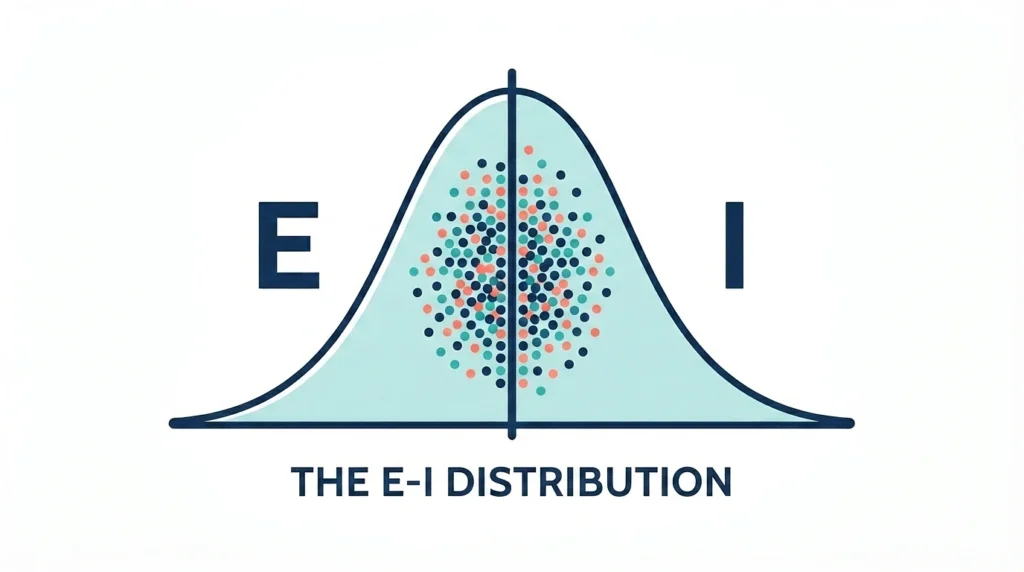
The Myers-Briggs doesn’t measure those preferences and leave them on a scale. It sorts you into either/or boxes, an E or an I, a T or an F, and that hard sorting is the part the evidence won’t support. Retake the test after only five weeks and somewhere between 39 and 76% of people come out a different type. Not a slightly shifted score, a different four-letter word for who they are. Nobody’s personality was remade over a month. It happens because most people don’t sit at the poles, they cluster near the middle of each dimension, and near the middle a couple of changed answers is enough to tip you clean across the line. The underlying preference is reasonably stable. The border the test draws through the center of it is not.
That’s the whole difference between measuring a trait along a spectrum and forcing it into a kind. Your actual personality is a set of dials, most of them resting somewhere between the two ends. The four-letter type takes each dial and pretends it’s a switch, on or off, this or that. And once you’re holding the switch, the temptation is to start living by it. I can’t do that, I’m an introvert. I’m blunt, it’s just my type. There’s the trap, the moment a tool for looking at yourself hardens into a fence you build around yourself, and the label stops describing you and quietly starts deciding for you.
It’s also why every serious source, the test’s own publisher among them, warns against using these for hiring or any weighty judgment about a person. They don’t predict who will do a job well. The predictive power simply isn’t there, and a category that reshuffles half the people who hold it inside five weeks has no business standing guard over anyone’s career. Isabel Briggs Myers, who built the thing and cared a great deal about how it was used, would likely have been appalled to see it deployed that way.
So the honest way to use one of these turns out to be smaller than the marketing promises and larger than the cynics allow. Take it, read the result, mark the lines that make you sit up, and treat those as a prompt to think honestly about your own tendencies. Then hold the four letters loosely, because the parts of you they point at are real, and the boxes they sort you into are not.

