


Somebody says “sweet dreams” to you and you don’t think twice about it. Two words, automatic, the verbal equivalent of a wave. But I got curious about why such a throwaway little phrase sticks around the way it does, why it lands different coming from certain people, and whether there’s anything underneath it besides habit.
Turns out there’s more going on than I figured. Not magic, nothing woo. Just some fairly well-studied stuff about how people wind down, how affection actually works, and why the small repeated things end up mattering more than the grand ones.
Two Words At The End Of The Day Work On A Wound-Up Brain
Here’s what I didn’t appreciate until I looked the timing is half of what makes it work. It shows up right at the hinge of the day, when you’re trying to put everything down and you usually can’t.
And that hinge is a real physiological problem. When you carry the day’s stress to bed, your arousal stays jacked up and it costs you. Researchers running people through a stress task right before bed found they took longer to fall asleep, slept less deeply, and were slower the next day. Presleep arousal is the enemy of falling asleep, and most of us walk into the bedroom still running the day in our heads.
So anything that nudges the brain toward “okay, we’re done now” is doing something. The wind-down direction is the whole game, and the phrase points that way. A 2021 study in Behavioral Sleep Medicine found relaxing pre-bed activities improved sleep quality and lowered anxiety, while the same line of work keeps flagging the opposite, emotionally charged stuff in the last hour cranks arousal up and makes settling harder.
A soft “sweet dreams” won’t undo a genuinely terrible day. I’m not claiming that. But as the last note you hit before lights-out, it’s aimed at winding down rather than winding up, and at bedtime that direction is the whole point.
The Phrase Is Doing Affection Work, And Affection Is More Measurable Than You’d Think
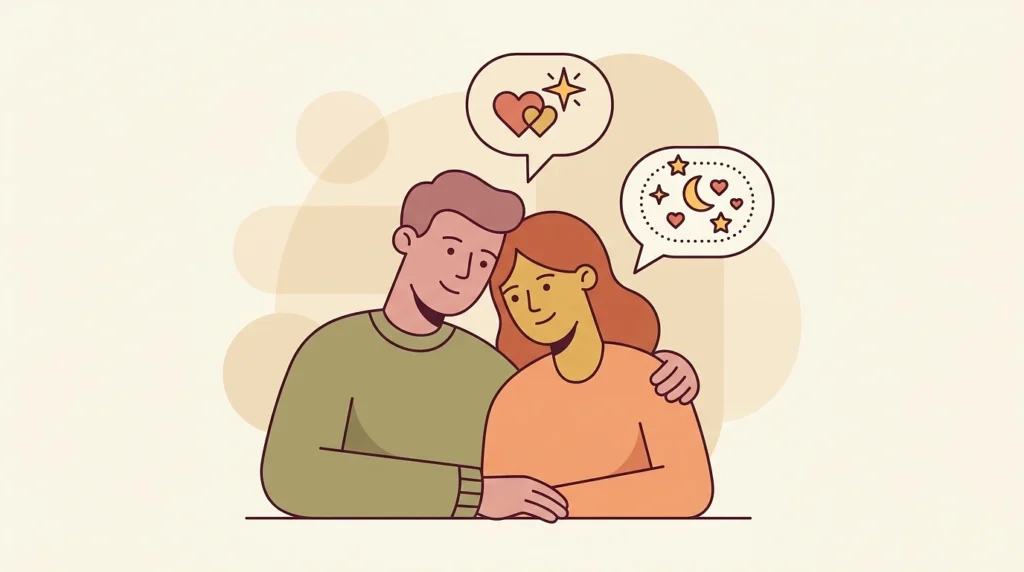
This is the part that surprised me, because I always lumped “sweet dreams” in with filler. The stuff you say without meaning much. That’s not really right.
It’s a small unit of what researchers call verbal affection, and verbal affection has a whole literature behind it. Affection exchange theory treats giving and receiving it as the actual machinery of pair-bonding, and the findings line up, both expressing and getting affection ties to higher self-esteem, more relationship stability, and links with secure attachment across multiple studies.
What got me is that this is a category somebody actually built measurement scales around. The sample items they score people on:
- Saying “I love you.”
- Praising or complimenting the other person.
- Small verbal warmth, the goodnight version included.
There’s a finer point I liked too. One study of 280 couples looked at how affection lands depending on who’s catching it, and for people who are more avoidant, more guarded about closeness, the speaker’s nonverbal warmth mattered a lot for whether it got through at all.
Which tracks with real life. “Sweet dreams” said warmly and “sweet dreams” said flat are two different messages, and the guarded person on the other end is reading your tone, not the dictionary.
It Only Works Because You Say It Over And Over
Here’s where I get a little opinionated, because people get this backwards. They think the big romantic declarations are what hold a thing together.
They’re not. It’s the boring repeated stuff.
A goodnight phrase is a ritual, and rituals run on repetition. Said once, “sweet dreams” is nothing. Said every single night for three years, it turns into a load-bearing wall, the thing whose absence you’d feel instantly. You already know this. The night your person forgets to say it, or says it clipped and distracted, you notice. That noticing is the proof it was doing something all along.
I think that’s the whole secret of the phrase and most people walk right past it. It’s not profound. It’s relentless. And relentless beats profound in relationships almost every time.
Across The World, Everybody Made Up Some Version Of This
Pull back and you notice nearly every culture built its own goodnight blessing. Different words, identical job:
- Spanish, que sueñes con los angelitos, may you dream with the little angels.
- German, schlaf gut, sleep well.
- French, fais de beaux rêves, make beautiful dreams.
I don’t think that’s borrowing, one place inventing it and the rest copying. It’s that the problem is universal. Every human everywhere has to do this strange daily thing where they go unconscious for hours, and the people around them want to send them off gently. So culture after culture landed on a soft phrase to mark the handoff into sleep, independently. When something shows up everywhere like that, it’s usually answering a need everybody has.
Why It Gets Heavier The Farther Apart You Are
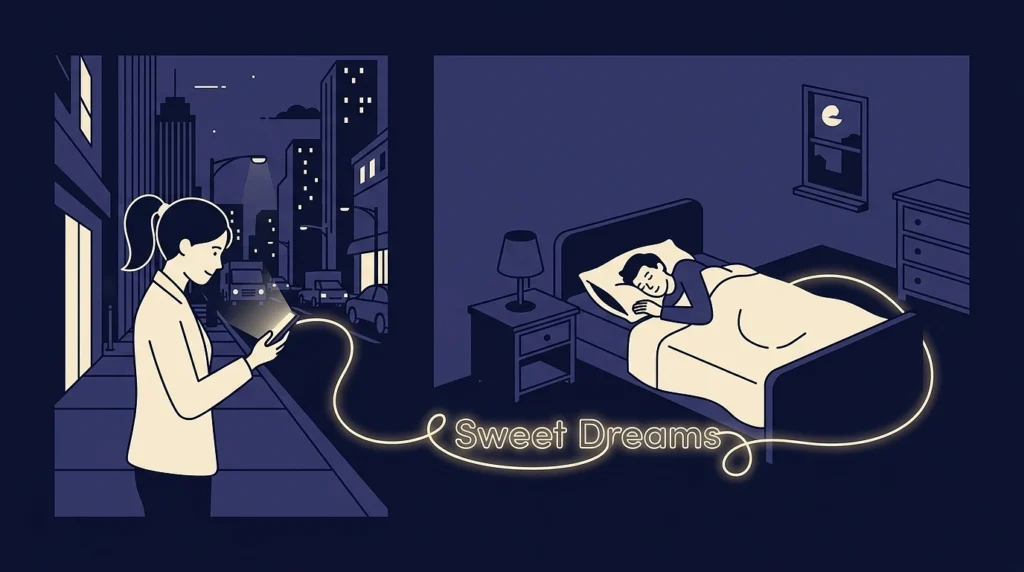
In the same house, “sweet dreams” is one warm thing among many. You also had dinner together, passed each other in the hall, traded a look about something. Put a thousand miles between you and that little phrase has to carry a lot more on its own.
The long-distance research is pretty pointed about which contact actually holds things up. The small, consistent pings matter more than the occasional big gesture. A 2021 study of 647 people found that frequent, responsive texting was tied to higher relationship satisfaction specifically for long-distance couples, more than for couples living close. And the broader maintenance work keeps circling the same word, routine, daily check-ins that keep a sense of presence in each other’s lives and quietly signal commitment.
A nightly “sweet dreams” text is about the smallest possible version of that routine. A daily ping that says I’m still here, still thinking about you, last thought of my day was you.
Worth being straight, though. Distance is genuinely hard and a goodnight text doesn’t fix it, research also finds people in long-distance relationships can carry more emotional distress than couples who are physically close. The phrase helps hold the line. It isn’t a cure for the miles.
Where It Gets Overused And Slightly Fake
Let me push back on my own article for a second, because there’s a version of this that annoys me.
The phrase has gone a bit corporate. It’s a brand caption now, a hashtag under a soft-focus sunset, a sign-off pasted onto messages by people who don’t mean a thing by it. Used that way, hollow and automatic and performed for an audience, it loses the exact quality that made it worth anything. The whole reason it works between two real people is that it’s specific, it’s sincere, and the tone carries it. Strip those out and you’ve got two words doing PR.
I’d rather somebody say nothing than post “sweet dreams” to fourteen thousand followers like it means what it means to a person who actually loves them.
So no, I’m not romanticizing it across the board. Said to the right person with the day winding down behind it, it’s quietly one of the better things we say to each other. Said as filler, it’s filler. The words don’t change. Everything around them does.
Sources:
- Bedtime stress, sleep latency and next-day performance
- https://www.ncbi.nlm.nih.gov/pmc/articles/PMC7399217/
- Relaxing pre-sleep routine, sleep quality and anxiety
- https://www.mentalhealthctr.com/the-link-between-stress-and-sleep/
- Affection exchange, self-esteem, stability and secure attachment
- https://www.sciencedirect.com/science/article/abs/pii/S0191886919304374
- Verbal and nonverbal affection with avoidant partners, 280 couples
- https://pubmed.ncbi.nlm.nih.gov/32181704/
- Frequent responsive texting and long-distance satisfaction, Holtzman et al. 2021
- https://healthforlifegr.com/making-long-distance-relationships-work/
- Long-distance communication routines and maintaining presence
- https://kevonowen.com/clinical-psychotherpy/managing-long-distance-relationships-staying-emotionally-connected/

