


A friend of mine sat through a med spa consultation last year expecting to hear a number somewhere around a thousand dollars. She walked out with a quote for $5,400. Nobody had lied to her, exactly. The website said “starting at $600,” which was true, for one vial, and her chin needed three vials a session across three sessions. That gap between the advertised number and the real number is the single most common complaint you’ll find in Kybella patient forums, so let’s just do the math out loud before anything else.
Kybella itself is legitimate. It’s a synthetic version of deoxycholic acid, a molecule your own digestive system uses to break down dietary fat, and when a provider injects it into the fat pad under your chin, it ruptures the membranes of fat cells, which your body then clears out over the following weeks. Those cells don’t grow back. The FDA approved it in 2015 for moderate to severe submental fullness after a proper drug-style clinical program, which almost nothing else in the cosmetic injectable aisle can claim. The question was never whether it works. The questions are what it actually costs, what the recovery honestly looks like, and whether your particular chin is the kind it helps.
The Real Price Lands Between $2,400 And $7,200 For Most People
Kybella is priced by the vial, and this is where quotes go sideways. A vial runs $600 to $1,000 depending on your market, most chins need 2 to 3 vials per session, and the American Society of Plastic Surgeons puts the national average at $1,200 to $1,800 per session. Then multiply by sessions, because one session is almost never the plan. Sessions get spaced 4 to 6 weeks apart so your body can finish clearing the destroyed fat before the next round.
| Your situation | Likely sessions | Vials per session | Realistic total |
|---|---|---|---|
| Mild fullness, thinner build | 2 | 1–2 | $2,400–$3,600 |
| Moderate fullness (most patients) | 2–3 | 2–3 | $3,600–$5,400 |
| Severe fullness | 4–6 | 3–4 | $7,200–$10,800+ |
Insurance covers none of this. It’s cosmetic, full stop. And here’s the part that annoys me about how this gets marketed: the per-session framing makes Kybella look cheaper than chin liposuction, but a heavier treatment plan can meet or pass a surgeon’s lipo quote, which handles everything in one procedure. That comparison belongs in your consultation, and a provider who waves it off is telling you something about how they sell.
The Trials Behind It Are Solid, Which Is Rarer Than It Should Be In Aesthetics
Two large phase 3 trials, REFINE-1 and REFINE-2, tested this against placebo in over a thousand patients. In REFINE-1, published in Dermatologic Surgery in 2016, about 75% of treated patients achieved at least a one-grade improvement on the clinician fat-rating scale, against a small fraction of the placebo group. And the results hold. A three-year follow-up study of REFINE responders found 82.4% still maintained their improvement at year three without any additional treatment. A separate 12-month open-label study found 84.9% of subjects satisfied with the appearance of their face and chin.
That durability is the honest selling point. The fat cells that got destroyed stay gone. The caveat, and providers say this fast and quiet, is that your remaining fat cells can still enlarge if your weight climbs, so “permanent” assumes your weight stays roughly where it is.
Now The Swelling, Because The Before-And-After Photos Skip This Chapter
Every Kybella article shows you week zero and week twelve. Nobody shows you day three, when you look like a bullfrog. I’m not exaggerating for effect. The swelling after a Kybella session is dramatic, it’s expected, and it’s actually part of the mechanism, because the inflammatory response is how your body processes the ruptured fat cells.
The phase 3 trial data is blunt about how common the local reactions are:
- Pain at the injection site hit 65% to 80% of patients across the phase 3 trials.
- Bruising or hematoma showed up in roughly 54% to 70%.
- Numbness and firmness under the chin lasting days to weeks were routine.
- Marginal mandibular nerve paresis, a temporary weakness that makes your smile pull crooked, occurred in about 4.3% of trial patients. It resolved on its own in the trials, but “my smile was lopsided for six weeks” is a sentence you should hear before you book, not after.
- Difficulty swallowing was reported in a small percentage, also temporary.
Plan the calendar accordingly. If you have a wedding, headshots, or anything photographed within three weeks of a session, move one or the other. The visible swelling typically calms within a week or two, but the deeper firmness takes longer, and results don’t show until 4 to 6 weeks out because that’s simply how long the cellular cleanup takes.
Who Kybella Won’t Help, And A Decent Provider Will Say So Upfront
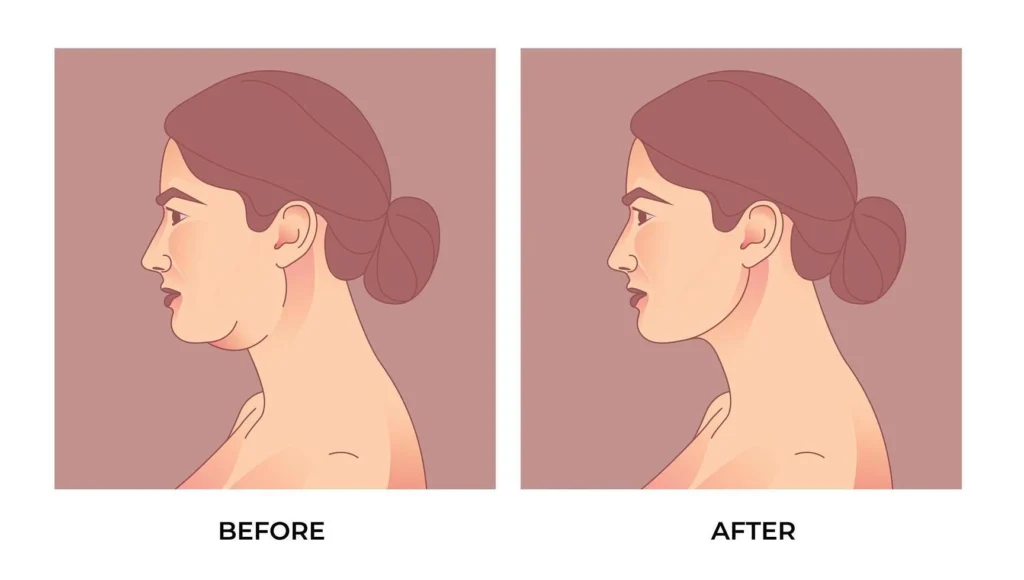
This treatment removes fat. It does nothing for skin, and that distinction eliminates more candidates than any other factor. If the fullness under your chin is loose or sagging skin rather than a fat pad, dissolving what little fat sits there can genuinely make things look worse, because you’ve removed the volume that was propping the skin up. Age matters here. Skin elasticity declines over time, which is why the trials focused on adults with decent skin tone and why an ethical injector will pinch and assess before quoting you anything.
A few more honest exclusions. If your submental fullness is mostly platysma muscle or gland rather than fat, injections into it accomplish nothing. If you’re planning significant weight loss, do that first, since your chin may resolve on its own and the treatment plan will shrink either way. And Kybella is FDA-approved for the under-chin area only. Providers do use it off-label on jowls, bra fat, and elsewhere, but the trial evidence you just read applies to the chin, and off-label use rides on far thinner data.
The Injector Matters More Here Than With Almost Any Other Cosmetic Injection
The space under your chin is crowded. The marginal mandibular nerve runs right through the neighborhood, which is exactly why that 4.3% crooked-smile statistic exists, and why the FDA restricts administration to trained healthcare professionals. Grid marking, dosing per site, depth of injection, all of it is technique, and technique is experience. Ask any prospective provider how many Kybella treatments they’ve personally performed, ask to see their own before-and-afters rather than the manufacturer’s, and ask what their protocol is if a nerve issue shows up. Patients weighing Kybella treatments in Chicago tend to end up at established aesthetic practices like ImageLab Med Spa for exactly this reason, since a clinic that does chin contouring routinely has seen the odd cases, not just the easy ones.
Speaking of which, one practical filter that works anywhere: if a clinic quotes you a total price before anyone has physically examined your chin, walk. Vial count can’t be known from a phone call, and a quote invented without an exam is a sales number, not a treatment plan.
How fast will I see something? Most patients notice change 4 to 6 weeks after a session, with full results a month or so after the final one. Twelve weeks post-treatment is the standard checkpoint the trials used.
Does it hurt? The injections sting and burn for a few minutes, which ice and numbing cream blunt but don’t erase. The tenderness afterward is the bigger deal.
Is one session ever enough? Occasionally, for very mild fullness. The trial protocols allowed up to six sessions, and the 12-month study’s average patient received about 4.7 treatments. Budget for the plan, not the teaser price.
The treatment does what the trials say it does. My only real gripe is with the marketing around it, which sells a $600 entry price and a serene stock photo for what is honestly a $4,000-ish commitment and two weeks of hiding your chin in scarves per round. Go in knowing that, and Kybella earns its spot. Go in on the teaser math, and you’ll be the next person writing the angry forum post my friend almost wrote.

