


The earliest known mention of a stubby holder in print dates from 1970, in an Australian Women’s Weekly story about navy women stationed in South Australia. Nobody has ever settled who invented the thing. The Australian Food Timeline lists half a dozen claimants and concludes that the true origin will probably stay a mystery.
More than fifty years on, it hardly matters. There’s one in the door pocket of the ute, a few in the camping tub, and a stack in the kitchen drawer with logos from a cousin’s wedding, a footy club that folded and a plumber who came out once in 2019. That drawer is the reason marketers like them. Plenty of giveaways don’t last the month, while a stubby holder is still being handed around at barbecues years after the event it was made for.
Why a Stubby Holder Gets Kept When The Branded Pen Doesn’t
People keep it because it does a job, and the logo is there each time it’s used.
The research on this is consistent, even if none of it is about stubby holders in particular. The biggest regular study of promotional products is run by the Advertising Specialty Institute in the US, and its 2026 findings on drinkware are about as close as the data gets. In that survey, 87% of people said they’d keep a branded drinkware item because it was useful. More than three-quarters said they’d use it at least once a week and hold on to it for a year or longer.
A fair warning about those numbers. They come from bottles, mugs and tumblers, and from consumers in North America and Europe. No one, as far as we could find, has published a study that isolates the Australian stubby holder. Older Australian research from the industry body APPA agrees with it, though. In its survey of people who had received promotional gifts, 76.4% said they kept them because they were useful, and 76.1% could name the advertiser on the product. It also found the kitchen was the number one place those items were kept and used.
A stubby holder fits that pattern neatly. It costs nothing to keep, takes up no room, and solves a small problem that turns up every warm weekend: a cold drink that won’t stay cold, and a wet hand.
Who Sees The Logo, And How Often
The institute works out a product’s reach with a simple sum: how long people keep it, multiplied by how often they use it, multiplied by how many others are around when they do. For drinkware as a whole, that comes to roughly 1,300 impressions over the life of one item.
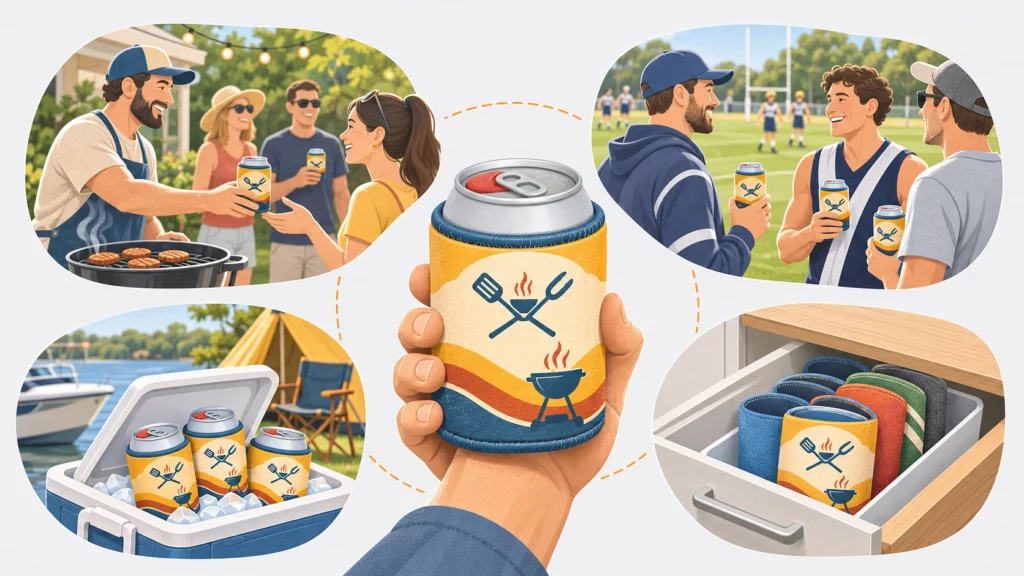
It’s the last part of the sum where a stubby holder does better than most merchandise. A branded pen is used alone at a desk, and a tote bag is seen by strangers who walk past it. A stubby holder comes out when there’s company. Think about where they actually turn up:
- around the barbecue, where one person fetches the drinks and hands out whatever holders are in the drawer.
- on the sideline at Saturday sport.
- in the esky on a camping trip or a day on the boat.
- at the work Christmas party, the engagement, the fortieth.
In each of those settings it sits in someone’s hand at chest height for as long as the drink lasts, facing whoever they’re talking to. And because the host hands them out, your holder ends up with people who were never at your event and have never heard of you. Sooner or later somebody turns it round, reads it and asks who Dave’s Concreting is.
There’s a slower effect as well. A household’s eight or ten holders come out of one drawer for years, so the family sees your name over and over without really noticing, and APPA’s recall figure suggests it sticks.
What Separates a Keeper From One That Gets Thrown Out
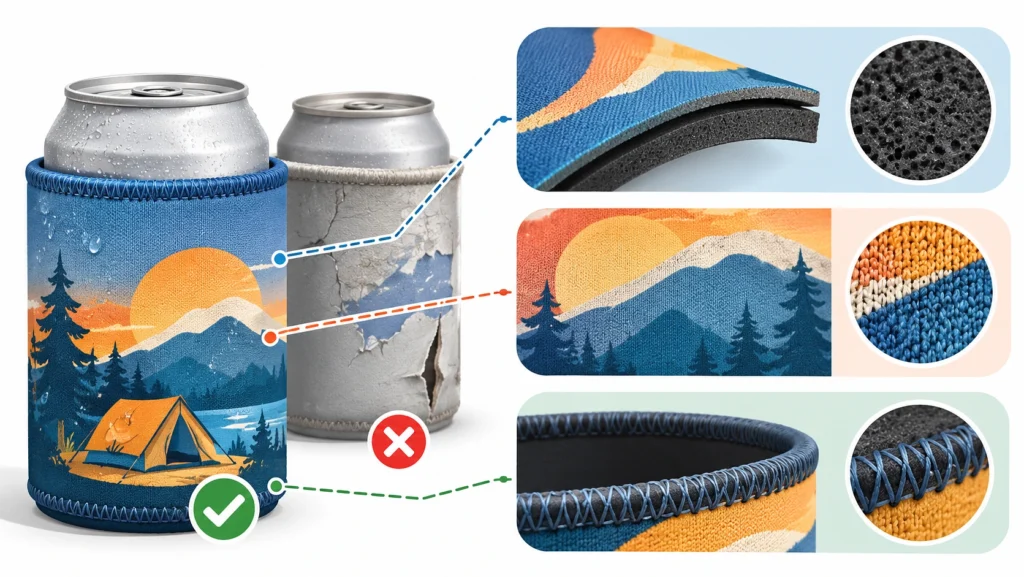
Not every stubby holder makes it to the drawer. APPA’s newer research, summarised in a piece titled What end users really want, and why cheap is never actually cheap, puts it bluntly: recall only happens when people use an item, and they only show it off when they’re proud to be seen with it. For a stubby holder that comes down to three things.
The Material
Neoprene is the wetsuit rubber, and it’s what the good ones are made of. It’s soft, it springs back, and it grips a wet can. The thin foam kind tends to crease and split, and a split holder goes in the bin with your logo on it.
The Print
A logo that cracks and flakes after a summer in the esky does a brand no favours. Dye sublimation, where the ink is fixed into the fabric itself, avoids that. Soupcan, an Australian maker, prints its stubby holder range this way and says the image won’t crack or peel. Its holders are also double stitched and overlocked, which matters more than it sounds when something is pulled on and off a can a few hundred times.
The Design
This is the part that’s easiest to get wrong. A logo on a plain background is an ad, and people can tell. The holders that get picked out of the drawer first have something on them worth picking: a decent joke, the club colours, the date of the grand final, a drawing of the boss’s dog. Put the business name and number on as well, by all means. Give the person holding it a reason to like it first.
Which Businesses And Occasions Suit Them
Anything local and face to face. A national bank gains little from a stubby holder. A business whose customers live within twenty minutes gains a good deal, because the holder stays in the area and gets seen by neighbours.
Tradies are the obvious case. A sparky who leaves one on the kitchen bench at the end of a job has put a phone number in that house for years, somewhere it will be found when the hot water goes. Sports clubs use them for fundraising and for the end-of-season do, and a premiership-year holder becomes something members hang on to on purpose.
Then there are the personal ones. Weddings, fortieths, hens’ and bucks’ weekends and family reunions are a staple for the printers, and Soupcan lists all of those alongside its tradie and club ranges. A wedding holder is no use for marketing, but it explains the habit. People are used to treating these as keepsakes, in the way they might keep one of the custom figure keychains made as a likeness of a friend, and a business holder inherits some of that goodwill.
Cafes, breweries, caravan parks, fishing charters and real estate agents all hand them out for similar reasons. If your customers are the sort who spend weekends outside, and particularly if they’ve just built somewhere to do it (this guide to planning an outdoor living area is for them), a stubby holder will get used.
What to Sort Out Before You Order
A first order doesn’t take long to arrange, though a few decisions make the difference between a box that’s gone in a month and one that sits in the storeroom.
- How many. Price lists generally start at 50. Order for the people you’ll actually see in the next six months, and reorder if they go quickly.
- Which size. Standard cans, slim cans and long necks each need their own holder. Find out what your crowd drinks.
- Artwork. A full wrap gives you the whole surface to work with. Soupcan’s template for one is 220mm by 130mm, which is a useful size to brief a designer with.
- Timing. Allow a week or so for delivery within Australia, more before Christmas, and ask about an express option if the event is close.
- Who it’s for. A stubby holder is tied to drinking in most people’s minds. They fit a can of lemonade just as well, but think twice before putting one in a junior club’s welcome pack.
As for handing them out, put them where a drink is about to be opened. A box left on the counter is easy to walk past, whereas a holder slipped onto the first can at the client barbecue usually goes home with the person holding it.

