


A friend called me last spring, thrilled, because a clinic had offered to “burn the nerves causing her back pain” and make it stop for a year. She wanted to know if it sounded too good to be true. My answer was that the procedure is real and genuinely effective, but that the sentence she’d been sold skipped the single most important part, the test that comes first, and that skipping it is exactly how people end up with a burned nerve and the same pain they walked in with. She hadn’t been told about that test at all. That omission is the reason this article exists.
Radiofrequency ablation, RFA, is a legitimate and well-studied treatment that helps a specific group of people a great deal and does nothing for everyone else, and the difference between those two groups isn’t luck. It’s a diagnostic gate almost nobody explains in the brochure. So here’s the honest version: what RFA actually does, who it truly helps, how long the relief really lasts, and why the test before the procedure matters more than the procedure.
What RFA Actually Does
The mechanism is simpler than the name. RFA uses a specialized needle to deliver radiofrequency energy that heats a tiny target of tissue, and in doing so it disrupts specific small nerves so they can no longer carry pain signals to the brain. It doesn’t fix the underlying joint or structure. It interrupts the messenger, not the message, quieting the pain signal from a problem that’s still physically there.
The most common and best-supported use is for facet joint pain, the small stabilizing joints running up the back of your spine. The nerves carrying pain from those joints, the medial branch nerves, are small, predictable, and reachable, which makes them an ideal RFA target. That’s why “back and neck pain” is the headline use, though RFA is also used for certain knee, hip, and other joint pains on the same principle: find a nerve reliably carrying the pain, and quiet it.
Two things it is not. It is not surgery, it’s a needle procedure done with live X-ray guidance, usually outpatient, usually with you home the same day. And it is not a cure, because the structure generating the pain remains, which becomes important when we get to how long relief lasts.
The Test You Need First, and Why It Decides Everything

Here’s the part my friend’s clinic left out, and it’s the hinge of the entire treatment. Before RFA is worth doing, you need a diagnostic medial branch block, and understanding why turns this from a gamble into medicine.
Your back has many possible pain sources stacked on top of each other: facet joints, discs, muscles, ligaments, nerves. History, exam, and even an MRI can suggest the facet joints are the culprit, but they cannot confirm it, and RFA only works if the facet nerves are genuinely the ones carrying your pain. The medial branch block settles the question directly. A physician injects a small amount of numbing anesthetic precisely onto those medial branch nerves, and then you simply report what happens to your pain. If numbing those exact nerves erases most of your pain, they were the messengers, and ablating them will help. If numbing them changes little, your pain is coming from somewhere else, and no amount of ablation will touch it.
This is why the block is a gate, not a formality. The clinical evidence is blunt about it: a positive response to diagnostic blocks strongly predicts whether the ablation will work, and the guideline standard is demanding on purpose. Most guidelines call for two separate blocks, done on different occasions, each producing roughly 80 percent or more pain relief, before proceeding to RFA. The two-block, high-threshold standard exists because it dramatically raises the odds that the person on the table is someone RFA will actually help.
So the uncomfortable translation of my friend’s offer: a clinic proposing to ablate your nerves without first proving, via a block, that those nerves are the problem is proposing to burn something on a hunch. If nobody has mentioned a diagnostic block, that is the question to ask before anything else, and a good pain physician not only expects the question, they built their plan around it.
Who It Actually Helps
Put the mechanism and the gate together and the ideal RFA candidate comes into sharp focus, which is more useful than any general “back pain sufferer” description.
- People with confirmed facet joint pain, meaning the medial branch blocks worked, are the core group. This is the whole ballgame, and it’s why the block comes first.
- People with chronic, persistent pain that’s already outlasted the conservative options, physical therapy, medication, activity changes, rather than fresh or first-line cases.
- People whose pain is mechanical and localized, often worse with bending backward, twisting, or standing, patterns typical of facet-driven pain, rather than shooting nerve pain down a limb, which usually points to a different source and a different treatment.
And just as usefully, who it tends not to help people whose pain comes primarily from a disc, a pinched spinal nerve, or widespread non-specific back pain, and people who didn’t get meaningful relief from the diagnostic block. For them RFA isn’t a longer shot, it’s the wrong tool, and the block is what reveals that before a needle is ever aimed at the wrong nerve.
How Long the Relief Actually Lasts
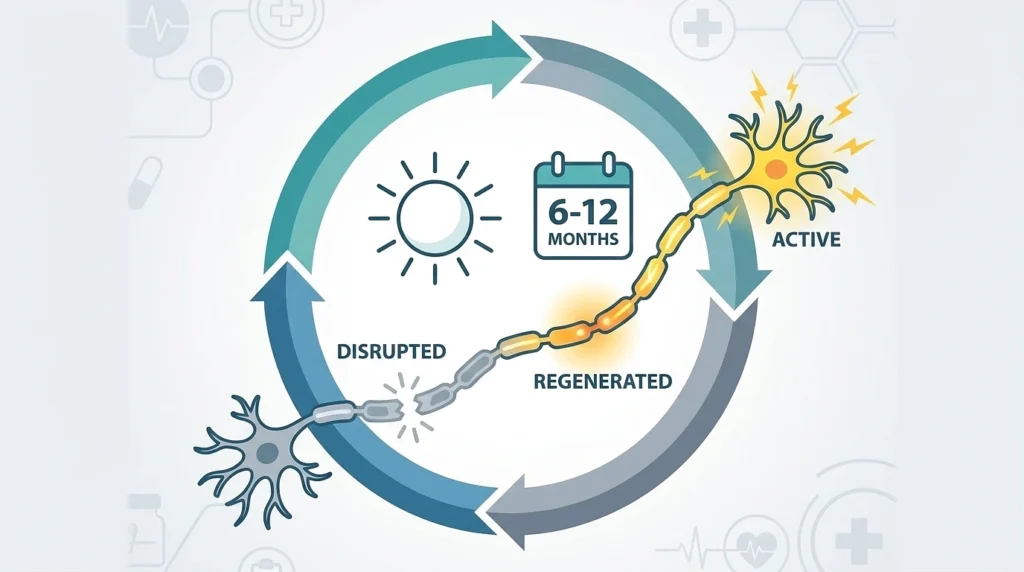
Now the honest answer to the year-of-relief promise, which is both real and more complicated than the pitch.
When RFA works in a well-selected patient, relief commonly lasts somewhere in the range of six months to a year or more, with many studies clustering around that window and real-world data showing roughly half of carefully selected patients still meaningfully improved at the twelve-month mark. That’s a genuinely good result for chronic pain. But the mechanism explains the ceiling: the treated nerves grow back. Ablation disrupts them, it doesn’t remove them permanently, and over months they regenerate, which is why the relief is measured in months and years rather than “forever.”
The reassuring flip side is that RFA is repeatable. When the nerves regrow and pain returns, the procedure can generally be done again, and for many people it becomes a periodic maintenance treatment, roughly annual, that keeps chronic facet pain manageable without surgery or long-term reliance on pain medication. So the accurate framing isn’t “a year and then it fails.” It’s “a year or so of relief per treatment, renewable,” which for the right person is a genuinely sustainable way to live with a chronic problem. Individual results vary widely with technique, anatomy, and how well the patient was selected in the first place, which loops back, again, to the block.
The Honest Summary Before You Book
RFA is one of the better tools in chronic pain medicine for a specific job, quieting confirmed facet joint pain, and a weak-to-useless tool for pain coming from anywhere else, which is the entire reason the diagnostic block exists. Relief typically runs six months to a year or beyond per treatment, the nerves regrow, and the procedure can be repeated as needed. The candidates it helps most are people with chronic, mechanical, block-confirmed facet pain who’ve already tried the conservative options.
One closing note, offered plainly because this is your spine and a real medical decision, not an article’s to make. Everything here describes the general shape of RFA, and your specific pain, its cause, your physical health, and your options belong in a conversation with a qualified pain physician who examines you. Use this to ask sharper questions, above all “have we confirmed with a diagnostic block that my facet nerves are actually the source,” and treat any offer to skip that step as your signal to seek a second opinion rather than a shortcut to take. My friend, for what it’s worth, asked her clinic that exact question, got a diagnostic block, learned her facet joints were indeed the source, and had a genuinely good year afterward. The test first is what made the treatment work.

