


$25,000.
That’s the low end of what a medical evacuation costs, and it only gets you moved somewhere inside North America. Fly someone home from farther away and the CDC puts the bill at more than $250,000. People buy travel insurance thinking about lost luggage. The policies earn their money on the ugly stuff.
Below are the trip disasters that actually happen to ordinary travelers, what each one roughly costs, and whether a standard policy would have covered it. Some answers are a clean yes. A couple are a flat no, and people tend to learn that at the claims desk.
Travel insurance pays best on medical emergencies and airline chaos, and worst on anything you knew about before you booked.
Broke Your Ankle On A Hike? Getting Home Costs More Than The Hospital
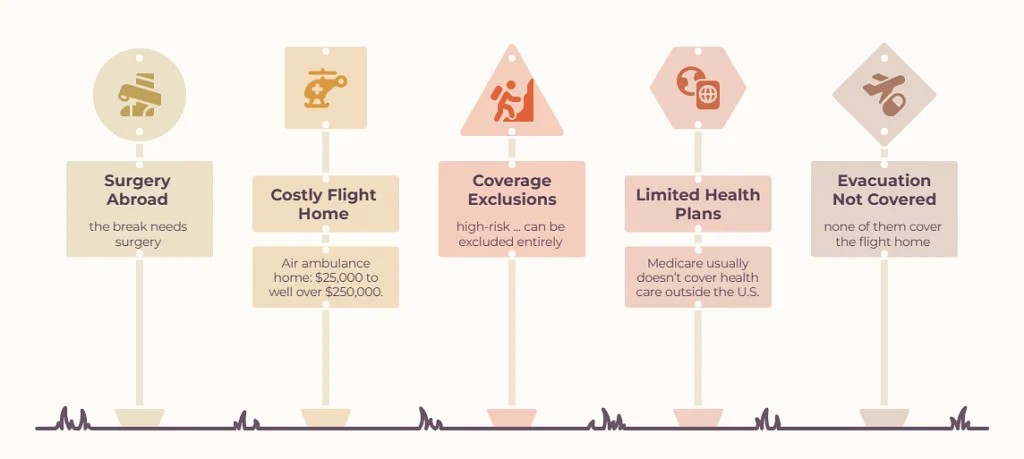
Picture a slip on a wet trail in Costa Rica. The local clinic sets the ankle, but the break needs surgery, and you’d rather have it done at home. Now you need a medical flight with a nurse on board, or at least a business-class seat with your leg up, a wheelchair at both ends and a companion ticket.
The rough bill looks like this:
- Local ER, X-rays and a cast: a few hundred to a few thousand dollars, depending on the country.
- Surgery abroad, if you can’t wait: often five figures.
- Air ambulance home: $25,000 to well over $250,000.
Would Insurance Pay For That Flight?
Yes, if you bought travel medical coverage with evacuation included. That’s a separate line from trip cancellation, and plenty of cheap plans leave it out. Two catches. The insurer decides whether you get flown home, not you. And if the injury happened during something the policy calls high-risk, like climbing, skydiving or scuba below a certain depth, it can be excluded entirely. Read that list before you go zip-lining.
Your Health Plan Probably Won’t Help
American travelers over 65 get caught here constantly. Medicare usually doesn’t cover health care outside the U.S., and in most cases you pay all of the costs yourself. Some Medigap plans pick up emergency care in the first 60 days of a trip, up to a $50,000 lifetime cap, and none of them cover the flight home. Plenty of private U.S. health plans are just as thin overseas. Call yours and ask the exact question: “Do you cover an emergency room visit in another country, and do you pay for medical evacuation?”
If your own health plan says no to evacuation, travel medical coverage is the single most important thing to buy for an international trip.
Old Health Problems Get Claims Denied
This is the fail nobody plans for. A traveler with a heart condition has a flare-up in Lisbon, spends two nights in the hospital, files a claim, and gets a letter back saying no.
The reason is the pre-existing condition clause. Many policies exclude any condition that needed treatment or a medication change in roughly the 90 days before you left. One study cited by the CDC found insurers only fully paid about two-thirds of claims, and pre-existing illness was one of the top reasons for refusals, right next to missing paperwork.
Can A Waiver Save The Claim?
Maybe not. Some plans offer a pre-existing condition waiver if you buy the policy within a short window after your first trip payment, often 14 to 21 days. Miss that window and the waiver’s gone. If you’re over 75, start shopping early, because coverage for existing conditions gets much harder to find.
The Airline Canceled. Who Pays For Tonight’s Hotel?
Your 7 p.m. flight out of Denver gets scrapped. The next seat is tomorrow afternoon. You need a hotel, two meals and an Uber, so call it $250 to $400 for one bad night.
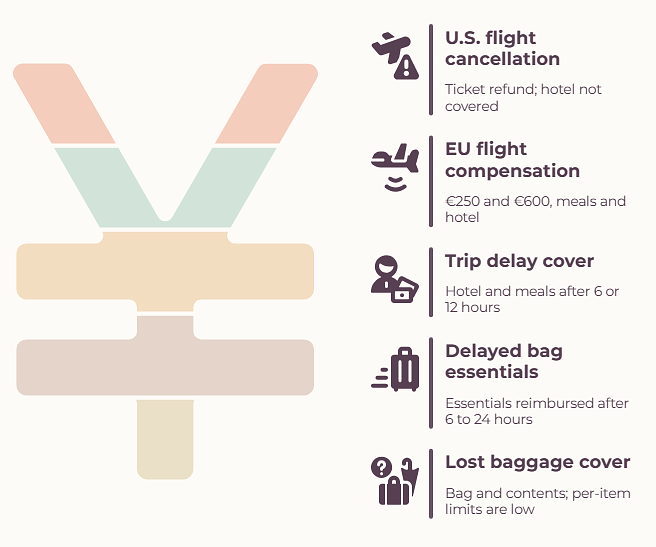
The airline owes you less than you’d hope. Under U.S. Department of Transportation rules, you’re entitled to an automatic cash refund if your flight is canceled or significantly changed and you don’t accept the rebooking. “Significantly” means more than three hours on a domestic flight or six on an international one. That refund covers the ticket. It doesn’t cover your hotel.
Flying in Europe changes the math. If a flight from an EU airport, or on an EU airline into Europe, arrives three or more hours late for reasons the airline controls, EU passenger rules set compensation between €250 and €600 depending on distance, on top of meals and a hotel if you’re stuck overnight.
Trip Delay Cover Pays For The Night
Yes, for the hotel and meals, as long as the delay passes the policy’s minimum. Trip delay coverage commonly kicks in after 6 or 12 hours and pays a daily limit with receipts. Keep every receipt and get the airline to put the cancellation reason in writing.
“My Bag Is Still In Frankfurt”
You land in Rome on a Saturday morning. Your suitcase doesn’t. The airline says Monday, maybe Tuesday. Meanwhile you need clothes, a charger, toiletries and something to wear to dinner. That’s easily $200 to $500 before the bag turns up.
The DOT rules give you back your checked bag fee if the bag isn’t delivered within 12 hours of a domestic flight landing, or 15 to 30 hours on an international one, as long as you filed a report. Your emergency shopping trip is a separate issue.
Keep The Receipts For Every T-Shirt
Yes, usually. Baggage delay coverage reimburses essentials after a set wait, often 6 to 24 hours, up to a daily cap. Lost baggage coverage pays for the bag and what’s in it if it never shows up, but the per-item limits are low, and electronics and jewelry often have their own smaller caps. Pack the expensive stuff in your carry-on.
You Just Don’t Want To Go Anymore
Work blows up, the relationship ends, or you simply change your mind two weeks out. You’ve got $3,000 in nonrefundable flights and hotels.
Standard Cancellation Says No
No, not with standard trip cancellation. Those policies only pay for listed reasons: your own illness, a death in the family, a hurricane at the destination, a layoff, and so on. Changing your mind isn’t on the list. The fix is a “cancel for any reason” upgrade, which costs more and typically refunds 50% to 75% of your trip cost, not all of it. You also have to buy it soon after you book.
Cancel for any reason is the only coverage that pays when you choose not to go, and it never pays back the full trip.
How To Check A Policy Before You Pay For It
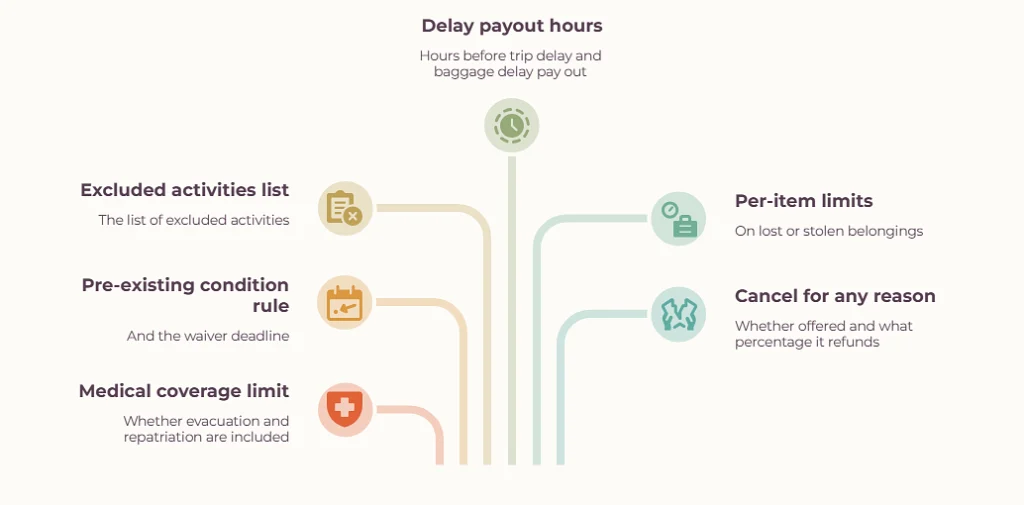
The cheapest plan on the comparison site is often cheap because it leaves out the expensive parts. You might buy through a credit card perk, a travel agent, or travel insurance online direct from an insurer like HDFC ERGO. Either way, find these lines in the policy wording:
- Medical coverage limit, and whether evacuation and repatriation are included.
- The pre-existing condition rule and the waiver deadline.
- The list of excluded activities.
- How many hours of delay before trip delay and baggage delay pay out.
- Per-item limits on lost or stolen belongings.
- Whether cancel for any reason is offered, and what percentage it refunds.
Some of this overlaps with protection you might already have. Plenty of premium credit cards include trip delay and baggage coverage when you pay for the flight with the card, so check yours before you double up. Ask your bank too, as part of a broader look at whether your bank still fits the way you travel and spend.
Before the trip, snap photos of your receipts, your passport and the policy itself, and keep them somewhere you can reach from your phone. A vacation checklist sorted by when things matter helps here, and if you’re booking somewhere remote, factor in the transfers and add-ons that never show up in the headline price, like those in this breakdown of overwater bungalows under $500 and the transfer costs nobody quotes. Remote places are exactly where an evacuation bill gets huge.

