



In April 2003, a 27-year-old climber named Aron Ralston parked his truck in the Utah desert and walked into a slot canyon alone. He had told nobody where he was going. Partway down, a boulder shifted and pinned his right arm against the rock wall. He stayed there for more than five days, and he got out by cutting off his own forearm with a cheap multi-tool.
His employer reported him missing when he failed to turn up for work, but nobody could tell the police which canyon he had gone to. Ralston has said since that leaving no word of his plans was his biggest mistake.
Most of us will never see the inside of a slot canyon. The same gap opens on ordinary nights, though, every time someone sets off alone and nobody is expecting them at a particular hour.
The remedy is dull and it works. Before you leave, tell one person which way you are going and what time you should arrive.
What The Message Should Say
For a walk home, one line covers it: “Taking the river path, back by 7:15.” The route matters more than the destination. Your friend already knows where you live. What they do not know is whether you went by the main road or cut through the park.
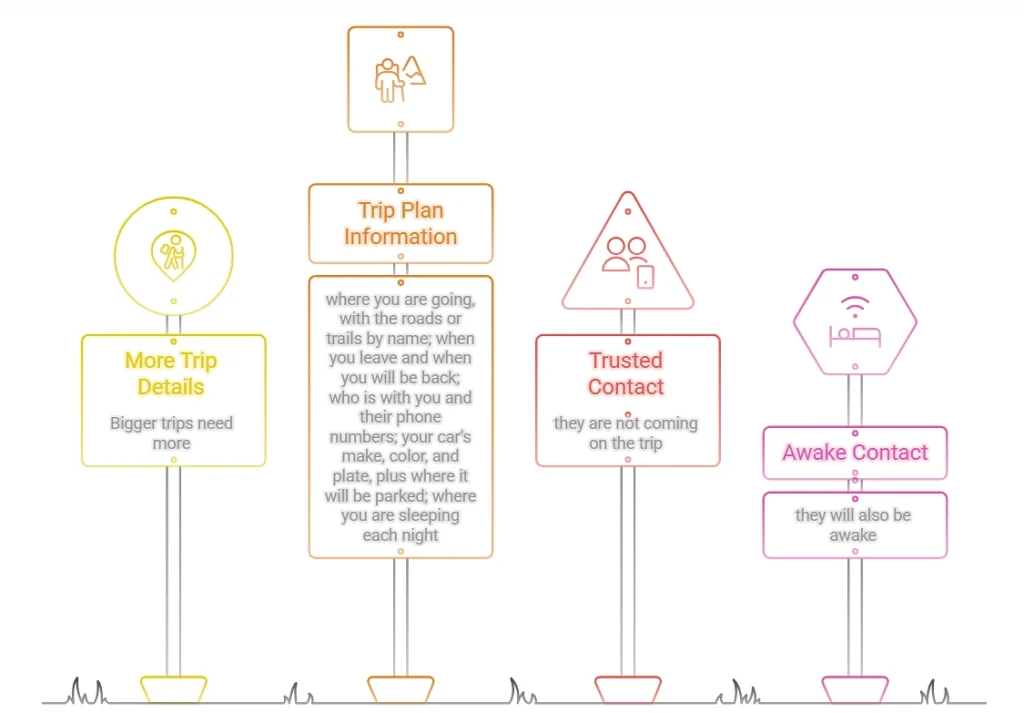
Bigger trips need more, and there is no reason to invent a format when the National Park Service has already published one. Its trip plan asks for:
- where you are going, with the roads or trails by name.
- when you leave and when you will be back.
- who is with you and their phone numbers.
- your car’s make, color, and plate, plus where it will be parked.
- where you are sleeping each night.
A photo of a paper map with the route inked in does the job just as well as a typed list.
Be choosy about who gets the message. The Park Service calls this person a “Trusted Contact” and sets a single condition, which is that they are not coming on the trip. It helps if they will also be awake. A roommate who is asleep by nine is no use to someone walking home at midnight.
Give Your Contact a Deadline
“I’ll text when I’m back” sounds responsible and leaves a hole. If the text never comes, how long should the other person wait? An hour? Until morning? People in that position tend to do nothing, because calling the police over a late friend feels like an overreaction.
Take the decision off their shoulders. The Park Service form does it in one filled-in sentence, along the lines of: if we are not back at this place by this time, call this number. Your version might be “home by 7:15, and if you’ve heard nothing by 7:45, call me, then call the police.” Half an hour of slack is plenty in a city. On a mountain, allow a few hours, since slow descents are common.
Then keep your side of the bargain and say when you are in. A friend who has sat up worrying over nothing will be slower to react next time.
Nobody Official is Keeping Track Of You
People are often surprised by this. Rangers do not tick visitors off a list at closing time. The Park Service states that it will not accept a visitor’s Trip Plan and does not monitor anyone’s progress. The Coast Guard goes further and prints “Do NOT file this plan with the U.S. Coast Guard” on the front of its own float plan form, which is about as plain as a government document gets.
Both agencies act when a member of the public phones in to say that a named person is overdue. Until that call arrives, there is no search.
Once it does arrive, whatever you told your contact becomes the starting point. A trail name narrows many square miles to a few. A description of your car lets a ranger drive to the trailhead and see whether it is still there. This is also why changing your mind halfway is risky. If you take a different route and say nothing, the Park Service warns, the people looking for you may be sent to the wrong place.
Phones Help, Up To a Point
Apple built a version of this into the iPhone in 2023. Check In sits in the Messages app. You pick a friend, set a destination, and go. Your friend is told when the phone arrives. If the phone stops moving toward the destination, it asks you to confirm that you are fine, and after 15 minutes without an answer it notifies your friend and shares your location and battery level.
It is a clever feature with a short list of catches. Both people need iOS 17 or later. Apple does not offer it in every country. And it is no help to the large share of the world on Android, where the nearest substitute is live location sharing in Google Maps or WhatsApp. Those apps show where a phone is. They will not sound an alarm when it stops.
Batteries die, of course, and signal vanishes in exactly the places where people come to grief. The Park Service tells visitors plainly that they may have no service in a park. Treat the phone as a second line of defense behind a person who has your plan.
The Same Rule For Work, Dates, And Running
Much of the modern advice on this subject traces back to one case in London. In 1986, Suzy Lamplugh, a 25-year-old real estate agent, left her office to show a house to a client nobody at the firm knew. She was never seen again and was declared dead in 1993. Her parents set up the Suzy Lamplugh Trust, and its guidance for people who work alone has been copied into British police and employer handbooks ever since. The core of it is a question every lone worker is supposed to be able to answer: would someone raise the alarm if you did not come back when you were supposed to?
That question is worth asking outside office hours too.
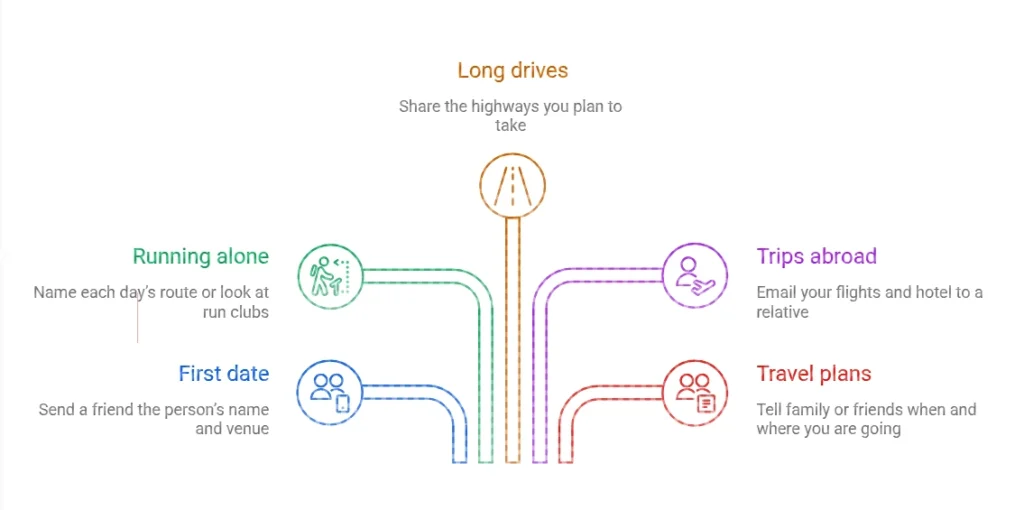
A first date is the obvious case. Send a friend the person’s name and the venue, and say when you expect to leave.
Runners have a wrinkle of their own. Safety advice tells them to change route from day to day, so last week’s loop tells nobody where they are tonight, and the route has to be named each time. Anyone uneasy about running alone after dark could look at the run clubs that have sprung up in most cities.
Long drives and trips abroad are simpler. Share the highways you plan to take, or email your flights and hotel to a relative, and add a line to your packing checklist so that it gets done.
Britain’s Victim Support charity boils all of this down to one instruction: make travel plans in advance and let family or friends know when and where you are going.
What Rescuers Need to Know About You
Being located is one problem solved. There may be another. A person who has collapsed or been knocked unconscious cannot explain that they are diabetic or allergic to penicillin.
Paramedics are trained for this. According to Nationwide Children’s Hospital, emergency crews look at the wrists first and the neck second for medical identification, and they do not normally search a wallet or try to unlock a phone. For anyone with epilepsy, a heart condition, type 1 diabetes, or a severe allergy, that makes a medical wristband the most reliable way to pass the message on.
There is not much room on one, so leave off anything that would not change how you are treated. “Type 1 diabetes, insulin” is useful. A home address is not. Children with serious allergies are obvious candidates, and parents already teaching children with food allergies to speak up can think of the band as cover for the days a child is too ill to talk.
Learn First Aid Before You Need It
The first person to reach a casualty is often not a professional. It is whoever happened to be there, and for that reason the Park Service suggests that at least one person in any group know CPR and first aid.
The training is similar the world over. Whether it is a Red Cross class in Ohio or one of the first aid courses Singapore employers send their staff on, expect to spend a day in a classroom, kneeling on the floor and pressing on the chest of a plastic dummy. The dummy is harder to compress than most people expect, which is rather the point of practicing.