


A woman was admitted after fainting, with a heart attack in progress. She received high-dose intravenous vitamin C. Her point-of-care glucose readings came back high, she was treated for diabetic ketoacidosis on the strength of those readings, and the physicians who wrote up the case concluded the erroneous readings probably contributed to her death.
The vitamin C had not raised her blood sugar. It had fooled the meter.
That case sits in the AACE Clinical Case Reports literature under a title that does not soften it: pseudohyperglycemia managed as diabetic ketoacidosis, described by its authors as an endocrinological catastrophe. It is the reason this article starts here rather than with sore arms and nausea.
Vitamin C And Glucose Look Similar Enough to Confuse a Glucometer
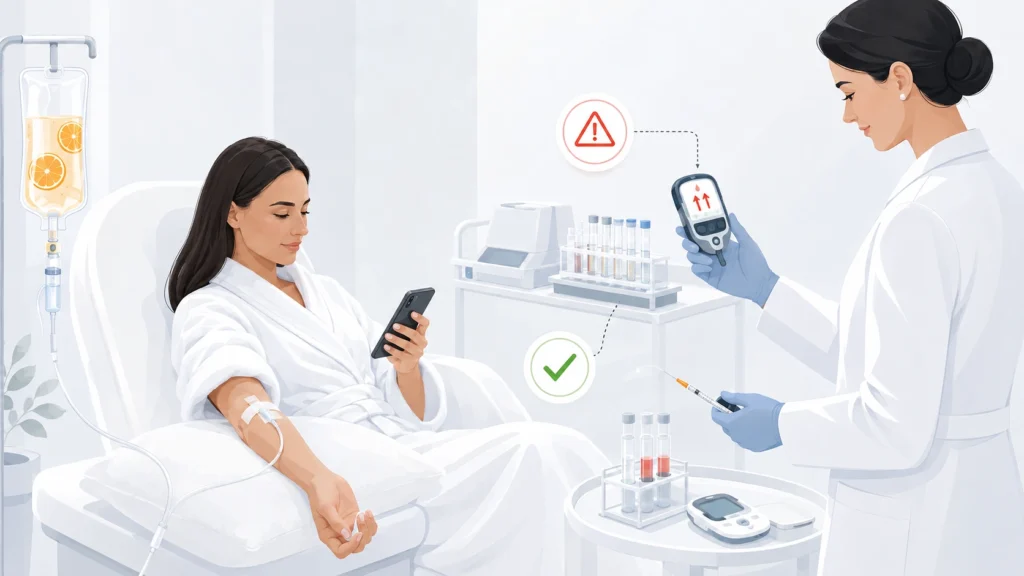
The molecules are structurally alike. Many point-of-care glucose meters read one as the other, which produces falsely elevated blood sugar readings while the patient’s actual glucose may be normal or low.
Treating a false high means giving insulin somebody does not need.
Research protocols take this seriously in a way wellness clinics generally do not. The VICToRY trial, testing vitamin C in burn patients, mandates that glucose can only be measured by core laboratory assay, by a point-of-care blood gas machine validated for high plasma vitamin C IV drip, or by one specific glucometer model validated in that setting. That restriction runs for seven days after the last dose.
Seven days. Not seven hours.
If you use insulin and you are considering an IV vitamin C infusion, this is the question to bring: what will my glucose readings do, for how long, and what should I use to measure them. A clinic that has not thought about it is telling you something.
Three of Four Patients With Known G6PD Deficiency Developed Hemolysis
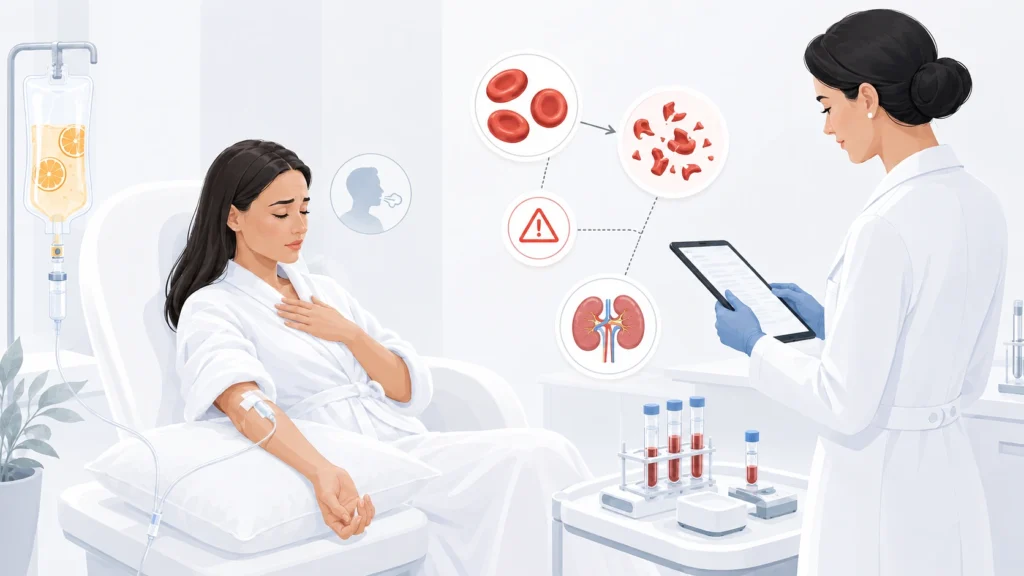
Glucose-6-phosphate dehydrogenase deficiency is the other serious risk, and the numbers underneath it are worth separating carefully.
Across a scoping review covering 2,801 patients who received high-dose intravenous vitamin C, hemolysis occurred in three people. That is 0.1%, which sounds reassuring until you read the denominator properly. Those three were among four patients in the entire dataset known to have G6PD deficiency.
Rare in the population. Close to expected if you have the condition.
Hemolysis means red blood cells rupturing. In a meta-summary of fourteen published cases, half the patients went on to develop further complications including acute kidney injury, disseminated intravascular coagulation, oxalosis and methemoglobinemia. Around 78% of complications appeared within three days. One patient died.
Two details from that review deserve more weight than they usually get.
Only two of the fourteen had any previous history of hemolysis. Most did not know they were at risk, which is the entire problem with a condition that affects hundreds of millions of people worldwide and is frequently undiagnosed.
And 42.9% developed hemolysis after oral vitamin C, not intravenous. The IV route concentrates the risk. It does not own it.
There is also a published case of a patient who received 75 grams intravenously, developed breathlessness within an hour, and required three units of packed red cells across a five-day admission for continuing hemolysis. He was screened for G6PD deficiency during that stay and came back negative.
Kidney Injury Comes From Oxalate, And It Is The Second Most Reported Serious Harm
Ascorbic acid metabolises to oxalate. Oxalate binds calcium. Calcium oxalate crystals deposit in the renal tubules.
In that same 2,801-patient review, oxalate nephropathy was reported in five patients, with one case of kidney stones. Rates around 0.2%.
Anyone with existing kidney impairment, and anyone with a history of calcium oxalate stones, is starting from a worse position on this than the general population. That history is not a footnote for the intake form, it is the thing that should determine whether the infusion happens at all.
In Controlled Trials, Adverse Event Rates Matched Placebo
Here is the counterweight, and leaving it out would be dishonest.
The same scoping review examined nine double-blind randomised controlled trials covering 2,310 patients. Adverse event rates for high-dose vitamin C were identical to placebo in one study, numerically lower in another, and numerically higher in a third. Six of the nine reported no adverse events in either arm.
Its conclusion was that there is no consistent evidence high-dose IV vitamin C is more harmful than placebo in blinded trials.
Both things are true at once. The serious harms documented above are real, published and occasionally fatal. They are also rare, and they cluster in identifiable groups rather than falling randomly on whoever books an appointment.
Which makes screening, rather than avoidance, the sensible response.
The Routine Side Effects, Briefly
Most of what people actually experience is minor and self-limiting.
Vein irritation and pain at the infusion site, because concentrated ascorbic acid is hard on vein walls. Bruising, more so on blood thinners. Infiltration, where the solution leaks into surrounding tissue and the arm swells, tight and cool to the touch, requiring the line to come out and go somewhere else. Nausea, which usually settles if the drip rate is slowed. Fatigue afterwards. Considerably more urination for the rest of the day, since your kidneys are clearing an enormous excess.
Lightheadedness during infusion is common enough to expect, and usually reflects a drop in blood pressure. Tell the nurse rather than waiting to see. Racing or irregular heartbeat, cold sweats, sudden weakness or breathlessness warrant stopping the infusion, not monitoring it.
What to Establish Before Booking
Doses in the published literature run enormously wide, from 1 gram a day to 200, with a median around 22.5 grams in the reviewed trials. Wellness clinics commonly offer 15 to 25 grams, and starting at the lower end is standard practice for good reason.
Before any of that:
- Ask whether they screen for G6PD deficiency. Given that most affected patients in the case literature did not know they had it, a clinic offering high-dose infusions without testing is skipping the single most predictive safety check available.
- Get kidney function tested, and disclose any history of stones.
- Disclose diabetes and any insulin use, specifically because of the glucometer problem, and ask how long the interference lasts with their protocol.
- Disclose hemochromatosis or any iron overload disorder, since vitamin C increases iron absorption.
- Disclose anticoagulants, warfarin in particular.
Verify the facility is licensed with your state health department and that a qualified clinician supervises rather than merely signs off.
And take the question to your own doctor rather than the clinic selling the infusion. Most healthy smiles begin meet their vitamin C requirement from food at 75 to 90 milligrams a day, insurance does not cover these treatments, and the evidence that healthy people gain anything from doses a thousand times higher is considerably thinner than the marketing suggests.

