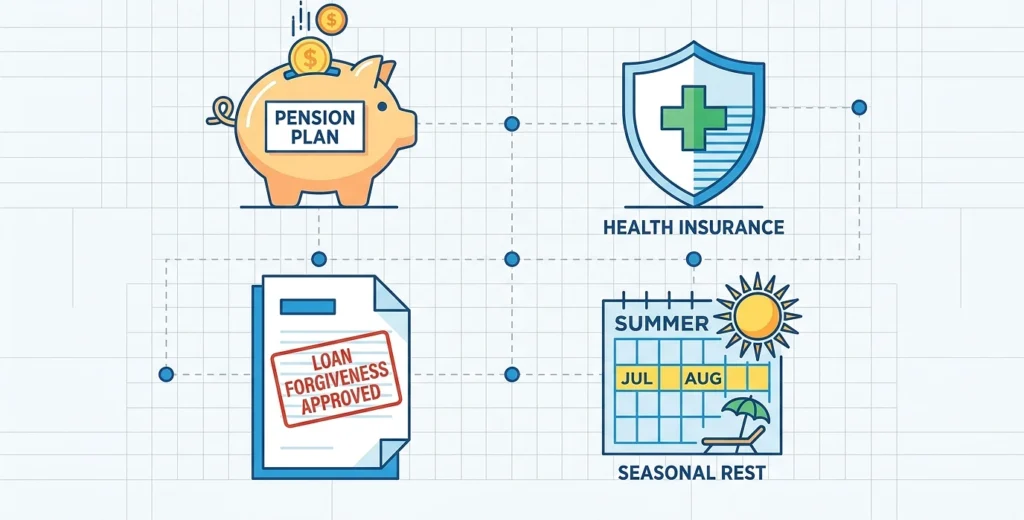
Yes, the pay cut is real and it is bigger than most people admit when they talk you into this move. Teachers in the US earn about 27% less than other workers with the same level of education skills, and if you are coming from a decent office salary you will feel that gap every single month for the first few years. And the switch is still worth it for most people who make it, because the pension, the healthcare, the loan forgiveness and the shape of the year quietly hand back a big chunk of what the salary takes away, and the work itself gives you something an office job was never going to pay you in any currency. The people it does not suit are the ones doing it for the summers off, and they tend to be gone within two years.
That is the short version. The longer version has actual numbers in it, and some of them are uncomfortable.
How Big the Pay Cut Actually Is
The average public school teacher in the US earned around $74,500 in the last school year according to NEA data, and the average starting salary sat at about $48,100. That starting figure is the one that matters if you are switching careers, because unless you carry serious credentials into the door, you are starting near the bottom of the pay scale no matter what you earned in your office job. A forty year old former project manager and a twenty two year old fresh graduate can land on almost the same step.
Where you teach changes the picture a lot, and it changes it more than most people expect.
Situation
Roughly what it pays
Average teacher salary, California
$101,000
Average teacher salary, Mississippi
$53,700
Starting salary, District of Columbia
$64,600
Starting salary, Montana
$36,700
Education support roles, national average
$38,500
So the honest math looks like this. If you are leaving a $90,000 office job in a mid cost state, your first teaching contract might pay half that, and it can take ten years or more on a step schedule to climb back to where you were. Some people read that and walk away right there, which is fair, and it is better to walk away now than in October of your first year.
One more number that deserves a bold line because it tells you how tight things really are for some educators. A Gallup poll found that 71% of US teachers hold at least one additional job to make ends meet. That is not a scare figure, it is mostly tutoring, summer school, coaching stipends and side work, but it tells you the base salary alone does not stretch far in plenty of districts.
The Money That Comes Back Through Benefits, Pensions and Time
The salary comparison on paper is unfair to education, because office jobs and school jobs pay in different shapes and the paycheck is only one of them.
Start with the pension. Most public school teachers are still enrolled in defined benefit pension plans, which barely exist in the private sector anymore, and a pension that pays you a percentage of your salary every year for the rest of your lifestyle is worth a very large amount of money that never shows up in a salary comparison table. Private sector workers get a 401k match if they are lucky, and the risk sits entirely on them.
Then the rest of the package, which stacks up quietly:
Health insurance through school districts is usually cheaper and broader than what mid size private employers offer.
Public Service Loan Forgiveness can wipe remaining federal student loans after ten years of qualifying payments in a public school role, which for some career changers is worth tens of thousands.
Job security in public education is stronger than almost any office role, and layoffs work on seniority rules rather than a surprise Tuesday meeting with HR.
The calendar gives you around two months a year that you can rest, retrain, or earn with, and summer income from tutoring or curriculum work can claw back a few thousand on its own.
None of that makes the pay gap disappear. It narrows it, and depending on your state and your loan balance, it can narrow it a lot.
Why the Work Feels Different, and Why That Ends Up Mattering More
This is the part with no numbers in it, because there are no numbers for it.
Anyone who has spent years in office work knows the specific tiredness it produces. I sat through the quarterly planning meeting, I updated the tracker, I sent the recap email about the meeting about the tracker, and if I quit tomorrow the company would absorb it by Friday and nothing in the world would be different. That feeling is not burnout exactly. It is the slow discovery that the work does not need you, it just needs someone.
Education is the opposite problem. The work needs you too much. It follows you home and living, it wakes you up at night before report cards, and a bad day in a classroom is worse than a bad day in any office because the bad day has faces. People who make the switch do not describe it as easier. They describe it as heavier and better at the same time, because a kid who could not read in September and can read in March is a result that belongs to you in a way no closed ticket or shipped deck ever did. Office work pays better and matters less, and at some point in a working life that trade stops being acceptable, and that point is usually the moment this whole career change starts.
Ways Into Education That Do Not Require Starting a Degree From Zero
The move is more open to career changers than it used to be, partly because teacher shortages forced states to build faster doors in.
Alternative Certification While You Work
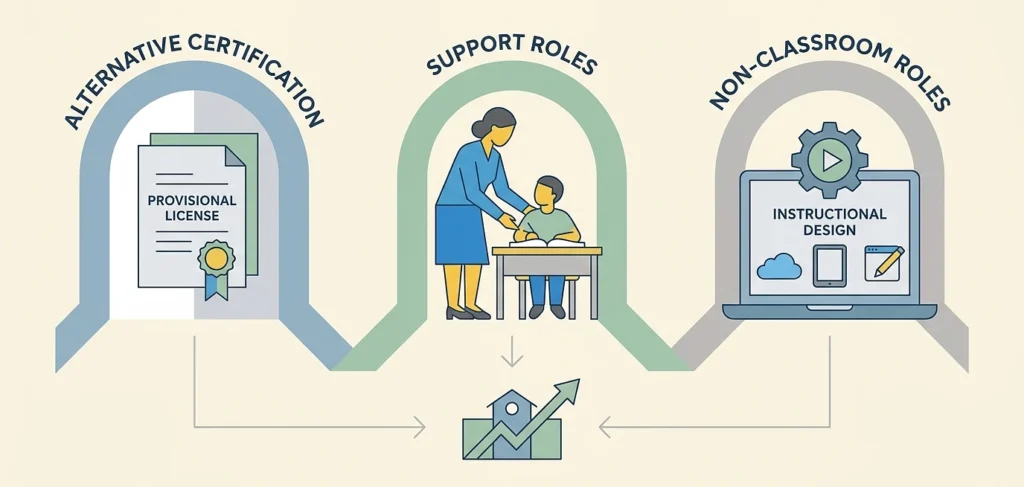
Most states now run alternative certification programs where a person with a bachelor’s degree in any field can start teaching on a provisional license and complete the pedagogy training alongside the job, usually over one to two years. Shortage subjects like math, science and special education are the easiest way in, and some districts attach signing bonuses to them.
Support Roles First
Teaching assistant and paraprofessional roles pay poorly, the national average sits under forty thousand, but they let you test the environment for a year before you commit to certification, and districts often help fund the license for support staff who want to move up. A lot of people quietly use this route as a paid trial run.
Education Jobs That Are Not Classrooms
Corporate training, instructional design, edtech content roles, school administration, adult education and private tutoring all count as a life in education, and instructional design in particular tends to pay close to office salaries because half the job is the office skill set you already have. If the classroom pay cut genuinely does not work for your mortgage, this side of the field is where former office workers land most comfortably.
Who Should Stay in the Office
Some people should not make this move, and pretending otherwise helps no one.
If your motivation list starts with summers off and finishes early, stay where you are, because the school year hours are longer than they look once grading and planning are added, and the people who came for the holidays are the fastest to leave. If you are the main earner in a household that is built around your current salary and you have no savings buffer for the transition years, the numbers above are your answer, at least until the mortgage shrinks. And if what you actually hate is your current company rather than office work itself, changing employers is a much cheaper experiment than changing careers.