


You wash your face, pat it dry, scoop out the thick jelly stuff from the tub, spread it over everything and go to bed pleased with yourself. Morning arrives and your cheeks feel exactly as tight as they did the night before. Nothing changed. So you assume you bought the wrong mask and go looking for a better one.
The mask was probably fine. What went wrong is that you used a sealing product with nothing underneath it to seal in.
A Night Mask Is A Lid, Not A Drink
Almost every sleeping mask on the market is built around occlusion. The formula sits on the surface, forms a water repellent film and slows down how fast water evaporates out of your skin into the bedroom air. Dermatologists call that evaporation transepidermal water loss, and it is the actual mechanism behind tight, flaky, uncomfortable skin.
Slowing it down works well. A film of petrolatum cuts water loss through the epidermis by close to 98 or 99%, which is why petroleum jelly has stayed in dermatology for over a century while thousands of prettier products came and went.
But a lid has to be a lid over something. If your skin was already low on water when you applied the mask, the film locks in a deficit and holds it there for eight hours. You wake up with the same dryness, sealed in neatly.
Three Jobs, And Your Mask Only Does One
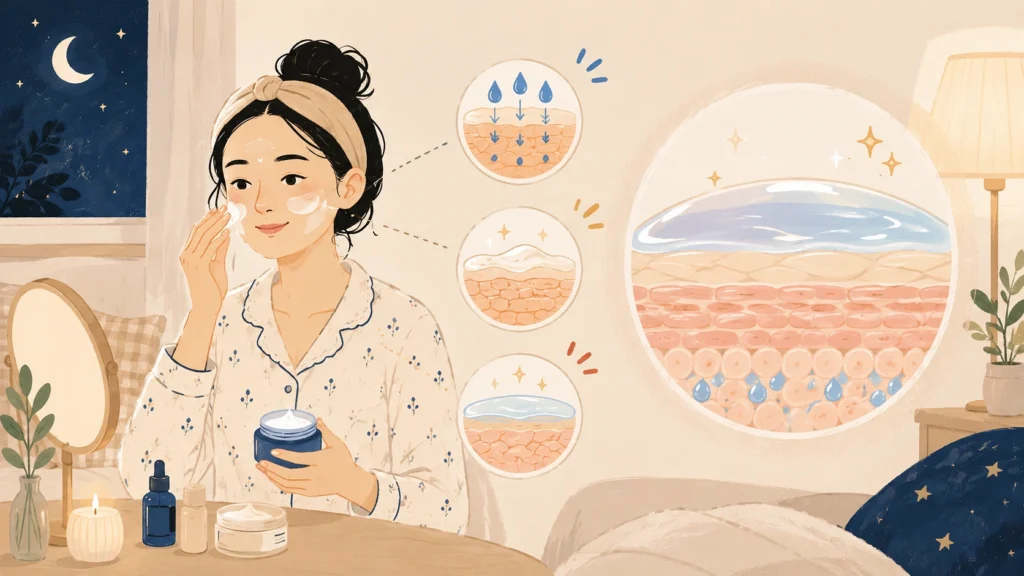
Moisturizing is not a single action. It splits into three separate functions and products mix them in different ratios:
- Humectants pull water in and hold it. Glycerin, hyaluronic acid, urea, panthenol, sodium PCA.
- Emollients fill the gaps between skin cells so the surface feels smooth and less rough. Squalane, shea butter, ceramides, fatty alcohols, plant oils.
- Occlusives sit on top and block evaporation. Petrolatum, mineral oil, dimethicone, lanolin, beeswax.
Most sleeping masks are heavy on the third category with some emollient for feel. They are the roof. Very few of them supply meaningful water themselves, because water is what the layer underneath is supposed to bring.
Reading Your Own Tub In Ten Seconds
Turn it over and look at the first five ingredients, since those make up most of what is in there. If you see petrolatum, dimethicone, mineral oil, shea butter or beeswax near the top and no glycerin until halfway down the list, you own an occlusive. That product needs something applied before it. If glycerin sits in the top three and there is very little in the way of oils or silicones, you own a humectant heavy gel, and that one has the opposite problem described below.
Humectants Can Dry You Out In A Dry Bedroom
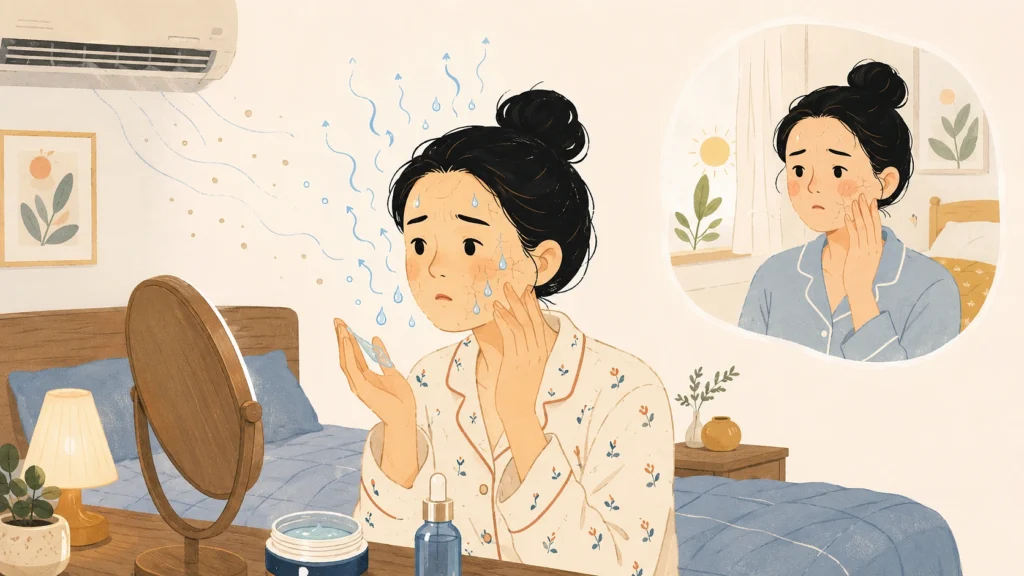
This part reverses what most product copy implies, and it is the reason a lot of hydrating gel masks make skin worse rather than better.
A humectant attracts water from wherever water is available. It only pulls meaningful moisture out of the surrounding air when ambient humidity sits above roughly 70%. Below that, it draws water from the deeper epidermis and dermis instead, moving your own internal water up toward the surface where it can then evaporate away. Without an occlusive on top to stop that evaporation, some humectants raise water loss and make dryness worse.
Now think about where you sleep. A heated bedroom in winter or an air conditioned one in summer regularly sits at 20 to 40% humidity. That is deep in the range where a glycerin or hyaluronic acid product applied to bare skin and left alone is pulling water upward and letting it go.
I have been applying hyaluronic acid every night for months and my face keeps getting tighter. That is not a mystery and it is not your imagination. It is a humectant working exactly as chemistry says it will, in a room too dry for it.
Occlusives Are Not Interchangeable
Product marketing tends to treat every rich cream as equally sealing. The measured gap between them is wide.
| Ingredient | Approximate reduction in water loss |
|---|---|
| Petrolatum | Up to 98 percent |
| Mineral oil | Moderate, well below petrolatum |
| Dimethicone | Around 20 to 30 percent |
| Plant oils and butters | Variable, generally weakest |
Dimethicone is the ingredient behind most of the lightweight, non greasy sleeping masks people prefer cosmetically, and it does a fraction of the sealing work of the greasy option nobody wants to put on their face. If your skin is genuinely dry rather than mildly dehydrated, the cosmetically elegant choice is the one that will underperform.
The Overnight Timing Claim Is Shakier Than The Marketing Suggests

Brands lean hard on the idea that skin repairs itself at night and is more receptive to whatever you apply. There is real research behind part of this and it is less settled than the copy implies.
Yosipovitch and colleagues measured barrier function every two hours across a 24 hour span in 16 volunteers, published in the Journal of Investigative Dermatology in 1998, and found significant circadian rhythms in water loss, skin surface pH and skin temperature. Their conclusion was that skin permeability runs higher in the evening and night than in the morning. That study is the foundation for most nighttime skincare claims you read.
More recent work complicates it. A 2024 pilot study using a controlled inpatient protocol found that in control subjects water loss actually started decreasing a few hours before bedtime, while in atopic dermatitis patients it rose. Small sample, so treat it as a question mark rather than a reversal, but the neat story about universally leaky nighttime skin is doing more work in advertising than the evidence supports.
What survives regardless of the timing argument is simpler. You are lying still for eight hours, not touching your face, not washing it, and nothing is rubbing the product off. That alone gives an occlusive the longest uninterrupted contact time it will get all day, and that is a good enough reason to use one at night without needing the chronobiology angle at all.
The Sequence That Makes The Mask Work
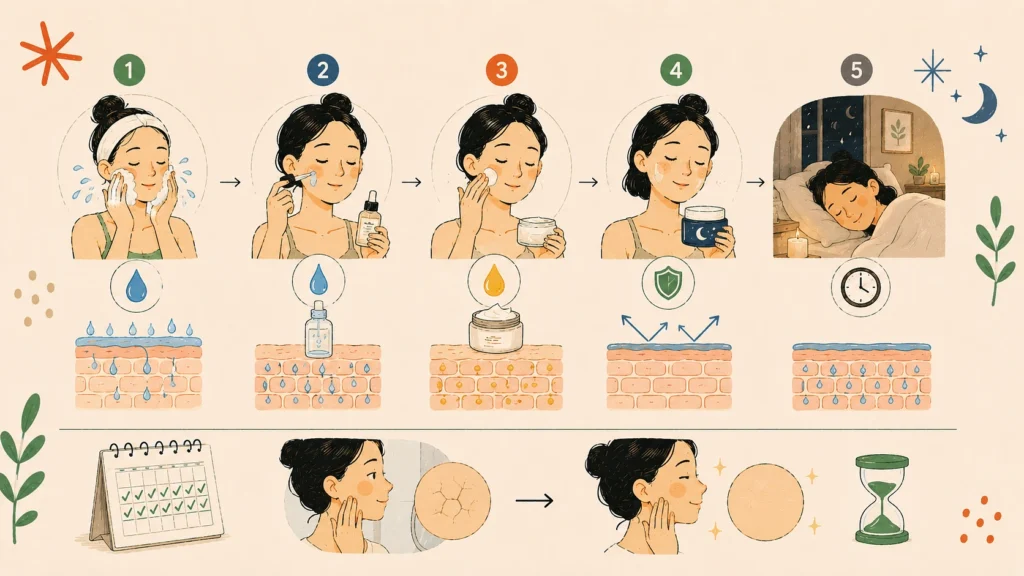
The mask goes last. Everything before it is what the mask is protecting.
- Apply to skin that is still slightly damp from cleansing rather than fully dry, because you are giving the humectant water to grab that is not coming out of your own dermis.
- Put the humectant layer on first, a serum or essence with glycerin, hyaluronic acid, panthenol or urea reasonably high in the list.
- Add a cream with emollients and lipids if your barrier is rough or compromised, since ceramides and fatty acids restore the mortar between skin cells rather than just coating them.
- Finish with the sleeping mask as the outer film and use a thin layer, because a thicker one seals no better and just transfers onto your pillow.
- Run the same sequence for at least two weeks before judging it, since surface cell turnover takes time and one night proves nothing.
When The Mask Is Not The Problem At All
Some dryness will not respond to any topping layer because the cause sits somewhere else entirely. Hot showers strip surface lipids. Foaming cleansers with high pH do the same thing twice a day. A retinoid ramped up too fast produces peeling that looks like dryness but is not. So does a bedroom running very low humidity all winter, where a cheap humidifier will do more than any tub of anything.
There is also a distinction people collapse constantly. Dry skin lacks oil and is usually a permanent skin type. Dehydrated skin lacks water and is a temporary condition that can happen to oily skin too. A mask heavy in occlusives helps the first one considerably and does very little for the second unless you feed water underneath it first.
And if your skin is cracking, itching, weeping or splitting despite all of this, that is not a moisturizer conversation any more. Persistent barrier failure of that kind wants a dermatologist rather than another product, and the sooner the better, because the longer a broken barrier stays open the more sensitized the skin underneath becomes.

