


The phone on the kitchen table in a Strasbourg flat has a French number, a Romanian bank card and a Revolut card sitting behind it, WhatsApp open on a group called “Familia,” and a transfer of 200 euros to a mother in Bacău that went through at lunchtime for a fee of nothing. Twenty years ago the same evening would have involved a phone card from a tabac, a queue at Western Union on Saturday morning and a letter. Now most of what ties a Romanian in France to home fits in one pocket and costs close to zero, and the shape of that daily routine is worth laying out, because it isn’t the one the immigration debates describe.
Around 133,000 Romanian-born people live in France by the last INSEE count, and the routine that connects them to home runs on three things: fee-free money apps for the monthly transfer, EU roaming that makes a French SIM work in Romania at no extra cost, and free video calls that have turned the weekly phone call into a daily one.
How Many Romanians Live In France And Where
INSEE’s 2019 figures, the latest full count, put Romanian-born immigrants in France at about 133,000, not including French citizens of Romanian descent, whom nobody counts. Paris and the Île-de-France take the largest share, then Strasbourg and Mulhouse in the east, with smaller communities spread through the southwest, Brittany and Provence. Compared with Italy and Spain, where the Romanian communities run past a million each, France is a mid-sized destination, which changes the texture of daily life: fewer Romanian shops on the corner, more reliance on the phone.
Where The Money Goes Each Month And How It Gets There
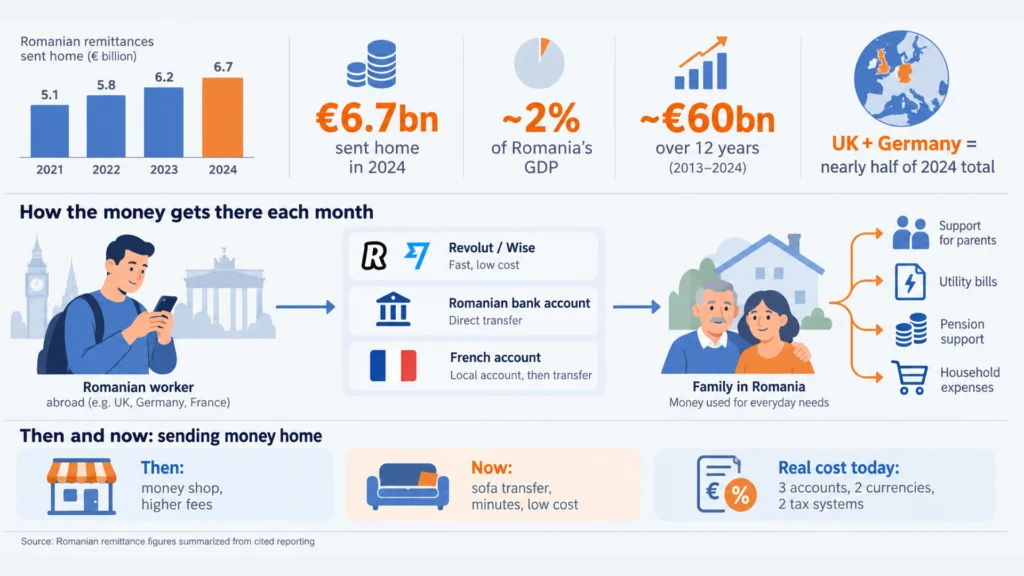
Romanians abroad sent home about 6.7 billion euros in 2024, close to 2 percent of Romania’s GDP, according to figures from a National Bank of Romania board member reported by Romania Insider, and roughly 60 billion over the twelve years to mid-2025. The UK and Germany sent nearly half of last year’s total between them. France sends less than its community size would suggest, partly because a lot of the French-Romanian money moves in ways the bank statistics catch badly: a Revolut transfer between two accounts in the same app doesn’t look like a remittance to anyone.
That’s the change in the last ten years. The transfer that used to mean a Saturday at a money shop paying 5 or 10 percent in fees now happens from the sofa:
- Revolut and Wise move euros to lei at close to the mid-market rate, with a small fee or none, and arrive in minutes.
- A Romanian bank account kept open from before the move still works for pensions, utility bills and the parents’ card.
- A French account handles rent, salary and the CAF, and has to exist for the paperwork even if it’s barely used for anything else.
Running three accounts is normal and slightly ridiculous, and most people who’ve done it for a few years have asked themselves whether their bank still fits the life they’re living or whether the French account exists only because the landlord wanted a RIB. The honest answer is usually the latter.
The monthly transfer home costs close to nothing now and takes minutes. What people still pay for is complexity: three accounts, two currencies and a tax return in each country.
Why A French SIM Works In Romania Like It’s At Home
The EU’s roam-like-at-home rule means a French mobile plan used in Romania is charged at French prices for calls, texts and data, with a fair-use limit on data for long stays, and the rule has been extended to 2032. In practice that means the summer trip home, the Christmas fortnight and the funeral nobody planned for all happen on the same phone with the same number and no second SIM. A Romanian SIM used in France works the other way round just as well, which is why a lot of people keep both: the French one for daily life, the Romanian one in a drawer for the bank’s two-factor codes and the aunt who refuses to learn a new number.
The fair-use detail matters for anyone splitting time between the two countries. Operators can ask for proof that you mostly live in the country of the SIM, and a French plan used in Romania for months on end can get a surcharge letter. For a two-week visit nobody notices.
What The Daily Call Home Looks Like
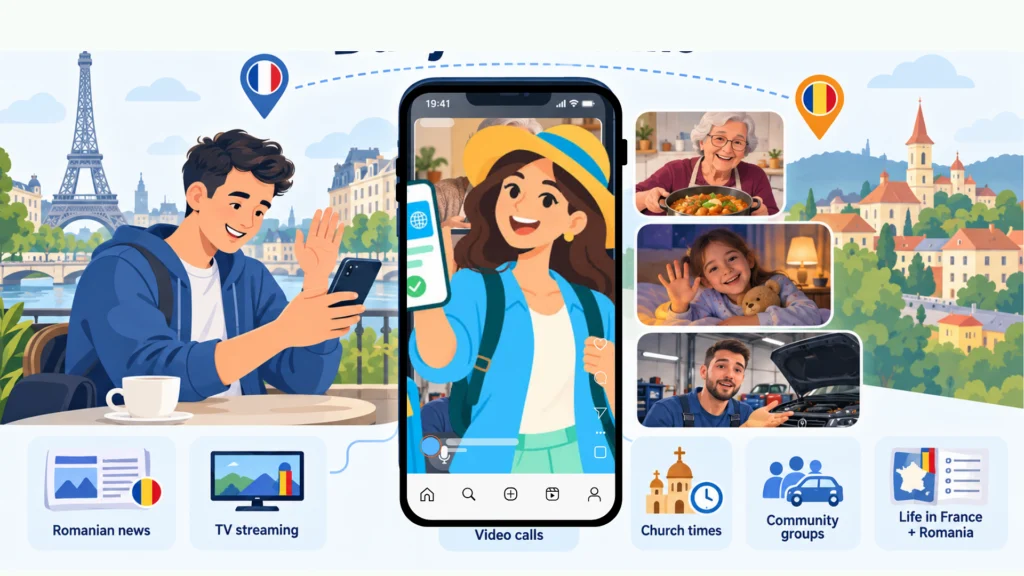
WhatsApp, mostly, and on video. The weekly Sunday call that older migrants remember has become a few short calls a day: the grandmother shown what’s for dinner, the child made to say good night in Romanian, the brother asked whether the car passed its inspection. The cost is zero, which has quietly changed what the calls are for. When a call cost money it carried news. Now it carries nothing in particular, and that’s the point of it.
The same phone keeps the Romanian side of life running alongside the French one. Romanian news apps and TV streams, church service times for the Orthodox parish, the Facebook groups where someone in Lyon is driving to Cluj on Friday and has two seats, and a shelf of Romanian-language sites written for people living abroad. One example of that last category is cazinouristraine.com, a Romanian-language guide to foreign online casinos aimed at Romanians in France; the site itself states that the operators it lists hold no French ANJ license and that online casino games aren’t authorized in France, which is the kind of thing a reader there needs to know before using it, and the sort of plain disclosure the better Romanian-language sites now carry. The point is the breadth of it: a Romanian in Toulouse can run almost the whole of daily life in Romanian from the phone and only switch to French at work and at the prefecture.
How Holidays And Visits Home Get Paid For
The trip home is the biggest line in the year’s budget after rent, and it’s organized the way everything else is, through the phone and in a group chat. Flights booked on a Romanian or Hungarian low-cost carrier out of Beauvais or Basel-Mulhouse, a car hired at Bucharest or Cluj or borrowed from a cousin, money for the family split in the same app the transfers go through. Families who’ve had the awkward conversation about who pays for what on a shared trip will recognize the August version of it, when three siblings in three countries land in the same village and the question of who covers the parents’ roof repair comes up over the first dinner.
The cost-of-living squeeze in France has changed the arithmetic a little. Where a decade ago the transfer home was a fixed sum sent without thinking, now it gets weighed against a French electricity bill that has doubled, and the everyday habits people use to absorb rising costs are applied on both sides of the border at once: the Romanian account gets the fixed transfer, the French one gets the belt-tightening.
What Still Doesn’t Fit In The Phone
Two things, mainly. The first is paperwork. A Romanian in France files taxes in France, may still owe filings in Romania on property or rental income there, and deals with two sets of forms that don’t talk to each other; no app has fixed that, and the accountants in Paris who handle both systems are booked out every spring. The second is presence. The daily video call shows the grandmother the dinner, but it doesn’t take her to the doctor, and most of the France-Romania traffic on the roads in August is people making up for that in person, in the two or three weeks a year the French employer allows.
What the phone has done is move the cost of staying connected from money to attention. The transfer is free, the call is free, the roaming is free. What a Romanian in France spends now is the twenty minutes a day that keeps two lives running in two countries, and most of them would tell you it’s cheaper than the alternative.

