


At 8 a.m., the shadow of an office building stretches west across its parking lot. By 3 p.m., that same shadow lies on the east side, and every car left in the morning shade has been sitting in full sun for hours.
Parking for afternoon shade means choosing a space by where the shadow is going to be later in the day. Often that space is in bright sun when you pull in, which is why most drivers pass it by. The afternoon is when the air is hottest and a parked car heats up most, so that is the shade worth planning for.
Shadows Move From West To East As The Day Goes On
A shadow always falls on the side of an object away from the sun. In the United States, the sun rises in the east, climbs through the southern half of the sky and sets in the west. The shade from a tree or a building follows the opposite route. It starts long and to the west, shortens and swings to the north around midday, and stretches out to the east as the afternoon goes on.
NASA’s educational pages use the lichen on tree trunks to make the same point. With the sun’s path curving across the southern sky, the north side of a tree trunk is the one that stays most shaded. For a driver, that turns into two rules:
- The east side of a tree or building is shaded in the afternoon.
- The north side of a tall building is shaded for most of the day.
The north-side rule has one exception. In midsummer the sun rises and sets a little north of due east and west, so the north face of a building catches some sun early in the morning and late in the evening.
Where To Park For The Time You Arrive
| When you park | Where the shade is now | Where it will be at 3 p.m. | Space to choose |
|---|---|---|---|
| Morning, staying all day | West of trees and buildings | East and northeast of them | East side, even though it is sunny now |
| Around noon | Short, on the north side | East and northeast | Northeast corner, close to the object |
| Early afternoon | Starting to reach east | Further east and longer | East side, a little away from the trunk or wall |
| Any time, all-day shade | North of tall buildings | Still north, shifting slightly east | North side of the tallest building |
South of the equator, the east and west parts stay the same but north and south swap. The sun crosses the northern sky in Australia, so the all-day shade there is on the south side of a building.
A Shaded Car Stays 16 Degrees Cooler Inside After An Hour
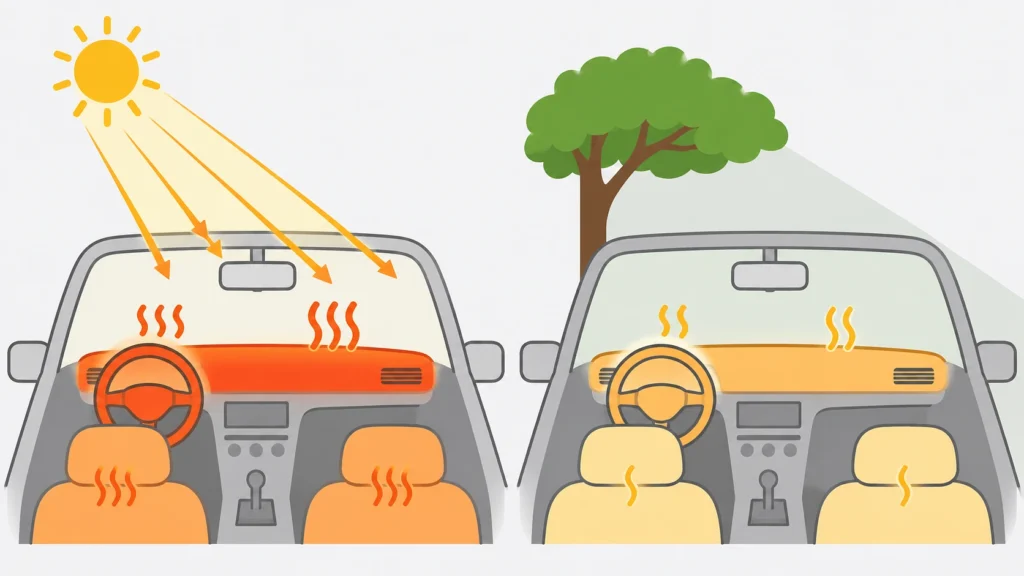
Researchers at Arizona State University and the University of California San Diego parked matching cars in sun and in shade on summer days above 95 degrees Fahrenheit, then measured them after an hour, about the length of a grocery trip. In the sun, the average cabin temperature hit 116 degrees in one hour. The shaded cars came in close to 100.
The surfaces you touch showed a wider gap than the air:
- dashboard: 157 degrees in sun, 118 in shade (39 degrees cooler).
- steering wheel: 127 in sun, 107 in shade (20 degrees cooler).
- seats: 123 in sun, 105 in shade (18 degrees cooler).
A 157-degree dashboard is hot enough to hurt bare skin, and years of that heat dry out and crack vinyl and leather. Shade also cuts the time the air conditioner needs to bring the cabin down once you drive off.
The study measured one hour. A car left from morning until evening goes through the same heating all afternoon, so where the shadow sits between noon and 5 p.m. does most to decide how hot the car is when you come back.
How To Find The Afternoon Shade Before It Arrives
You need one fact when you pull in, and that is which way is west. The compass app on a phone gives it in a few seconds. On a clear morning you can skip the phone, because the sun is in the east and west is the opposite direction.
- Find west.
- Pick the tallest thing near the spaces, such as a tree, a building or a parking structure.
- Park on the side of it that faces away from west, as close to it as the lot allows.
In A Parking Lot
The row along the east wall of a store or office is the one to look at for a long stay. It is sunny in the morning, and the building’s shadow covers it from early afternoon. Under trees, the space just east of the trunk gets shade first, and the spaces further east get it later as the shadow grows.
On The Street
Buildings shade the street the same way. On a street that runs north to south, park along the west curb, where the buildings behind you block the afternoon sun. On a street that runs east to west, the south curb is the cooler one, because the buildings on that side throw their shadows north across it.
At Home And On The Road
A driveway with no garage can still be shaded. A carport, or a tree planted on its west side, covers the car in the hours that count, and it is worth thinking about when planning an outdoor living area. On a road trip, the same habit applies at hotels and trailheads, so add it to your vacation checklist beside the sunscreen.
Trees have a cost. Sap, bird droppings and falling branches can mark the paint, so a building’s shadow is the cleaner choice when both are on offer.
What To Do When The Lot Has No Shade At All
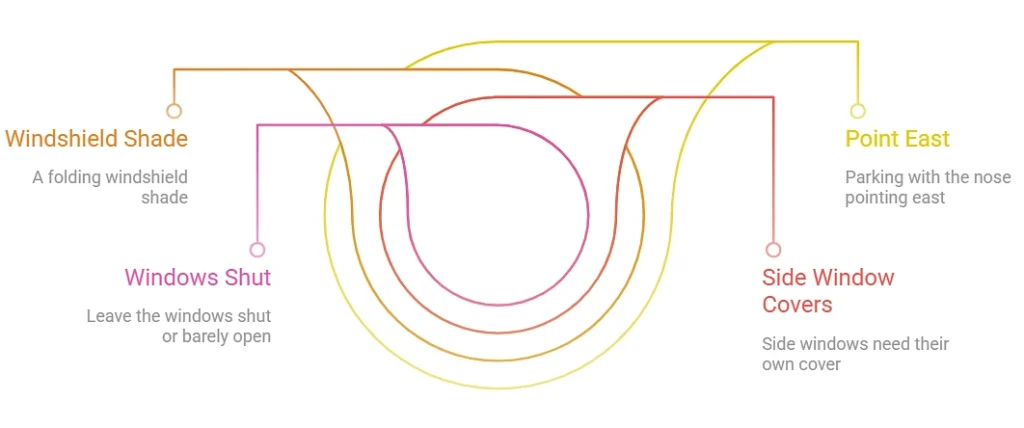
Some lots are bare asphalt from edge to edge. The fallback is to bring your own shade and to point the car sensibly.
Turn The Windshield Away From The West
The windshield is the largest piece of glass on most cars, and it slopes toward the sky. Parking with the nose pointing east keeps the afternoon sun off it and off the dashboard and steering wheel behind it.
Put A Shade Behind The Glass
A folding windshield shade costs little and works better on surfaces than on air. Popular Science reports on tests by the Florida Solar Energy Center in which shades cut the cabin temperature by 15 to 20 degrees and cooled the steering wheel and other surfaces by a whopping 40 to 50 degrees.
Side windows need their own cover, especially in the back seat where children sit. Drivers shopping for car shades in Australia or in the US face the same choice between a universal shade held on by suction cups and one cut to the window shape of a particular model. The fitted kind covers the whole pane and leaves no strip of sun at the edges.
Leave The Windows Shut Or Barely Open
Opening the windows an inch feels like it should help. Safety agencies say it changes little, and an open gap is an invitation to thieves and summer rain.
Shade Does Not Make A Parked Car Safe For Children Or Pets
No parking spot, however shady, is a safe place to leave a child or an animal. In the Arizona study, the shaded cars still passed 100 degrees inside, and the researchers estimated that a 2-year-old’s body temperature could reach a dangerous 104 degrees in just under two hours in the shade. The National Highway Traffic Safety Administration is direct about it and says that cracking the windows or parking in the shade does little to protect a trapped child.
Shade helps the car and the driver who returns to it, and that is all it should be counted on for. Check the back seat every time you lock up.
Sun Still Reaches You Through The Side Glass While Driving
One more gap is easy to miss. The Skin Cancer Foundation warns that UVA rays can pass through window glass. Windshields are laminated and filter much of it, while the tempered glass in side windows, rear windows and sunroofs does not block UVA well. On long drives, sunscreen on the arm and face nearest the window, or a clear UV film on the side glass, covers what the parking spot cannot.
Tomorrow morning, before taking the first shaded space you see, look for the wall or the tree to the west of an empty one.

