


Most of what’s printed on a plumbing box is marketing. The print on the pipe isn’t. That thin line of ink running down a stick of PVC or PEX, or the letters cast into a brass fitting, is put there by the factory because the code says it has to be, and it tells you the standard the part was tested to, the pressure it takes and whether it’s cleared for drinking water.
Inspectors read it, too. Section 301.1 of Minnesota’s plumbing code wants every pipe length and every fitting marked by the manufacturer, and it won’t accept marks added in the field. A contractor who writes “PW” on a pipe with a marker hasn’t certified anything, he’s just written on a pipe.
NSF-61 Or NSF-pw Means The Pipe Can Carry Drinking Water
The NSF code is the first thing to find. NSF’s own page on plumbing product markings lists all of them, but on a normal house job these are the ones that come up:
- NSF-61: certified for contact with drinking water.
- NSF-pw: NSF 61 plus a performance standard, which for plastic pipe is NSF 14.
- NSF-dwv: drain, waste and vent only.
- NSF-rfh: radiant floor heating.
- CLD23: cold water only, up to 73°F.
People get caught on NSF-61. It’s a health test, not a strength test, and the Copper Development Association says so plainly about copper tube carrying that mark. The pipe won’t leach anything nasty into the water, fine, but whether the wall is thick enough for the pressure in the line is a different question, and the answer to that one is the ASTM number further along the print.
NSF 372 Or “61-G” On The Stamp Confirms Lead-Free Brass
Brass is where lead turns up. The federal limit is a weighted average of 0.25% lead or less on wetted surfaces, 0.2% for solder and flux, and the EPA’s guide to lead free certified drinking water products says the mark to look for is NSF/ANSI/CAN 372, “61 & 372” or the older “61-G.” A fitting that only says NSF 61 should be checked against the certifier’s online listing, since older NSF 61 approvals weren’t all tested to the current lead-free rule. Clearance-bin valves are the usual suspects.
Green, Blue And Red Stripes On Copper Mean Type K, L And M Wall Thickness
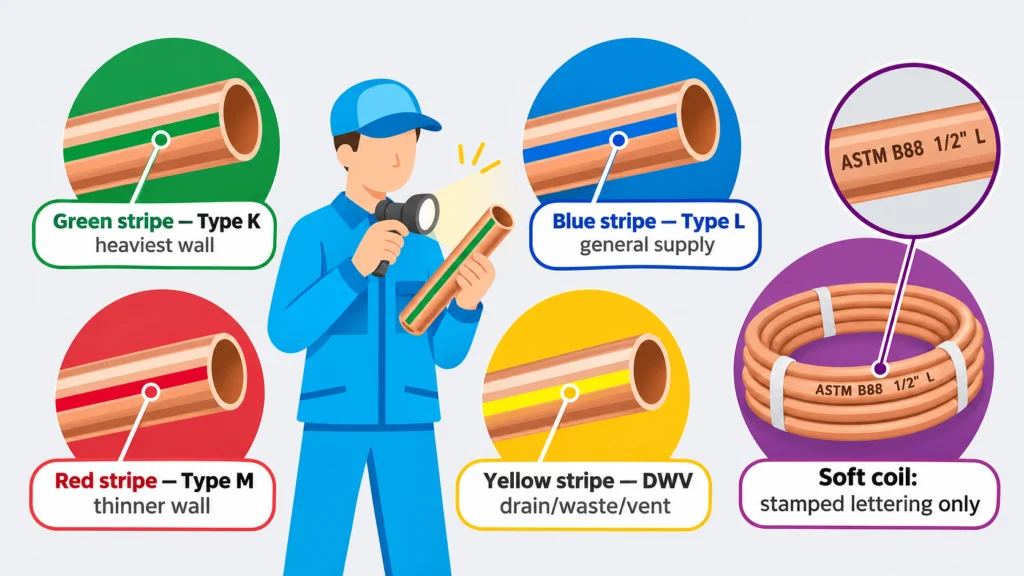
Okay, copper. ASTM B88 tube is color coded, green for Type K, blue for Type L, red for Type M, and yellow for DWV under ASTM B306, and the Copper Development Association keeps a table of copper tube types that matches what’s printed on the stick. K has the heaviest wall and usually goes underground. L does most house and commercial supply work. M is thin and cheaper, and plenty of local codes only allow it above ground where it can be seen, which buyers tend to forget when the red-stripe bundle is the cheapest thing on the rack.
Soft coils don’t get stripes at all, going by Cerro’s technical sheet. The type is in the stamped lettering, and on a dusty coil that can take a minute and a flashlight.
ASTM D1785 Marks Pressure-Rated PVC, While D2665 Alone Means Drain Only
PVC is where a misread costs the most, because drain pipe and pressure pipe look almost identical on the rack. Three things on the print get mixed up more than anything else.
- D2665 on its own is drain, waste and vent. It isn’t pressure pipe, however solid it feels in the hand. Pressure pipe carries ASTM D1785, and a lot of white Schedule 40, Charlotte Pipe’s for one, is dual marked with both.
- “Cellular core” or ASTM F891 means foam-core DWV, often printed NON PRESSURE, and it shares shelf space with the real thing. An old thread on a water-treatment mailing list had someone buy three sticks of Schedule 40 at one Lowe’s and get three different print lines, the foam-core one among them.
- The psi number shrinks as the pipe gets bigger. Charlotte lists its dual-rated Schedule 40 at 330 psi at 1-1/2 inch, 280 at 2 inch and 220 at 4 inch, all at 73°F. Heat brings that down. DWV fittings carry no pressure rating, so pressure pipe glued into a drain fitting is only as good as the fitting.
The First Digit In A PEX Material Code Rates Chlorine Resistance
PEX print strings are long. On most brands, and Uponor explains the print string on PEX pipe in about this order, you get the maker, the size, the SDR, then ASTM F876/F877 and CSA B137.5, the NSF 14 and 61 listings, then the fitting standards, F1960 for expansion and F1807 for brass crimp.
The fitting part matters if brands get mixed. Pipe that isn’t listed for the fitting system on the job is outside its certification even when the joint doesn’t leak.
Somewhere in that string sits a code like PEX 5106 or PEX 3006. Under ASTM F876 the first digit is chlorine resistance, 5 the best and 0 the worst, and the second is UV, where a 1 means it was tested for 30 days of sunlight. Watts lists its WaterPEX-a as 3006. On city water that’s heavily chlorinated, the 5 is worth the extra money.
And the red or blue print? Hot and cold. That’s all it is.
A Certification Logo Can Be Faked, So Check The Listing Instead
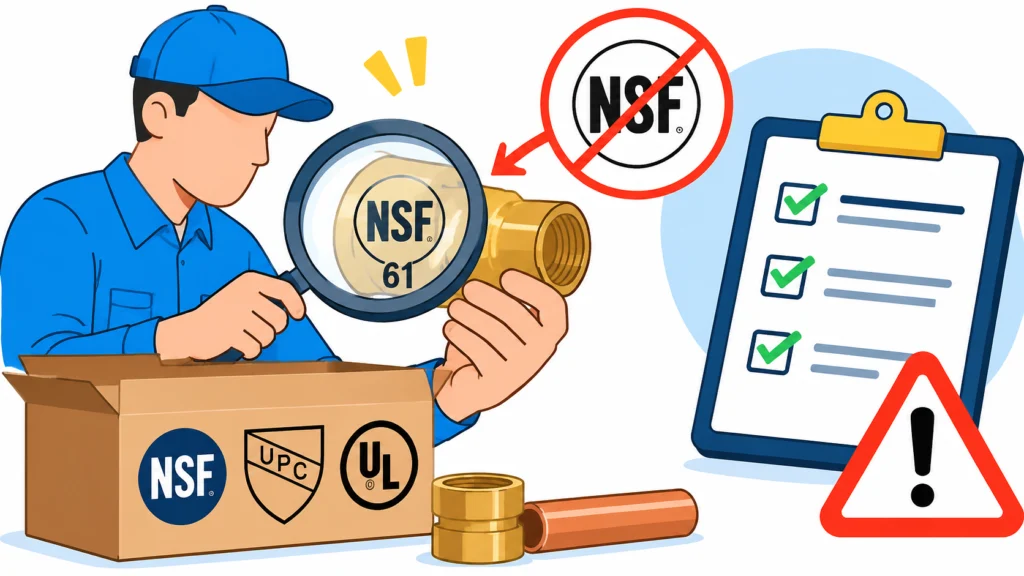
Counterfeit marks exist, and not only on junk. Moen had IAPMO test 19 cheap off-brand faucets sold online and 17 failed the drinking-water standard, and IAPMO’s write-up on those counterfeit faucets says some of them wore certification marks they’d never earned. UL put out a notice this past summer about fake UL marks on YUK-brand sprinkler fittings. FM Approvals has a whole page of alerts like that.
So the logo on the box proves very little. What does help:
- search the brand and model number in the certifier’s online directory (NSF, IAPMO, UL, CSA).
- compare the stamp on the part with the manufacturer’s spec sheet, country of origin included.
- be wary when a low price and an unknown brand show up together.
Contractors Should Check One Carton Per Delivery Against The Spec Sheet
On a full rough-in the paperwork does most of the work. Ask for spec or submittal sheets when ordering from a wholesale plumbing supplier, make sure the standards listed match what the inspector will want, and when the pallet shows up, open one box per part number and read a few stamps. Ten minutes, maybe less. A wrong pipe caught at delivery is a return slip. Caught after the walls close, it’s a tear-out.
Homeowners have it easier. The pipe under the kitchen sink and beside the water heater shows what the house is plumbed with. Anyone working through a list of preventative home maintenance tips can add a look at that print, since an old repair done with drain pipe on a supply line is easy to spot once D2665 and D1785 mean something. If a new faucet is part of one of those practical kitchen upgrades, buy one whose listing can actually be looked up.
Most crews know all of this. They still skip it when the truck shows up late.

