


| What people blame themselves for | What the research actually shows |
|---|---|
| Being too stressed during the cycle | Meta-analysis of 14 studies and 3,583 women found pretreatment emotional distress was not associated with outcomes |
| Not relaxing enough after transfer | Cortisol and perceived stress showed no relationship to embryo quality or pregnancy rate |
| The coffee, the one glass of wine, the missed yoga class | Small or unclear effects, nowhere near the size people assign them |
| Waiting too long to start | Age matters enormously, and it works through embryo chromosomes rather than anything you did |
| Something about their body failing | Most failed transfers involve a chromosomally abnormal embryo, decided at fertilization |
Everything below explains why each row reads the way it does, and I am putting it first because plenty of people reading this have spent months building a case against themselves out of things that turn out not to be evidence.
Age Drives IVF Outcomes, And It Works Through Chromosomes Rather Than Effort
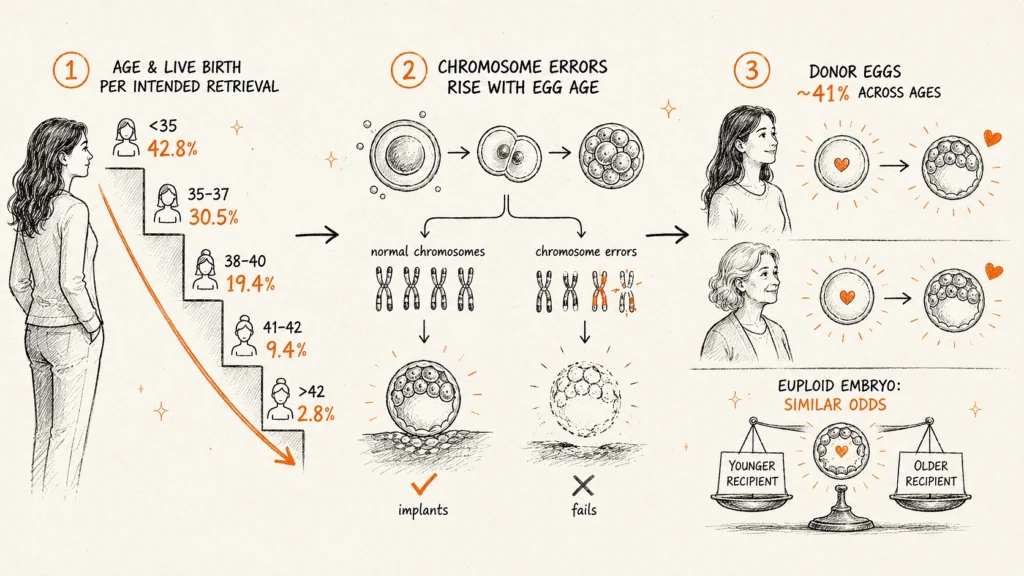
The numbers are steep and there is no gentle way to present them. National SART data on live births per intended egg retrieval runs roughly 42.8% under 35, then 30.5 percent at 35 to 37, 19.4% at 38 to 40, 9.4 percent at 41 to 42, and 2.8 percent past 42 using a patient’s own eggs.
The mechanism, defined plainly: as eggs age, errors in chromosome division become more common, producing embryos with the wrong number of chromosomes. That condition is called aneuploidy, and an aneuploid embryo usually fails to implant or miscarries early. It is a copying error inside a cell, not a verdict on the person carrying it.
Two findings make that mechanism visible, and they are the strongest argument in this whole subject.
First, donor eggs. When the eggs come from a donor in her twenties, live birth rates run around 41% for recipients of every age, holding roughly steady from the late thirties into the forties. Same uterus that was reportedly failing a month earlier. Different eggs. The uterus was rarely the problem.
Second, and this one genuinely surprised me when I read it, a 2025 analysis of genetically tested embryo transfers found no significant difference in pregnancy rates per euploid embryo across age groups. A 42 year old transferring a chromosomally normal embryo had statistically similar odds to a 32 year old doing the same. The age curve is not measuring whether your embryo will implant. It is measuring how many attempts it takes to find a normal one.
Stress Does Not Cause IVF Failure, And The Research On This Is Not Ambiguous
Now the row that matters most emotionally, because “just relax and it will happen” is the single most common thing said to people going through this, and it is wrong on the evidence.
Jacky Boivin and colleagues published a meta-analysis in the BMJ pooling 14 prospective studies covering 3,583 women, and found that emotional distress before treatment was not associated with whether the cycle worked. A prospective study measuring both salivary cortisol and validated stress scales found no relationship to fertilization rate, embryo quality, or clinical pregnancy rate. Another prospective study of 142 women controlling for age, infertility duration, and cause found no association with anxiety, depression, or stress. In that analysis, the only variable that predicted the outcome was maternal age.
Does that mean the stress is not real?
No, and that is a separate question entirely. The distress of infertility treatment is severe and well documented, it peaks between transfer and the pregnancy test, and it runs highest in people who have already had cycles fail. It deserves real support, and clinics that provide counseling are not offering a luxury. What the evidence removes is the causal link, not the difficulty. Your feelings during the cycle did not choose the outcome, and the guilt about them was never earned.
The Lifestyle Factors That Do Carry Weight, In Honest Proportion
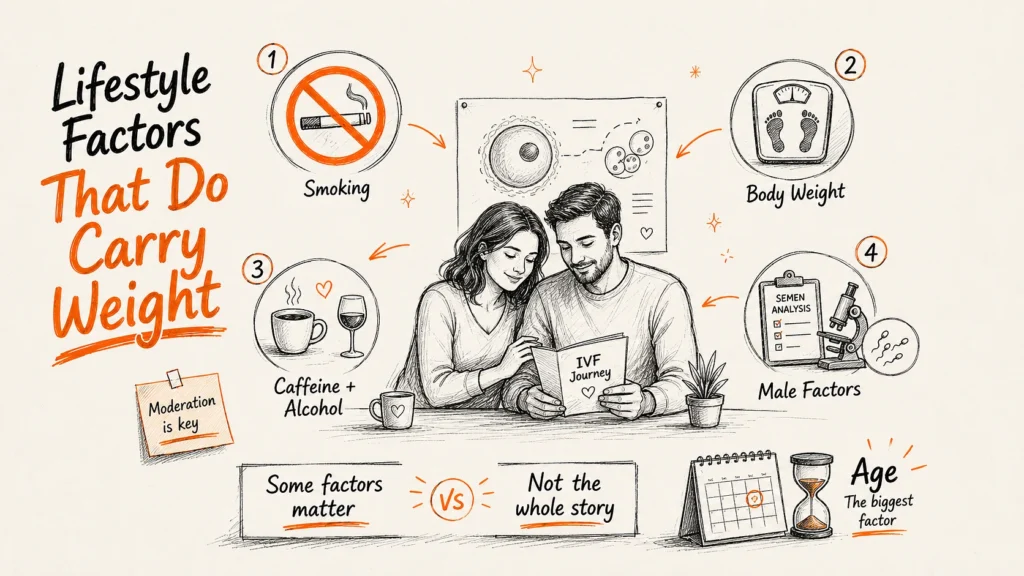
Some things genuinely matter. Fewer than the internet claims, and mostly with smaller effects than age.
- Smoking is the clearest one. Female smoking has a documented adverse effect on ovarian reserve, and in the same review, male smoking was associated with increased pregnancy loss. This is the lifestyle factor worth acting on hardest, and it involves both partners.
- Body weight at either extreme is associated with lower success and more cycle complications, though the effect size sits well below the age effect, and the guidance belongs with your clinic rather than a generic number from an article.
- Alcohol and caffeine show mixed and inconsistent findings, with reviews openly calling the results conflicting. Reasonable moderation is defensible. Treating a cup of coffee as the reason a cycle failed is not.
- Male factors deserve more attention than they receive, since sperm contributes half the chromosomes and roughly half of infertility involves a male component. If nobody has run a recent semen analysis, that is a question for the clinic.
Nobody should read that list and hear that fixing all four converts a difficult prognosis into an easy one. The honest framing is that these are the variables inside your control, they are worth improving because they tilt the odds slightly and because they matter for the pregnancy that follows, and they are not the reason a cycle failed.
The Questions Worth Bringing To Your Clinic Instead Of To Yourself
The useful energy in this process goes into the plan rather than the autopsy, and your reproductive endocrinologist is the person to build it with, since everything below depends on your specific history, test results, and diagnosis.
Ask what the retrieval to blastocyst attrition looked like and what it suggests. Ask whether genetic testing of embryos fits your situation, since the evidence supports benefit in some age groups and shows little gain in others. Ask what would change in the protocol next cycle and why. Ask how many cycles the plan realistically assumes, because cumulative rates across attempts look considerably different from any single cycle number. And ask about the counseling and support the clinic offers, not because stress is sabotaging you, but because this is genuinely hard and going through it unsupported helps no one.
If the last cycle failed, the most likely explanation is an embryo that carried a chromosomal error decided at the moment of fertilization, before anyone knew anything, entirely outside your control and unrelated to what you ate, felt, or forgot to do. That is a bleak sentence and also a clean one. Keep the list of things you can influence short and real. Give the rest of it back.

