


Key Takeaways
- Braided bumpers are padded bumpers, banned from cribs by federal law since November 2022, with 113 infant deaths behind the ban.
- A toddler bed changes the risk math, and it is the one scenario where pediatricians tend not to object.
- Under the fitted sheet, along the open edge or the wall gap, is the setup that stays put.
- It works as a roll barrier for an average sleeper, and a genuine faller needs a real rail or a low mattress.
- If yours is still in a closet from the baby registry days, this is the second life it was waiting for. If your child is still in the crib, leave it in the closet.
My sister-in-law sent us a braided bumper before the baby came. Long velvet braid, the kind all over Pinterest nurseries, sage green to match nothing we owned.
It went straight into the closet, still in its bag, and stayed there for almost two years. Not because I disliked it. Because I had read enough about crib bumpers to know it was never going anywhere near the crib, and at the same time it cost enough that throwing it out felt wrong. So what exactly do you do with a forty dollar braid you are not allowed to use?
Is a Braided Bumper Ever Okay in a Crib?
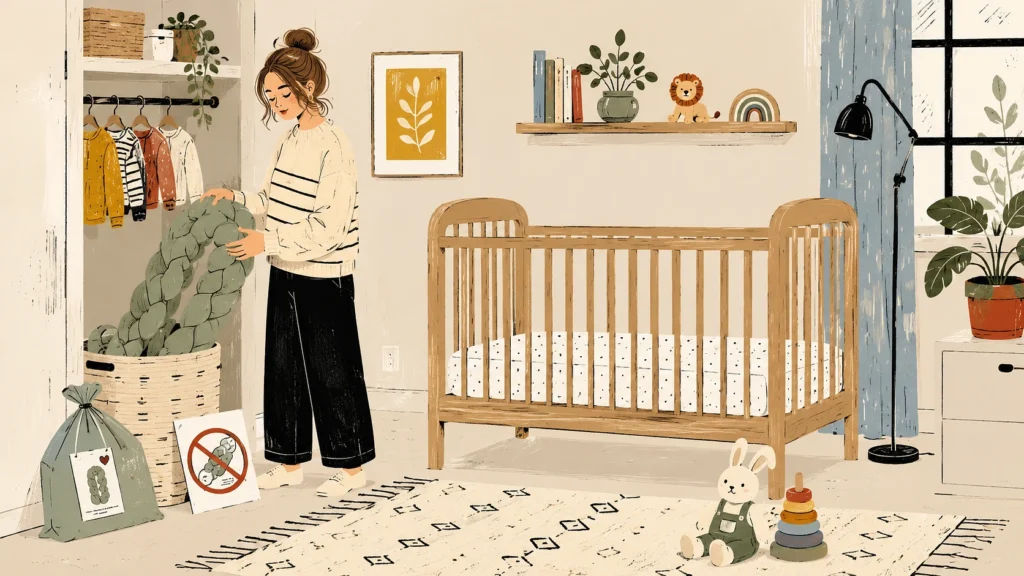
No. Not padded, not braided, not tucked under the sheet, not for one night.
The long version has a federal law in it. The Safe Sleep for Babies Act was signed in May 2022 and took effect that November, and it bans crib bumpers as hazardous products regardless of when they were made, covering padded bumpers, vinyl bumper guards and vertical slat covers, with only non-padded mesh liners excluded. A braided bumper is a padded bumper wearing a nicer outfit, and the CPSC connected 113 infant deaths to padded crib bumpers between 1990 and 2019. Babies roll into the padding and cannot roll away from it, and the American Academy of Pediatrics had been saying bare crib, firm flat surface, nothing soft, for over a decade before Congress caught up. The gap-between-slats problem bumpers were invented for was solved separately by crib slat spacing standards, so the product protects against nothing while adding a suffocation risk. That is the whole file on the crib question.
Which is why mine sat in a closet. And why the brands that used to print crib braided crib bumpers on the packaging now print toddler bed bumper instead, a rename the law essentially forced on them.
Why a Toddler Bed Is a Different Question
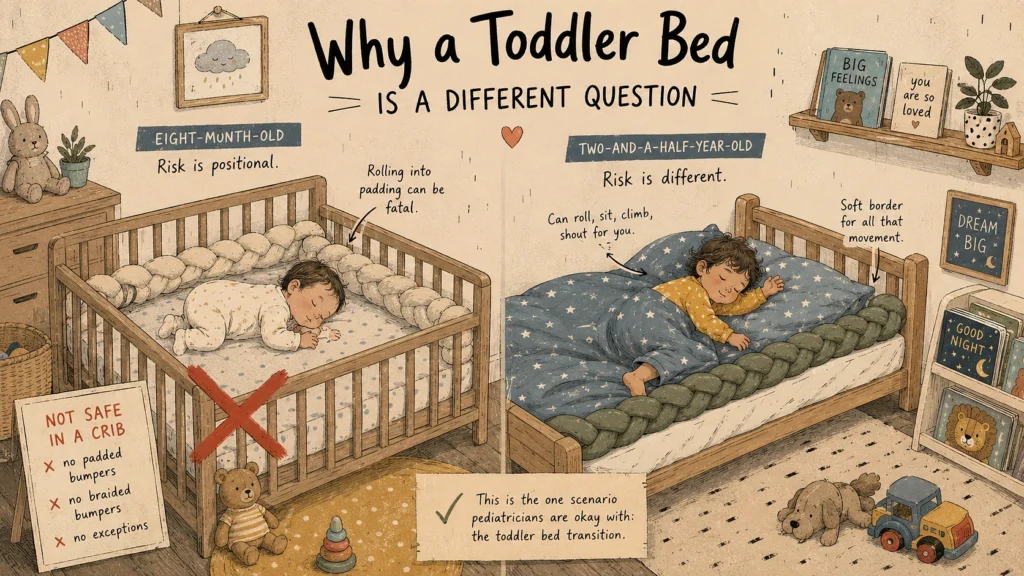
A sleeping eight-month-old and a sleeping two-and-a-half-year-old are not the same animal.
The infant risk is positional. A baby who rolls face-first into padding may not have the strength or motor control to turn back, and that is the entire mechanism behind those CPSC numbers. A toddler who has graduated to a bed can roll, sit, stand, climb, shove things, and yell for you at volume. The suffocation logic does not transfer, and this is the one bumper scenario where some pediatricians are actually fine with it, the toddler bed transition, when a kid keeps knocking their head on the rails or rolling out onto the floor.
Ever watched a toddler sleep? Ours rotates like a clock hand. She starts at twelve, and by morning she has visited every number and usually ends up with her feet on the pillow. The braid gave all that motion a soft border.
How Ours Is Set Up
Under the fitted sheet, along the open edge of the bed. The sheet holds it in place so it cannot wander during the night, and the braid makes a low ridge she rolls against and then rolls off of, back toward the middle.
When she went through a phase of scooting into the wall gap, I moved it to that side for a few weeks instead. One braid, two jobs, though never both at once because ours is not long enough.
Two honest limits, because this is where I would want another parent to be straight with me. A braid under a sheet is a speed bump, not a bed rail. It redirects a rolling sleeper, and it will not stop a determined one, so a kid who genuinely launches off the mattress needs a proper rail or the mattress moved low, and ours started on a frame close to the floor for exactly that reason. And this only applies to a child who is actually toddler-bed age. Putting the braid in the crib of a baby under one because it is technically a toddler product now is the same risk with new packaging.
When the Swap Actually Happens
The move out of the crib usually lands somewhere between eighteen months and three years, and the crib itself tells you when. Climbing out, or getting close to it, ends the crib era on the spot since a fall from the rail is worse than any bedtime regression. Height around 35 inches is the other common marker, because at that point the rail sits too low to contain a standing child.
We moved ours at two years and four months, the weekend after I found her with one leg over the rail at 6am, grinning. The braid came out of the closet the same day.
Sources
- CPSC business guidance, crib bumper ban under the Safe Sleep for Babies Act, 16 CFR part 1309
- Cleveland Clinic, crib bumper safety and CPSC fatality data
- NPR, coverage of the Safe Sleep for Babies Act signing, May 2022
- MOSSRIVER, CPSC bumper guidance summary and the toddler transition exception

