


My friend Rachel scheduled her second Kybella session ten days before her sister’s wedding, because the clinic’s brochure said “minimal downtime” and nobody corrected her. The wedding photos are lovely. Rachel appears in them with what she now cheerfully describes as a golf ball stored under her chin, mid-swell, right on schedule for a reaction the brochure had compressed into one breezy sentence. Her chin, months later, looks genuinely great. Her advice, delivered to anyone who asks and several people who don’t, is that Kybella works and that everything the marketing rounds off, the real cost structure, the swelling timeline, and who shouldn’t be in the chair at all, is exactly what you need to know before booking.
What Kybella Actually Is, in Thirty Seconds
Kybella is injectable deoxycholic acid, a synthetic version of a molecule your body already uses to break down dietary fat, placed in a grid of small injections into the fat pad under the chin. It destroys the fat cell membranes it touches, your body clears the debris over the following weeks, and the destroyed cells do not come back, which makes results permanent in the treated area as long as your weight stays stable. It’s FDA-approved specifically for that under-chin (submental) fat pocket, the session itself takes around 15 to 20 minutes, and there are no incisions. In clinical trials, 79 percent of patients were satisfied with their results. Everything appealing about it is real. So is everything below.
The Real Cost Math: You’re Buying Vials, Not Sessions
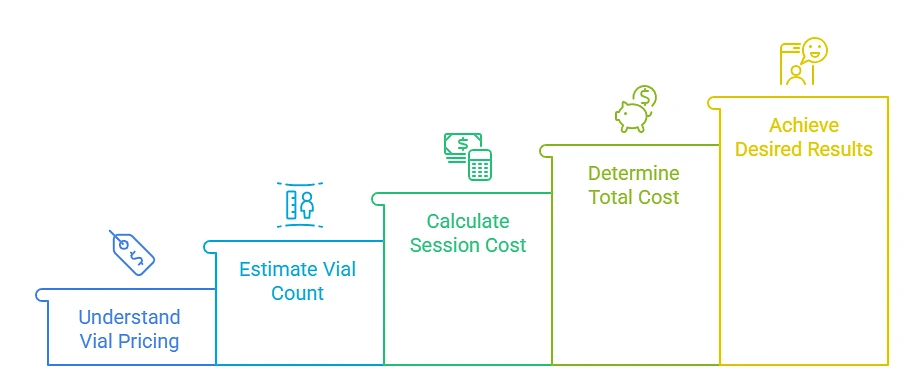
Here’s the pricing structure the quotes obscure: Kybella is priced per vial, and your anatomy decides the vial count, which is why two people can get quotes thousands of dollars apart from the same clinic and both be quoted fairly.
The verified numbers, consistent across markets: a single vial runs $600 to $1,000 depending on city and provider. Most sessions use 2 to 4 vials, putting a typical session at $1,200 to $2,400. And most people need 2 to 4 sessions, spaced about a month or more apart, which lands complete treatment plans in the $2,400 to $6,000 range, running past $7,200 for larger fat pads in expensive markets. Lighter cases, one to two vials over two sessions, can finish under $2,000.
Two pieces of buying advice fall straight out of that structure. First, the smart consultation question is per-vial price plus a realistic vial estimate for your anatomy, in writing, rather than a vague session quote, because the vials are the actual product. Second, and this one saves people from the most expensive mistake in the category: don’t bargain down the vial count. If the assessment calls for three vials per session and you ask for one to save money, you’re not buying a discount, you’re buying an under-dosed series that won’t produce the result, which is the costliest outcome available. Kybella is one of those purchases where the middle path is the money-waster: do it properly or don’t do it.
The Bullfrog Fortnight: The Swelling, at Its Honest Size
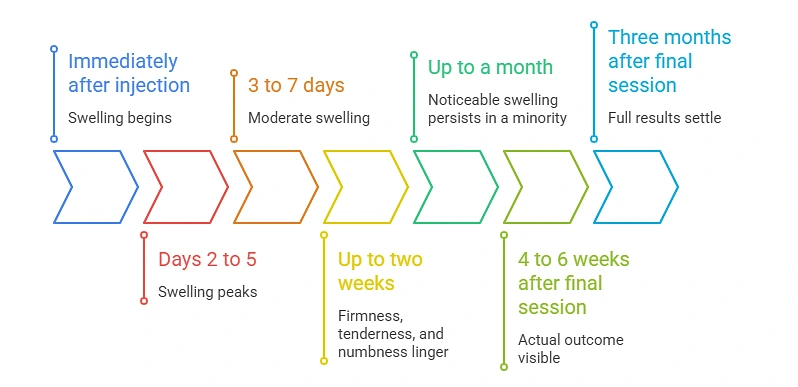
Now Rachel’s golf ball, because the swelling is the single most under-explained part of this surgery & treatments, right down to having its own nickname the brochures never print: the bullfrog effect.
Here’s the honest timeline. Swelling begins almost immediately after injection and peaks around days 2 to 5, and at peak it is not subtle; the under-chin area visibly balloons, which is where the bullfrog name comes from. Moderate swelling typically runs 3 to 7 days, firmness, tenderness, and numbness can linger up to two weeks, and in a meaningful minority of patients, noticeable swelling persists up to a month. Bruising is common and usually mild. And there’s a strange consolation worth knowing: the swelling isn’t a complication, it’s the mechanism. The inflammation is your body responding to fat cells being destroyed, so a puffy chin is, perversely, the drug doing its job.
The practical rules that follow are the ones Rachel wishes someone had stated plainly:
- Schedule around your calendar, not the clinic’s. No sessions within a month of weddings, reunions, photos, or big presentations. Many patients book Thursdays or Fridays specifically to hide the worst days in a weekend.
- Multiply by your session count. Two to four sessions means going through the swell cycle two to four times, roughly a month apart. It’s a season-long project wearing a lunchtime procedure’s clothes.
- Don’t judge the result mid-swell. Your actual outcome is invisible until roughly 4 to 6 weeks after the final session, with full results settling around the three-month mark. The number of people who panic at day four, looking at more chin than they started with, is large, and all of them were right on schedule.
Who It Won’t Help, and This List Matters Most
The third compressed truth is the biggest one, because Kybella’s failures are overwhelmingly candidacy failures, the right drug injected into the wrong problem.
If your issue is loose skin rather than fat, Kybella makes it worse. This is the exclusion that matters most and gets said least. Dissolving the fat that’s currently filling out lax skin leaves the skin emptier, and patients with existing jowls or under-chin laxity can end up with more visible sagging after the fat is gone. The classic strong candidate is the opposite profile: good skin elasticity, a small-to-moderate distinct fat pocket, often younger, where the skin snaps back over the new contour. If a provider pinches your skin, studies how it recoils, and examines your jaw anatomy before quoting, you’re in good hands; a consultation that skips the skin exam entirely is a consultation to walk out of.
The rest of the exclusion list, briefly and honestly. Platysmal bands, the vertical neck cords, are muscle, not fat, and no fat-dissolver touches them. Large fat volumes make Kybella’s per-vial math absurd; at that scale, liposuction is typically both more effective and cheaper, and a good injector says so. It is not a weight-loss tool in any respect, it treats one localized pocket. Medical contraindications include infection at the injection site and a history of swallowing difficulties. And the honest risk statistic that belongs in every Kybella article: in clinical trials, marginal mandibular nerve injury occurred in about 4 percent of subjects, showing up as a temporarily asymmetric smile; all reported cases resolved on their own, with a median recovery around 44 days. Rare, temporary, and real, which is the correct amount of concern: not a reason to refuse the treatment, absolutely a reason to choose an experienced injector who knows the anatomy cold.

