


Overview
The average proposal team wins 45 percent of what it submits, and the teams sitting above 50 percent are not writing better prose. They are choosing better pursuits through a formal bid or no bid gate, protecting submissions with a compliance matrix so no requirement slips, and organizing every response around the buyer’s own scoring rubric instead of their company story. This article walks through all three disciplines with the benchmark data behind each, because the difference between a coin flip and a winning practice was never the writing.
That is the most valuable word in proposal work, and most teams cannot bring themselves to say it. A request lands, sales gets excited, and forty hours of writing later the team has produced a beautiful answer to a solicitation they were never going to win. The benchmark data has been saying this plainly for years. In Loopio and APMP’s research across more than 1,500 proposal teams, selectivity shows up as one of the two strongest predictors of winning more, and the segment numbers make the case on their own:
| Team segment | Win rate |
|---|---|
| Average across all teams | 45 percent |
| North America regional average | 37 percent |
| UK regional average | 47 percent |
| Enterprise teams with formal bid scrutiny | 49 percent |
| Insurance sector, strongest gate discipline | 52 percent |
| Top performers with dedicated proposal teams | 54 percent |
Read that table from the bottom up. The gap between an average team and a top performer is nine points, and Loopio’s own analysis credits enterprise scrutiny of incoming bids for their edge, they win more because they are not spreading themselves thin answering low fit requests. Meanwhile 76 percent of companies overall now run some form of gate.
Price has been the top stated reason for losses since 2021, and only 13 percent of teams blame proposal quality. Which means the losing proposals were mostly fine documents aimed at wrong targets, incumbents entrenched, budgets mismatched, requirements written around a competitor. The writing was never the problem. The choosing was.
Four Questions Settle Bid Or No Bid, And One Of Them Embarrasses People

The gate does not need a scoring model with weighted criteria across nineteen dimensions. Four honest questions do most of the work.
- Did we know this was coming before it published? If the first time you heard of the opportunity was the solicitation itself, someone else has been shaping it for months, and you are likely column fodder, the extra bids an evaluator needs to demonstrate competition.
- Can we name the incumbent and a concrete reason the buyer would leave them? Vague dissatisfaction is not a reason.
- Does the scope match what we actually do, not what we could stretch to do?
- Would we take this work at the price that wins it? Since price is the top loss reason, a bid you can only win by underpricing your own delivery is a loss either way.
And ok, sometimes a strategic loss leader is fine, but that is a decision to make on purpose in the gate, not to discover in month three of delivery. Answer two or more of those badly and the forty hours belong to a different pursuit. Frankly, the teams that internalize this stop mourning the requests they skip. They start noticing their shortlist rate climbing, and the sector data backs the feeling, since insurance, the industry with the strongest gate discipline, also posts the highest win rates.
The Compliance Matrix, Because Evaluators Hunt, They Do Not Read
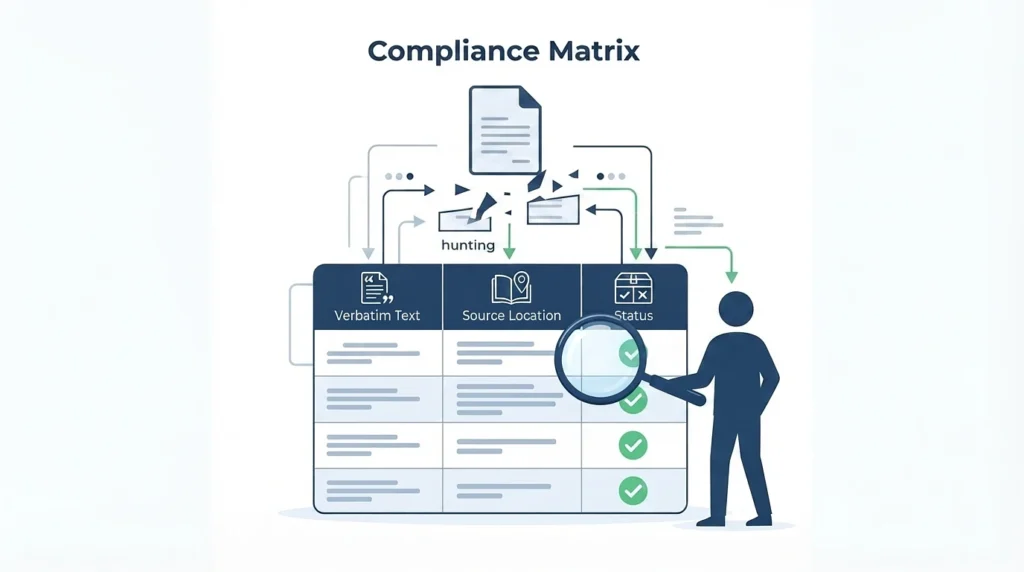
An evaluation team does not read your proposal like a novel. They hunt. They are checking requirements against responses, box by box, and in US federal work this is formalized under FAR Part 15, where contracting officers evaluate strictly against the factors stated in the solicitation and can reject a proposal as non responsive for missing a required element, without ever reading the rest of it. Missed attachments, blown page limits, wrong file format, an ignored amendment. Any of those can end a bid that took a month to write. That is not a technical failure. It is a compliance failure, and it is the most common way small businesses lose federal work.
Building The Matrix Means Shredding The Solicitation Into Rows
You shred the document, meaning you decompose the whole thing, and you capture every shall marketing tips, must, will, and should as its own row. Each row gets the verbatim requirement text, its exact source location down to section and page, the evaluation factor it maps to, the proposal section that answers it, an owner, and a status. In federal solicitations the cross referencing is the real labor, because instructions live in Section L, evaluation criteria live in Section M, the statement of work lives in Section C, and the three are frequently not in alignment with each other, which is exactly where requirements slip through.
Two habits separate matrices that work from matrices that decorate. The matrix has to track amendments, because solicitations get modified mid pursuit and a matrix built once at kickoff goes quietly stale within two weeks of an active draft. And when the request is complex, consider submitting the matrix with the proposal even when it is not required. It hands the evaluator a map of your compliance, it signals that your team follows instructions, and some solicitations are now requiring it outright anyway.
Writing To Section M Means Organizing The Proposal Around Their Scorecard, Not Your Story
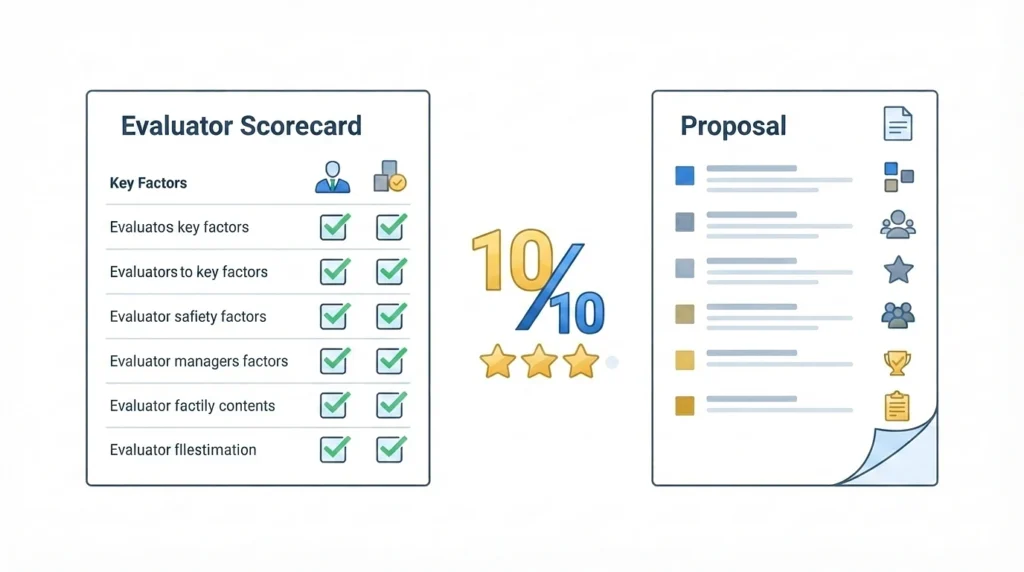
This is where good teams still leave points on the table, and it comes down to a question worth asking about every solicitation you answer.
What Does The Evaluator’s Scoresheet Look Like?
You are not guessing. In government work it is printed in the solicitation as the evaluation factors, their relative weights, and any pass or fail criteria. Commercial requests state it too, more loosely, in the evaluation criteria section. That document is the scorecard the individual reading your proposal must fill out, factor by factor, defending each score to a review board. So the winning move is plain and teams still resist it. Organize the response in their order, using their factor language, and put the answer in the first sentence under every heading. An evaluator scoring the technical approach factor should find a section that announces itself as the technical approach, opens with the answer, and hands them the evidence to justify a high score without hunting for it. Every minute an evaluator spends searching for your answer is a minute their pencil hovers over a lower number.
The resistance always comes from the same place, and I have some sympathy for it. Your company has a story, a differentiating narrative, a preferred flow, and their outline scatters it. Tell the story anyway, inside their structure. A proposal organized around your narrative and against their scoresheet reads beautifully and scores poorly, and scoring is the only reading that counts. Where the solicitation weights factors, weight your pages the same way. A factor worth 40 percent of the score deserves something like 40 percent of your space and your strongest proof, past performance citations, named references, verified figures. Boilerplate spread evenly across all factors is the written version of even depth everywhere, and evaluators can smell it.
None of the three disciplines here is glamorous. Saying no to bad pursuits, tabulating requirements in a spreadsheet, surrendering your outline to theirs. The teams doing all three are the ones sitting above 50 percent while everyone else averages a coin flip, and the difference was never the prose.

