


The word “gastritis” gets used as if it names one thing, and that’s the root of most of the confusion around it. There are really two conditions wearing the same name, and they behave nothing alike. One shows up loud, burns for a few days, and clears. The other arrives silent, often causes barely any symptoms at all, and can spend years slowly changing your stomach lining in ways that matter. Same word. Completely different stakes.
The distinction the name hides is acute versus chronic, and understanding it is the whole point, because the version that hurts the most is usually the one you least need to worry about, and the version that hurts the least is the one worth taking seriously. Let me walk through what gastritis actually is, what causes each kind, and why that second kind quietly progresses when the first one just heals.
What’s Actually Happening To The Stomach Lining
Start with the mechanism, because it’s simpler than it sounds. Your stomach is full of acid strong enough to break down food, and the only reason it doesn’t digest itself is a protective mucus layer, the stomach lining, that shields the tissue underneath. Gastritis is inflammation of that lining, and it happens when the shield gets weakened or breached and the acid starts irritating the tissue it was supposed to be protecting.
That’s it, at the core. Everything else, all the different causes, is just different ways of damaging that one barrier. Which is why the causes look so unrelated on the surface but do the same underlying thing.
Acute Gastritis: Loud, Painful, And Usually Self-Limiting

The acute kind is the one most people have actually experienced, even if they didn’t name it. It comes on suddenly, and it announces itself: a burning or gnawing pain in the upper abdomen, nausea, feeling full or bloated after a few bites, sometimes vomiting or a vanished appetite.
The usual triggers are the ones you’d guess. Nonsteroidal anti-inflammatory drugs, ibuprofen and aspirin especially, are a leading cause, because they interfere with the very prostaglandins that keep the protective mucus layer intact, so frequent or heavy use thins your shield. Alcohol is another, since it directly irritates and erodes the lining, which is why a heavy night can leave your stomach genuinely inflamed, not just queasy. Severe physical stress from serious illness or injury does it too, and so does bile reflux.
The good news about acute gastritis is in its nature: remove the cause and the lining generally heals. Stop the NSAIDs, ease off the alcohol, let the acute stressor pass, and the barrier repairs itself, often within days to weeks. It hurts, it’s unpleasant, and it can occasionally be serious enough to cause bleeding, but the default trajectory is recovery. The loud version mostly resolves.
Chronic Gastritis: Quiet, And The Reason This Article Has A Second Half
Now the version that earns the caution. Chronic gastritis develops slowly, persists for months or years, and, critically, often produces mild symptoms or none at all. People can carry it for a long time without knowing, which is exactly what makes it more consequential than the painful acute kind, not less.
Two causes dominate the chronic form. The first and biggest is a bacterial infection: Helicobacter pylori, a bug that colonizes the stomach lining, frequently in childhood, and can live there quietly for decades. It’s extraordinarily common worldwide, and it sets up a low-grade, persistent inflammation that never fully resolves because the stomach can’t clear the infection on its own. The second is autoimmune, where the immune system misidentifies the stomach’s own lining cells as a threat and attacks them, a process that tends to run alongside other autoimmune conditions.
Both of these keep the inflammation smoldering indefinitely, and it’s what that slow smolder does over years that the title is pointing at.
Why Chronic Gastritis Progresses: The Cascade The Tired Name Hides
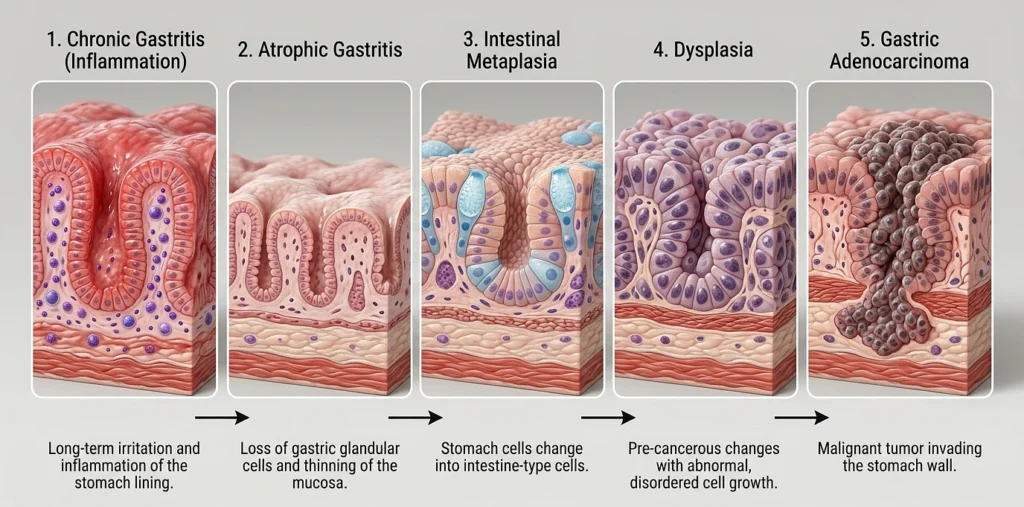
Here’s the part most gastritis explainers leave out, and it’s the genuinely important one. Persistent chronic gastritis, particularly the H. pylori kind, doesn’t just sit there being mildly annoying. In some people it moves through a recognized sequence of changes to the stomach lining that pathologists have mapped and named the Correa cascade.
The steps go in order: chronic inflammation, then atrophy (the glands in the lining thinning and dying off, called atrophic gastritis), then intestinal metaplasia (the stomach lining starting to resemble intestinal tissue, which doesn’t belong there), then dysplasia (genuinely abnormal cells), and at the far end, in a minority of cases, gastric cancer. This is why H. pylori is classified by the World Health Organization as a Group 1 carcinogen, the same top-tier category as tobacco. It’s also why stomach cancer remains one of the leading causes of cancer death worldwide despite most people never connecting it to the harmless-sounding word “gastritis.”
Before that frightens anyone, the essential counterweight, because the honest picture is genuinely reassuring at the individual level. This progression is slow and most people never travel far down it. The estimated annual rates of progression to cancer are small at each early stage: roughly 0.1% per year for atrophic gastritis and about 0.25% for intestinal metaplasia. Chronic atrophic gastritis itself is common, present in an estimated 20 to 30% of people and rising with age, and the overwhelming majority never develop cancer. The cascade is a pathway, not a conveyor belt, and most people who step onto it never reach the end.
What makes the distinction matter so much is timing. The early stages, plain H. pylori inflammation before atrophy sets in, are treatable and largely reversible: eradicate the bacteria with antibiotics and you stop the cascade, and the lining can recover. But once it advances to atrophy and intestinal metaplasia, those changes become harder to reverse, and management shifts from “cure it” to “monitor it.” That’s the real reason the quiet version deserves more respect than the loud one. Acute gastritis heals whether or not you catch it early. Chronic gastritis is most fixable exactly when it’s causing the fewest symptoms, and gets less fixable the longer it goes unnoticed.
The Other Slow Cost: What Happens To Digestion And B12
Cancer is the dramatic end of the cascade, but chronic gastritis extracts a quieter toll along the way, and it’s worth knowing because it’s more common than the rare bad outcome.
A damaged, atrophied lining stops doing its ordinary jobs well. It makes less acid and fewer enzymes, which impairs digestion and can leave you with lingering indigestion, excessive burping, bloating, and irritation after meals. And there’s a specific, important deficiency it can cause: the stomach cells that get destroyed in atrophic and autoimmune gastritis are the same ones that produce intrinsic factor, the protein you need to absorb vitamin B12. Lose enough of them and you can develop a B12 deficiency, which brings its own problems, fatigue, nerve issues, anemia, that often get blamed on everything except the stomach. It’s a good example of how a “silent” stomach condition can surface as symptoms nowhere near the stomach.
When To Actually See A Doctor
This is where the doctor-as-partner part is not a formality. Because chronic gastritis is quiet and the acute kind usually self-resolves, the judgment about which one you have, and whether H. pylori is involved, genuinely needs testing you can’t do at home, a breath or stool test for the bacteria, sometimes an endoscopy to look at the lining directly.
A few clear reasons to get evaluated rather than wait it out:
- Upper abdominal symptoms that persist or keep coming back, rather than the one-off flare that settles in a few days. Recurrence is the signal that it might be the chronic kind.
- Any red-flag sign, and these are urgent, not wait-and-see: vomiting blood, or stools that are black and tarry, which point to bleeding in the stomach and warrant immediate medical attention.
- Unexplained fatigue, anemia, or the neurological symptoms of B12 deficiency, since these can trace back to a stomach problem nobody suspected.
- Long-term NSAID use for other conditions, which is worth a conversation about protecting your stomach before damage accumulates.
The reframe I’d leave you with is the one the shared name obscures. If your gastritis is the loud, sudden, painful kind, it will very probably heal once you find and remove the cause, and while it’s miserable, it’s rarely the dangerous version. It’s the gastritis that barely bothers you, the low, persistent, symptomless kind, that’s worth checking out, because that’s the one that can be quietly progressing while it stays comfortable, and it’s also the one that’s most completely fixable if it’s caught before it advances. The discomfort you feel and the risk you carry are, with this condition, almost inversely related, which is exactly why you shouldn’t self-diagnose it by how bad it hurts. Let a doctor tell you which one you’ve got.

