


The standard advice about hair straightener damage focuses almost entirely on temperature. Turn it down. Use a heat protectant. Don’t go above 350°F on fine hair. Every product page, every stylist blog, every dermatologist quote frames the damage question as a thermal one.
The temperature story is real but it’s not the main story. The larger cause of visible damage from repeated straightening, meaning the split ends, the flyaways that never quite settle, the dullness that develops over months of daily use, is mechanical rather than thermal. It’s about how the plates grip the hair and drag it, and how many passes it takes to get the look you want.
Understanding this changes both the tool you should buy and the technique you should use, and it’s the one thing the general straightener conversation almost never addresses.
How Straighteners Actually Damage Hair
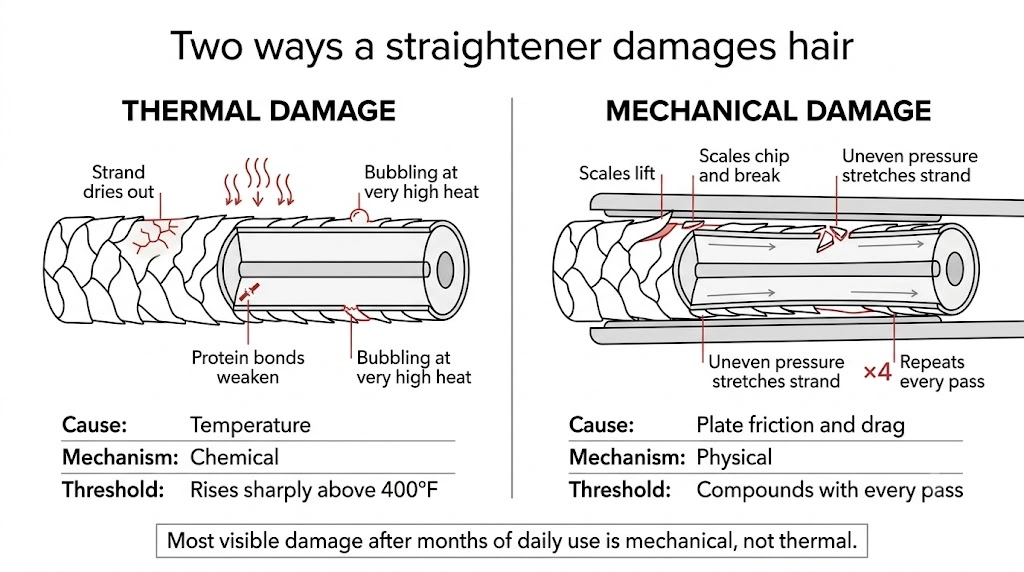
A healthy hair strand is wrapped in a cuticle layer that lies flat, like fish scales pointed toward the tip. When those scales stay smooth, hair reflects light evenly, feels smooth to the touch, and holds together in a defined strand. When they lift, chip, or break off, the strand loses its shine, catches on itself, tangles easier, and eventually splits.
Heat damages the cuticle chemically. Too much of it dries out the strand, weakens the protein bonds, and can cause bubbling at very high temperatures. All of that is real.
But mechanical stress damages the cuticle physically. When a straightener with rigid plates clamps down and drags across a section of hair, several things happen. The plates apply uneven pressure across the strand’s width. The friction of the drag lifts and eventually breaks off cuticle scales. Sections that don’t lie perfectly flat between the plates get pulled and stretched. And any strand that needs multiple passes to look straight gets all of this repeated two, three, four times.
The people whose hair looks visibly damaged after two years of daily straightening usually aren’t damaging it purely with heat. They’re damaging it with the number of passes, the drag pressure, and the mechanical action of plates that don’t accommodate their hair’s natural texture.
Why the Number of Passes Matters More Than the Temperature
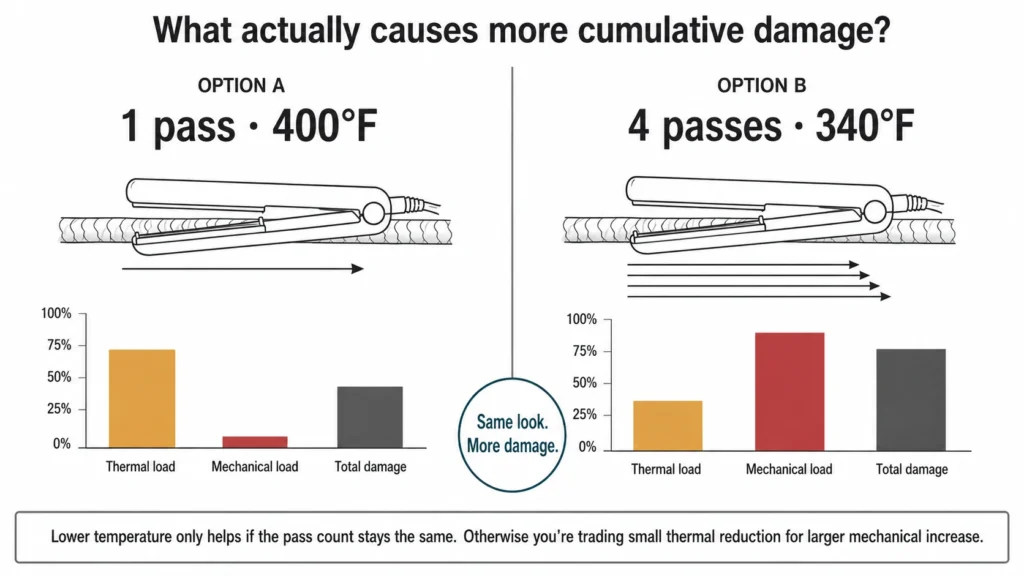
Here’s a comparison that clarifies the point. A single pass at 400°F does less cumulative damage to hair than four passes at 340°F. The lower temperature feels safer and gets marketed as such, but if the tool requires more passes to actually achieve the straightening result, the total mechanical stress on the hair is higher, not lower.
This is the piece of the equation that gets ignored by the “just use a lower temperature” advice. Lower temperature only helps if you can still get the look you want in the same number of passes. If you can’t, you’re trading a small thermal reduction for a much larger mechanical increase, and hair looks worse over time rather than better.
The straighteners that genuinely protect hair health aren’t necessarily the ones with the fanciest temperature controls. They’re the ones that reduce the number of passes required, distribute pressure evenly across the strand, and grip the hair without dragging it.
Where Design Actually Solves This
The design innovation that addresses the mechanical stress problem, rather than just the thermal one, is flexing plates. Rigid plates apply pressure at their contact points and leave gaps where the hair isn’t fully engaged. Flexing plates conform to the hair strand’s shape during a pass, distributing pressure evenly across the full width and length of the plate contact.
The practical result is fewer passes needed to achieve the same straightening result, more even heat contact so hot spots don’t develop, and less mechanical grip force required because the plates are working with the strand’s natural movement rather than clamping through it.
Dyson’s Corrale, which uses copper alloy flexing plates, is the most widely available example of this design. When you’re looking at the range at hair straighteners, the flexing-plate design is the piece that actually addresses the damage problem the category has traditionally worked around by just lowering the temperature. It’s the reason a tool at that price point matters for hair that gets straightened regularly, more than any of the temperature-management specs the marketing usually emphasizes.
The other Dyson approach worth understanding is the Airstrait, which uses controlled airflow at moderate heat to straighten wet hair rather than applying hot plates to dry hair. This is a different mechanical model entirely. There are no plates clamping and dragging. The compromise is that airflow-based straightening works better on some hair types than others (fine to medium hair gets great results, very coarse or very curly hair often doesn’t get the definition that hot plates provide), and it requires different technique than plate straighteners.
Both approaches address mechanical stress, just from different directions. Neither is a magic solution, but both represent design thinking that goes beyond “add more heat settings.”
What This Means for Technique
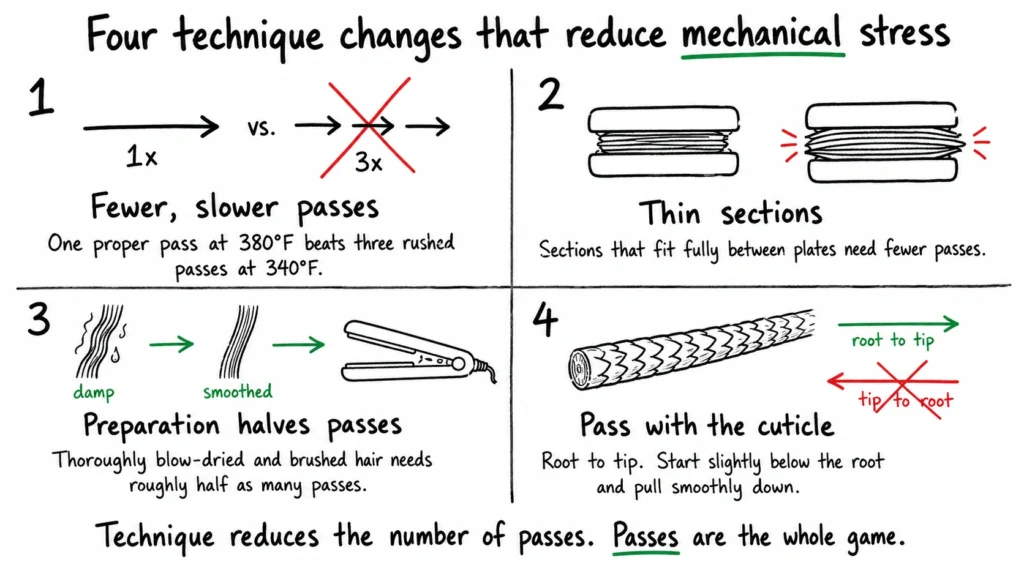
If mechanical stress matters more than temperature within reasonable ranges, the technique that protects hair looks different than the standard advice suggests.
Fewer, slower passes work better than more, faster passes. One properly executed pass at 380°F causes less damage than three or four rushed passes at 340°F, even though the temperature reads lower on the second option.
Section size matters more than temperature. Thin sections that fit entirely between the plates give better results with fewer passes. Thick sections that get partially compressed require more passes to fully straighten, and each pass adds mechanical stress.
Preparation reduces required passes. Hair that’s been thoroughly blow-dried and smoothed with a brush before straightening requires roughly half as many passes as hair that’s rough-dried or air-dried before styling. The preparation step is often the highest-leverage change in a routine.
The direction of the pass matters. Going with the cuticle (from root to tip) causes less scale lifting than going against it, which is why holding the straightener too long at the root and then pulling down usually causes more damage than starting slightly below the root and pulling smoothly.
The Practical Version
The version of this that translates into a buying decision is straightforward. If you straighten your hair a few times a month, a mid-range ceramic straightener with adjustable temperature is fine. The cumulative mechanical stress on your hair is limited by the frequency, and paying for the design innovations is probably not the best use of the money.
If you straighten your hair daily or near-daily, the tool matters more. The design that reduces passes required, distributes pressure evenly, and grips the strand without dragging it will produce noticeably healthier hair over a year of use than a cheaper tool at a lower temperature setting.
The temperature advice isn’t wrong. It’s just incomplete. The straightener that keeps your hair looking healthy over years of daily use is the one that reduces mechanical stress across the entire routine, and that’s a design question the standard product-comparison articles almost never address directly.

